

This Biblically Accurate Angels: What Scripture Really Reveals About These Terrifying Celestial Beings explores angels as the Bible truly describes them. It moves beyond soft images and focuses on Scripture. These beings reflect God’s power, holiness, and authority. Their appearance often inspires awe and reverence.
Understanding Biblically Accurate Angels: What Scripture Really Reveals About These Terrifying Celestial Beings deepens biblical knowledge and faith. It helps readers rely on God’s Word instead of tradition. Scripture shows angels serving God’s divine purpose. Learning this brings humility and wonder.
The Biblical Foundation of Angels
The Biblical foundation of angels is rooted in Scripture, where they are revealed as God’s created beings sent to serve His purposes and carry out His will.
From Genesis to Revelation, angels act as messengers, protectors, and worshipers who glorify God and assist His people.
What Scripture Reveals About Angels
Scripture provides extensive testimony about angelic beings, appearing in at least 300 biblical references across both Old and New Testaments. Rather than peripheral figures, angels occupy central roles in key biblical events—from the expulsion from Eden to the final judgment described in Revelation.
The Bible portrays angels as created beings who exist primarily to worship God and execute His will. Unlike humans, angels do not reproduce, do not die, and were all created simultaneously at some point before the creation of the physical world.
The Etymology and Meaning of ‘Angel’
The English word “angel” derives from the Greek angelos, which simply means “messenger.” This translation reflects the Hebrew word mal’akh, carrying the identical meaning. This etymology is profoundly significant: the term describes function rather than nature.
Angels are not named for what they are ontologically, but for what they do—they deliver messages and carry out divine commands. This functional designation appears throughout Scripture, where angels consistently serve as intermediaries between the divine and human realms.
Angels as Spiritual Beings and Ministering Spirits
Scripture clearly establishes angels as spiritual beings without physical bodies, though they can manifest in physical form when necessary. Hebrews 1:14 describes them as “ministering spirits sent to serve those who will inherit salvation.
This designation reveals their servant nature—they are created to minister, not to be ministered to. As spiritual beings, angels possess capabilities beyond human limitations: they can traverse physical barriers, appear and disappear, and operate beyond the constraints of time and space as humans experience them.
Yet they remain created beings, subordinate to God and limited by His sovereign will.
Contrasting Biblical Angels with Popular Culture
Biblical angels are powerful, awe-inspiring servants of God who inspire reverence and fear, not cute or human-like figures.
In contrast, popular culture portrays angels as gentle, winged humans, often ignoring their true biblical authority and purpose.
How Modern Media Misrepresents Angels
Contemporary portrayals of angels in film, television, and art often bear little resemblance to their biblical counterparts. Popular culture typically depicts angels as gentle, feminine figures with flowing robes and small decorative wings, often resembling romantic or sentimental imagery.
These representations emphasize beauty, comfort, and aesthetic appeal. Biblical angels, however, are frequently described as formidable warriors, executors of judgment, and beings so overwhelming in appearance that their first words to humans are consistently “Do not be afraid.
The contrast between Scripture and modern media reflects broader cultural preferences for comforting spirituality over the sometimes-unsettling reality of divine holiness.
Why Angels Say ‘Fear Not’ in Scripture
The phrase “fear not” or “do not be afraid” appears repeatedly when angels encounter humans in Scripture. This consistent pattern reveals an important truth: biblical angels are inherently fearsome.
Their glory, power, and otherness naturally provoke terror in human witnesses. When Gabriel appears to Mary, when angels appear to the shepherds at Christ’s birth, when angelic beings appear throughout the prophetic visions—the immediate human response is overwhelming fear.
This reaction stands in stark contrast to modern depictions of angels as comforting, approachable beings. The biblical command “fear not” is necessary precisely because angels manifest divine glory that humans find terrifying.
Angels as Warriors and Executors of Divine Judgment
Far from being passive messengers of comfort, Scripture repeatedly portrays angels as divine warriors executing God’s judgment. A single angel strikes down 185,000 Assyrian soldiers in one night. Angels unleash plagues upon Egypt.
Angels execute judgment on Jerusalem when David sins. In Revelation, angels pour out bowls of wrath, sound trumpets of judgment, and wage war against spiritual forces of evil.
This martial dimension of angelic nature reflects their role as servants of God’s holiness and justice, not merely His mercy. Understanding angels requires recognizing their capacity for awesome, even terrifying, acts of divine judgment.
Archangels: The Named Messengers of Heaven
Archangels are specially appointed heavenly messengers named in Scripture, entrusted with carrying out God’s most significant and authoritative missions.
Michael: The Warrior Prince
Michael stands as the only angel explicitly called an “archangel” in Scripture. His name means “Who is like God?”—a rhetorical question emphasizing God’s uniqueness and supremacy.
Michael appears consistently in contexts involving spiritual warfare and the protection of God’s people. In Daniel, he is described as “the great prince who protects your people,” specifically identified with Israel.
The book of Jude references Michael’s dispute with Satan over Moses’ body, demonstrating his authority even over the adversary. Revelation depicts Michael leading angelic armies in war against the dragon and his angels, ultimately casting them from heaven.
Gabriel: God’s Chief Herald
Gabriel, whose name means “God is my strength,” serves as heaven’s primary messenger for momentous divine announcements. He appears to Daniel to explain prophetic visions concerning the end times.
He announces to Zechariah the coming birth of John the Baptist, striking him mute for his unbelief. Most significantly, Gabriel appears to Mary to announce the miraculous conception and birth of Jesus Christ.
Though not explicitly called an archangel in Scripture, Gabriel’s consistent role in delivering the most crucial divine messages suggests a position of extraordinary importance among angelic beings.
The Unique Role of Named Angels
Named angels in the Bible have distinct roles, carrying specific divine missions that highlight God’s purposeful plan for humanity.
| Angel | Name Meaning | Primary Role | Key Biblical Appearances |
| Michael | “Who is like God?” | Warrior prince, protector of Israel, spiritual warfare | Daniel 10:13-21, Daniel 12:1, Jude 1:9, Revelation 12:7-9 |
| Gabriel | “God is my strength” | Chief messenger, herald of major divine announcements | Daniel 8:16-26, Daniel 9:21-27, Luke 1:19-20, Luke 1:26-38 |
The fact that Scripture names only these two angels (with Raphael appearing in deuterocanonical texts) is theologically significant. Unlike other ancient near-eastern religions with elaborate angelic hierarchies and extensive naming systems, biblical revelation maintains restraint.
This restraint prevents the veneration or worship of angels, keeping focus properly directed toward God alone. The named angels serve specific, crucial functions in salvation history, but even they remain servants of the Most High.
Seraphim: The Fiery Worshipers at God’s Throne
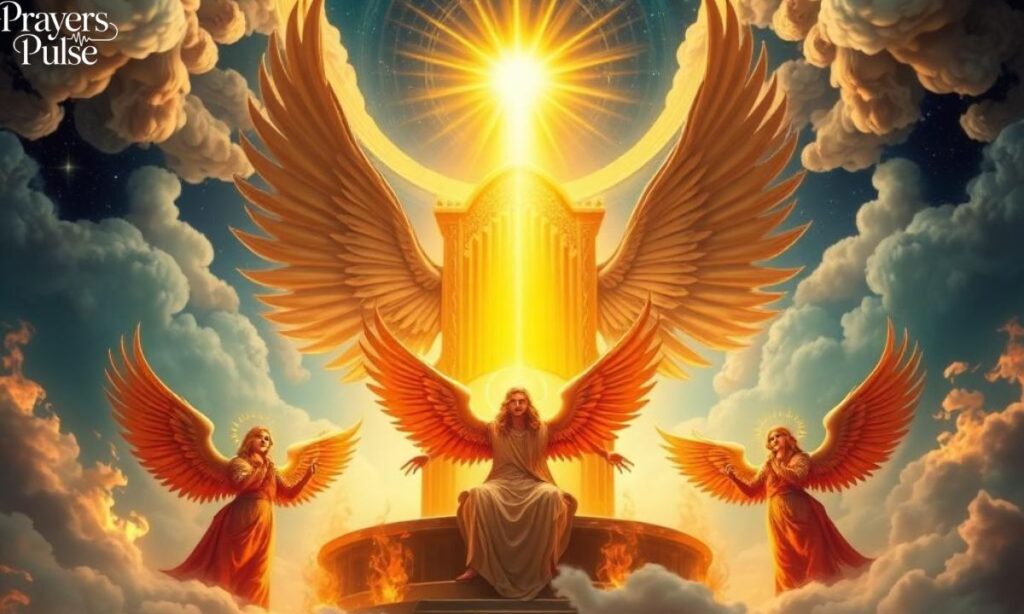
Seraphim are awe-inspiring, fiery beings who eternally worship and proclaim the holiness of God at His throne.
The Six Wings and Their Symbolic Meaning
Isaiah’s vision in the temple provides the primary biblical description of seraphim. These beings possess six wings each: with two wings they cover their faces, with two they cover their feet, and with two they fly.
This configuration is rich with theological meaning. The covering of their faces represents reverence before God’s overwhelming holiness—even these exalted beings cannot gaze directly upon divine glory.
The covering of their feet symbolizes humility and modesty in the presence of absolute holiness. The wings used for flight indicate their readiness to serve and respond instantly to divine commands.
The Threefold Holy Proclamation
The seraphim’s continuous proclamation—“Holy, holy, holy is the LORD Almighty; the whole earth is full of His glory”—represents the central focus of heavenly worship.
The threefold repetition emphasizes the superlative nature of God’s holiness; Hebrew uses repetition for emphasis, and triple repetition indicates the ultimate degree. This declaration reveals that the primary occupation of these highest angels is unceasing worship of God’s holiness.
Their proximity to the throne and their constant adoration establish holiness as the fundamental attribute of the divine nature.
Seraphim’s Role in Purification
Beyond worship, seraphim also participate in purification. When Isaiah cries out in awareness of his sinfulness, a seraphim takes a live coal from the altar and touches it to Isaiah’s lips, declaring his guilt removed and sin atoned for.
This purifying function connects directly to their proclamation of holiness. Those who minister in God’s immediate presence naturally become agents of sanctification, preparing others to approach or serve the Holy One.
The burning coal represents both judgment and cleansing, demonstrating that divine holiness both confronts sin and provides atonement.
Cherubim: The Multi-Faced Guardians of Holy Places
Cherubim are powerful, multi-faced guardians appointed to protect God’s holiness and sacred spaces.
Cherubim Guarding the Garden of Eden
Cherubim first appear in Genesis when God stations them at the east entrance of Eden, along with a flaming sword, to guard the way to the tree of life after humanity’s fall.
This inaugural appearance establishes their fundamental role as guardians of divine holiness. They prevent unholy humanity from accessing what belongs to God’s sacred domain.
The placement of cherubim at Eden’s entrance reveals that access to God’s presence requires mediation and righteousness—a theme that extends throughout Scripture until Christ becomes the ultimate mediator.
The Four Faces and Their Significance
Ezekiel’s detailed vision provides the most extensive description of cherubim in Scripture. Each cherub possesses four faces: human, lion, ox, and eagle. These faces have been interpreted variously throughout church history, but collectively they appear to represent the pinnacle of created order.
The human face represents humanity and intelligence; the lion symbolizes wild animals and royal majesty; the ox represents domesticated animals and service; the eagle signifies birds and transcendence. Together, these faces suggest that cherubim embody the fullness of creaturely excellence, making them fitting guardians of the Creator’s holiness.
Cherubim on the Ark of the Covenant
God commanded Moses to craft two golden cherubim to be placed atop the Ark of the Covenant, facing each other with wings outstretched over the mercy seat. This design was not arbitrary decoration but reflected heavenly reality.
The space between the cherubim represented God’s throne, where His presence dwelt among His people. On the Day of Atonement, the high priest would sprinkle blood on the mercy seat between the cherubim, symbolizing atonement accomplished in God’s very presence. These golden figures constantly reminded Israel that God’s holiness required both reverence and atonement.
Eyes Symbolizing God’s Omniscience
Cherubim are covered with eyes throughout their entire bodies. Backs, hands, wings. This remarkable feature symbolizes God’s omniscience. His all-seeing nature penetrates every corner of creation.
The sound of cherubim’s wings resembles God’s voice when He speaks. Thunder-like sounds are heard even in outer courts. Their every movement echoes with the weight of divine presence.
Living Creatures and Ophanim: The Most Mysterious Angels
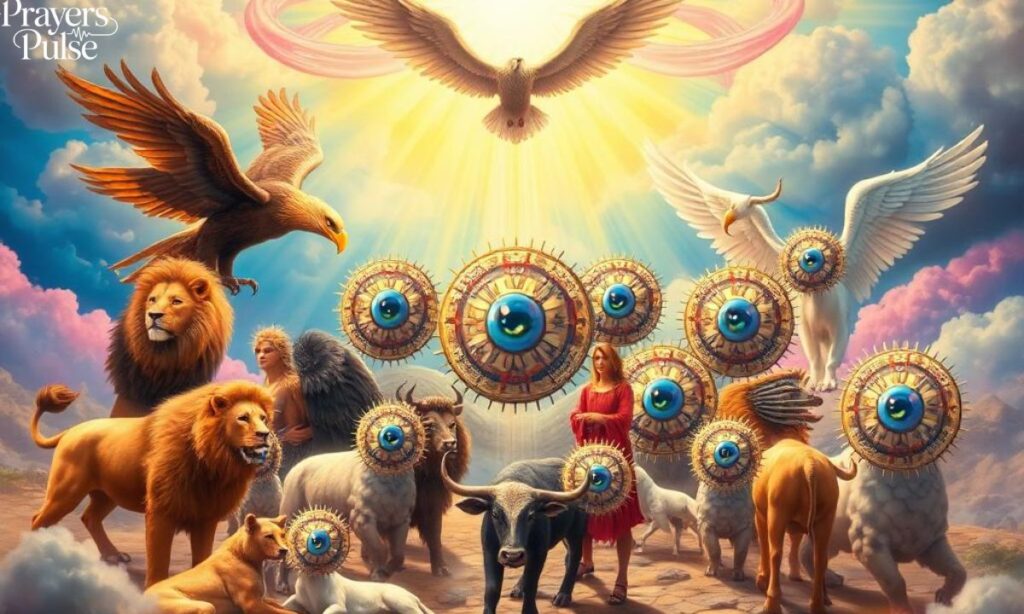
Living Creatures and Ophanim are enigmatic angels whose complex forms and movements reflect God’s majesty and divine mystery.
Ezekiel’s Vision of the Living Creatures
Ezekiel describes living creatures of extraordinary and unsettling appearance. These beings have four faces, four wings, and straight legs with feet like burnished bronze. They move in perfect coordination without turning, each going straight ahead.
Their form sparkles like gleaming bronze, and fire moves among them. Above their heads appears an expanse, and above that, a throne with the appearance of a human figure—God Himself.
These living creatures support and accompany the divine throne, their very existence proclaiming God’s transcendent majesty and the inadequacy of human categories to contain divine reality.
The Wheel Angels: Ophanim Explained
Among the most mysterious angelic beings are the ophanim, or wheel angels, described in Ezekiel’s vision. These beings appear as intersecting wheels covered entirely with eyes, moving in perfect synchronization with the living creatures.
The wheels can move in any direction without turning, symbolizing omnipresence and unrestricted divine mobility. Their eye-covered surfaces represent comprehensive, unblinking divine observation—nothing escapes God’s notice.
The ophanim seem to function as the mobility structure of God’s throne-chariot, demonstrating that God is not confined to any location but moves sovereignly throughout creation.
Wheels Within Wheels Covered With Eyes
The “wheels within wheels covered with eyes” symbolize God’s all-seeing, all-knowing presence and the intricate design of His heavenly order.
| Characteristic | Description | Symbolic Meaning |
| Intersecting Wheels | Wheels set at right angles to each other | Omnidirectional movement, unlimited divine mobility |
| Rims Full of Eyes | Entire circumference covered with eyes | God’s comprehensive knowledge, nothing hidden from divine sight |
| Moving With Living Creatures | Perfect coordination without independent action | Unity of divine purpose, harmonious execution of God’s will |
| Gleaming Like Chrysolite | Precious stone appearance, radiant brilliance | Divine glory and value beyond earthly measures |
This table summarizes the extraordinary features of the ophanim and their theological significance. These mysterious beings challenge human imagination while revealing profound truths about God’s nature.
The Relationship Between Living Creatures and Cherubim
Later in Ezekiel’s prophecy, the living creatures from the initial vision are explicitly identified as cherubim. This identification connects the mysterious four-faced beings with the guardians of Eden and the figures on the Ark, revealing a consistent angelic order dedicated to manifesting and protecting divine holiness.
The living creatures’ role in bearing God’s throne demonstrates that cherubim occupy the highest position among created beings, existing in immediate proximity to divine glory and serving as the platform for God’s presence.
General Angels: The Messengers Throughout Scripture
General angels are God’s messengers sent throughout Scripture to guide, protect, and deliver His will to humanity.
Angels Appearing in Human Form
Throughout Scripture, angels frequently appear in human form, often initially unrecognized by those they visit. Abraham welcomes three visitors who appear as ordinary travelers, later revealed to include divine messengers.
The angels visiting Lot in Sodom appear as men. Gideon, Manoah and his wife, and numerous others encounter angels who initially seem to be human.
This capacity to appear in recognizable human form enables angels to deliver messages and interact with humanity without overwhelming their recipients—at least initially. The consistent pattern suggests that many biblical characters may have encountered angels without realizing it.
The Mighty Acts Angels Perform
Biblical angels demonstrate extraordinary power in executing divine commands. They shut the mouths of lions to protect Daniel. They strike entire armies with plague or death. Angels release Peter from prison, causing his chains to fall away and opening locked doors. An angel strengthens Jesus in Gethsemane.
Angels roll away the massive stone from Christ’s tomb. They execute judgment on Herod for accepting worship due only to God. These mighty acts reveal angels as powerful agents of divine intervention, possessing abilities far beyond human capability but always deployed according to God’s sovereign purposes.
Angels Holding Swords as Warriors
Scripture repeatedly depicts angels bearing swords, emphasizing their martial nature. The cherubim guarding Eden wielded a flaming sword. An angel appears to Joshua as commander of the Lord’s army with a drawn sword.
When David numbers Israel in disobedience, he sees an angel standing with a drawn sword stretched over Jerusalem, ready to execute judgment.
In Revelation, Christ appears with a sharp sword proceeding from His mouth, and angels accompany Him as a heavenly army. These images consistently portray angels not as delicate messengers but as formidable warriors executing divine justice and judgment.
Angels in the Life and Ministry of Christ
Angels played vital roles in Christ’s life and ministry, announcing His birth, ministering during trials, and strengthening Him in obedience to God.
Angelic Announcements of Jesus’ Birth
Angels played crucial roles in announcing and attending Christ’s incarnation. Gabriel appeared to Zechariah to announce John the Baptist’s birth, preparing the way for the Messiah. Gabriel then appeared to Mary, announcing that she would conceive by the Holy Spirit and bear the Son of God.
An angel appeared to Joseph in dreams, first explaining Mary’s pregnancy, then warning him to flee to Egypt, then later directing the return to Israel.
On the night of Jesus’ birth, angels appeared to shepherds, announcing the Messiah’s arrival, followed by a multitude of the heavenly host praising God—the only biblical instance of angels singing.
Angels Ministering to Jesus During His Earthly Life
Following Jesus’ temptation in the wilderness, angels came and ministered to Him, providing sustenance and strengthening after His prolonged fast and spiritual battle with Satan.
In Gethsemane, as Jesus faced the approaching agony of crucifixion, an angel appeared from heaven, strengthening Him during His intense struggle.
These instances reveal that even the incarnate Son of God, in His humanity, received angelic ministry. The angels who serve the Father also served the Son during His earthly mission, demonstrating the unified purpose of heaven in accomplishing redemption.
Angels at the Resurrection and Ascension
Angels announced and explained the resurrection to the women who came to Jesus’ tomb. Matthew describes an angel descending from heaven, rolling back the stone, and sitting on it, his appearance like lightning.
The angel announced that Jesus had risen and directed the women to tell the disciples. At Christ’s ascension, as the disciples watched Jesus ascending into heaven, two angels appeared in white robes, explaining that Jesus would return in the same manner He departed.
These angelic interventions at resurrection and ascension bookend Christ’s victory over death, with angels serving as interpreters of these world-changing events.
Jesus’ Teaching About Angels and Judgment
Jesus frequently referenced angels in His teaching, particularly concerning judgment and the end times. He taught that angels would accompany Him at His second coming, gathering the elect from the four winds. Angels would separate the righteous from the wicked, as harvesters separating wheat from weeds.
He warned that angels rejoice over even one sinner who repents, revealing heaven’s perspective on redemption. Jesus also taught that angels neither marry nor are given in marriage, correcting misconceptions about angelic nature.
His teachings consistently portrayed angels as active participants in God’s redemptive and judicial purposes.
Angelic Activity in Acts and the Early Church
In Acts and the early Church, angels guided, protected, and empowered believers to advance God’s kingdom and spread the gospel.
Angels Guiding the Spread of the Gospel
The book of Acts records numerous instances of angels directing the early church’s mission. An angel appeared to Philip, instructing him to travel toward Gaza, where he would encounter and evangelize the Ethiopian eunuch.
An angel appeared to Cornelius, a Roman centurion, directing him to send for Peter—a pivotal moment in the gospel reaching Gentiles. An angel released the apostles from prison and commanded them to continue teaching in the temple.
These divine interventions through angels demonstrate God’s sovereign orchestration of gospel advancement, with angels serving as agents directing human messengers to appointed opportunities.
Angels Executing Divine Judgment
Acts also records angels executing judgment against those who oppose God’s purposes or claim glory belonging to God alone. When King Herod accepted worship from the people, allowing them to acclaim him as a god rather than a man, an angel of the Lord immediately struck him down.
He was eaten by worms and died, a dramatic demonstration of judgment against blasphemous pride.
This incident echoes Old Testament patterns where angels served as executors of divine judgment, revealing that angelic roles include both delivering mercy and executing justice according to God’s righteous purposes.
Paul’s Theological Insights About Angels
Paul’s letters provide significant theological reflection on angels. He warns the Colossians against angel worship, emphasizing that no angel should displace Christ’s supremacy.
He reminds the Corinthians that believers will one day judge angels, suggesting both human eschatological authority and possible judgment of fallen angels.
Paul teaches that principalities and powers—angelic authorities—were created through Christ and for Christ, placing all angelic orders under Christ’s lordship. He also mentions that women should have a sign of authority on their heads “because of the angels,” though this cryptic reference has generated considerable interpretive discussion.
Angels in the Book of Revelation
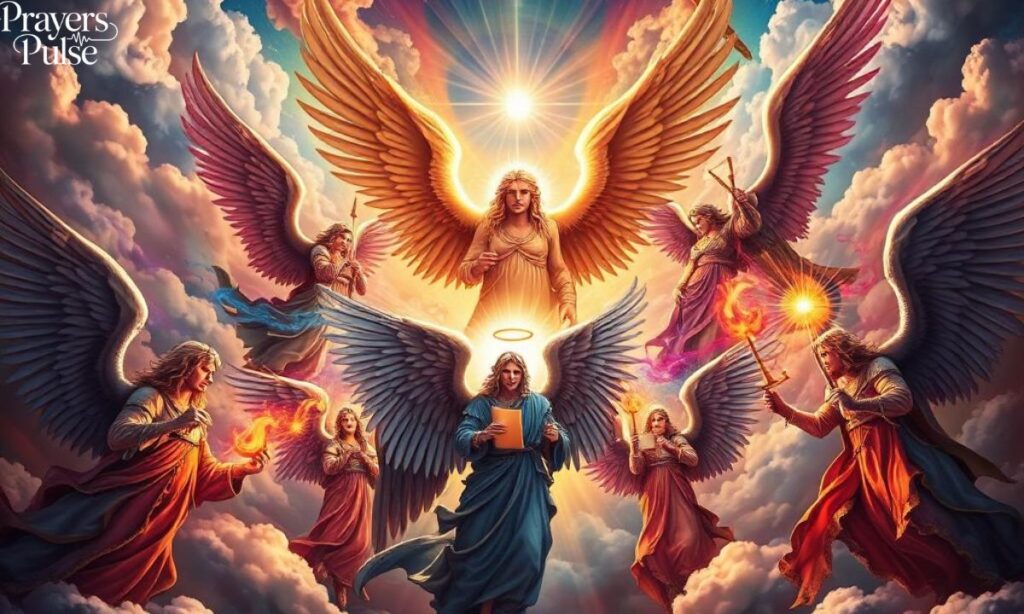
In Revelation, angels execute God’s judgments, deliver prophetic messages, and lead heavenly worship, revealing His ultimate plan for the world.
Seven Angels With Seven Trumpets
Revelation presents elaborate angelic activity in the unfolding of end-time events. Seven angels stand before God, and seven trumpets are given to them.
As each angel sounds his trumpet, specific judgments unfold: hail and fire, a mountain thrown into the sea, a star falling from heaven, darkness striking celestial bodies, demonic locusts released, and a massive army unleashed.
These trumpet judgments, executed by angels, demonstrate divine sovereignty over creation’s final chapters and angels’ continued role as executors of God’s will in bringing human history to its appointed conclusion.
Angels Pouring Out God’s Wrath
Following the trumpet judgments, seven angels receive seven golden bowls filled with God’s wrath. These angels pour out their bowls upon the earth, bringing forth painful sores, seas turned to blood, rivers and springs contaminated, scorching heat from the sun, darkness over the beast’s kingdom, preparation for Armageddon, and finally cosmic upheaval with earthquakes and hail.
These bowl judgments represent the final outpouring of divine wrath before Christ’s return. Angels serve as instruments of these judgments, demonstrating that even God’s wrath is executed through orderly, appointed means.
Michael’s War Against the Dragon
Revelation depicts cosmic spiritual warfare: Michael and his angels wage war against the dragon (Satan) and his angels. Michael prevails, and Satan is cast down from heaven to earth, his access to the heavenly realms permanently revoked.
This war represents the defeat of Satan’s accusations and his removal from heavenly councils. Michael’s victory demonstrates angelic authority over fallen angels and Satan’s ultimate subordination to God’s purposes.
The defeat of the dragon marks a crucial transition in redemptive history, limiting Satan’s sphere of operation as the final consummation approaches.
The Angel Binding Satan
Revelation also describes an angel descending from heaven with the key to the Abyss and a great chain. This angel seizes the dragon, binds him for a thousand years, and throws him into the Abyss, sealing it over him.
The fact that a single angel—not even Michael or Gabriel specifically—can bind Satan demonstrates the vast disparity between angelic power operating in God’s authority and Satan’s limited power as a defeated foe.
After the thousand years, Satan is released briefly, then ultimately thrown into the lake of fire. Throughout this sequence, angels execute God’s sovereign will in dealing with evil.
The Biblical Truth About Guardian Angels
The Bible shows that guardian angels watch over and protect God’s people, faithfully guiding them according to His will.
What Scripture Actually Teaches About Personal Protection
The concept of guardian angels has deep roots in popular Christian culture, but biblical evidence requires careful examination. Jesus taught that children have angels who “always see the face of my Father in heaven,” suggesting angelic concern for the vulnerable.
Psalm 91 promises that God “will command his angels concerning you to guard you in all your ways,” though this is a general promise rather than assignment of individual angels. Hebrews describes angels as “ministering spirits sent to serve those who will inherit salvation,” again suggesting service without specifying individual assignment.
Acts records a church gathering assuming Peter had “his angel” when he appeared at their door, revealing early belief in the concept.
Communal Versus Individual Angelic Ministry
While Scripture clearly teaches that angels protect and minister to believers, the evidence for individual guardian angels assigned permanently to specific persons remains limited.
The biblical pattern suggests communal rather than strictly individual angelic ministry. Angels serve God’s people collectively, intervening as needed according to divine purposes rather than serving as permanent personal attendants.
This distinction matters theologically: it maintains proper focus on God as protector and provider, with angels as His servants who minister according to His will, rather than creating a mediating layer of personal angelic intermediaries between believers and God.
Angels Assigned to Nations and Groups
Scripture provides clearer evidence for angels assigned to nations and groups than to individuals. Daniel describes Michael as the prince who protects Israel, and references the “prince of Persia” and “prince of Greece”—apparently angelic beings with particular national responsibilities.
Revelation addresses angels of the seven churches, though interpretation differs on whether these are literal angels, human leaders, or symbolic representations. This national and corporate dimension of angelic assignment fits the biblical pattern of God working through covenant communities rather than isolated individuals.
Satan’s Fall and the Origin of Fallen Angels
Satan’s prideful rebellion against God led to his fall, giving rise to fallen angels who oppose God’s purposes in the world.
Satan as a Fallen Cherub
Ezekiel 28 contains a lament that begins addressing the king of Tyre but transitions into language that seems to transcend any human ruler, describing an “anointed cherub” who was in Eden, covered with precious stones, blameless in his ways until wickedness was found in him.
Many theologians understand this passage as describing Satan’s original state and fall. If this interpretation is correct, Satan was originally among the highest order of angels—a cherub—placed in a position of extraordinary privilege and beauty, who fell through pride and rebellion.
This background explains Satan’s capabilities and his particular hatred of humanity, who now occupy the position of blessing he forfeited.
The Meaning of ‘Satan’ and ‘Lucifer’
“Satan” is not a personal name but a Hebrew term meaning “adversary” or “accuser,” describing function rather than identity.
The name “Lucifer,” often used for Satan, comes from Latin translations of Isaiah 14:12—”How you have fallen from heaven, morning star, son of the dawn!” The Hebrew phrase translated as “morning star” is “helel ben shachar,” which the Latin Vulgate rendered as “Lucifer,” meaning “light-bearer” or “morning star.”
Like Ezekiel 28, this passage addresses an earthly king but contains elements suggesting a deeper spiritual reality—the fall of a glorious being through pride.
Biblical Passages Describing Satan’s Rebellion
Jesus stated, “I saw Satan fall like lightning from heaven,” confirming a catastrophic fall from a former position.
Revelation describes a great dragon whose tail swept a third of the stars from heaven and hurled them to earth—commonly interpreted as Satan leading a rebellion that drew a third of angels into revolt against God. Jude and 2 Peter reference angels who sinned and were cast into darkness, kept in chains for judgment.
These passages collectively portray an ancient rebellion in which Satan, a high-ranking angel, led a substantial portion of angelic beings in cosmic insurrection against divine authority.
Pride as the Root of Angelic Rebellion
Scripture identifies pride as the fundamental sin causing Satan’s fall. Ezekiel describes the anointed cherub’s heart becoming proud because of his beauty, his wisdom corrupted by his splendor.
1 Timothy warns against placing a recent convert in leadership “or he may become conceited and fall under the same judgment as the devil,” explicitly identifying pride as the devil’s condemning sin.
Isaiah portrays the fallen one declaring, “I will ascend above the tops of the clouds; I will make myself like the Most High.” This arrogant self-exaltation—the desire to usurp God’s unique position—constitutes the essential nature of satanic rebellion, which continues to characterize all sin.
Other Fallen Angels: Demons and Spiritual Rebellion
Other fallen angels, known as demons, continue in spiritual rebellion, seeking to deceive and oppose God’s plan for humanity.
The Sons of God in Genesis Six
Genesis 6 presents one of Scripture’s most cryptic passages: “The sons of God saw that the daughters of humans were beautiful, and they married any of them they chose.” This passage has generated extensive interpretive debate.
Some understand “sons of God” as the godly line of Seth marrying the ungodly line of Cain. However, in Job and other Old Testament passages, “sons of God” clearly refers to angelic beings.
If Genesis 6 describes angels cohabiting with humans, producing the Nephilim, it represents a profound boundary violation—angels abandoning their proper domain. Jude references angels who “did not keep their positions of authority but abandoned their proper dwelling,” which may allude to this Genesis event.
Angels Bound in Chains of Darkness
Both Jude and 2 Peter describe angels who sinned and are now “kept in chains of darkness” or “sent to Tartarus” (a term for the deepest abyss), reserved for judgment. These passages suggest that not all fallen angels remain active as demons; some committed sins so egregious that God immediately bound them, holding them for final judgment.
If these bound angels are those who violated creational boundaries in Genesis 6, their imprisonment demonstrates God’s intolerance for certain forms of rebellion and establishes boundaries even within the demonic realm.
Demons and Unclean Spirits in the New Testament
The New Testament presents demons as spiritual beings who oppose God’s purposes, afflict humans, and recognize Jesus’ divine authority. Jesus and the apostles frequently encounter and cast out demons who cause physical and spiritual oppression.
These demons recognize Jesus as the Holy One of God, plead with Him, and obey His commands.
The New Testament never fully explains demons’ origin, but the consistent theological understanding identifies them as fallen angels—those who joined Satan’s rebellion and now operate as agents of his kingdom of darkness, seeking to deceive, destroy, and keep humanity from God.
Common Misconceptions About Biblical Angels
Common misconceptions portray angels as gentle, human-like beings, while Scripture reveals them as powerful, awe-inspiring servants of God.
The Cherubim Versus Putti Confusion
Perhaps the most pervasive misconception about biblical angels stems from Renaissance art’s conflation of cherubim with classical putti—the chubby, childlike figures with small wings that appear in Greco-Roman art.
These adorable, infantile figures bear absolutely no resemblance to biblical cherubim, who are formidable, multi-faced guardians of divine holiness.
This artistic confusion has so dominated popular imagination that “cherub” now commonly denotes a cute baby angel—nearly the opposite of Scripture’s portrayal. The biblical cherubim evokes awe and fear, not sentimentality.
Why Angels Are Not Deceased Humans
Popular culture frequently portrays dead humans becoming angels, earning wings through virtuous living. This concept has no biblical foundation whatsoever. Angels and humans are entirely distinct categories of created beings.
Angels were created before humans, as spiritual beings. Humans are created as embodied souls, ultimately destined for resurrection in glorified physical bodies. Scripture never suggests humans become angels at death.
Believers who die are “away from the body and at home with the Lord,” awaiting resurrection. This distinction matters: it preserves the biblical teaching of bodily resurrection and prevents confused theology about human destiny.
Understanding the Four Faces Symbolism
The four faces of cherubim—human, lion, ox, and eagle—have generated various interpretations throughout church history. Some see them representing the four Gospels: Matthew (man), Mark (lion), Luke (ox), John (eagle).
Others view them as depicting Christ’s nature: human (incarnation), lion (kingship), ox (servant), eagle (divine). Still others understand them as representing the pinnacle of all created orders.
What’s crucial is recognizing these faces as symbolic, revealing truth about God’s nature, creation’s order, and the cherubim’s comprehensive role in manifesting divine glory. The faces should inspire awe at divine majesty rather than literalistic confusion.
Frequently asked question
What are biblically accurate angels?
They are spiritual beings described in Scripture as powerful, holy, and often awe-inspiring.
Why are angels described as terrifying in the Bible?
Their glory, holiness, and divine authority can be overwhelming to humans.
How do angels appear in Scripture?
They appear in various forms, including radiant beings, warriors, or multiple wings and faces in visions.
Are all angels depicted as gentle in the Bible?
No, some angels execute God’s judgment and can be fearsome.
What roles do angels play according to the Bible?
They serve as messengers, protectors, warriors, and agents of God’s will.
Can humans encounter angels today?
While God can send angels, biblical encounters are rare and often extraordinary.
How do angels inspire fear and reverence?
Their divine power, holiness, and purpose highlight God’s majesty.
Are there specific types of angels mentioned in the Bible?
Yes, including seraphim, cherubim, and archangels like Michael.
Why is it important to understand angels biblically?
It helps believers worship correctly and recognize God’s power and authority.
Where can I study more about biblically accurate angels?
Through the Bible, theology books, sermons, and Christian study guides.
Conclusion
Biblically Accurate Angels: What Scripture Really Reveals About These Terrifying Celestial Beings shows that angels are powerful, awe-inspiring messengers of God. They are not just gentle helpers but mighty beings who execute His will. Understanding them deepens our respect for God’s majesty and authority. Their presence reminds us of God’s protection and justice.
Studying Biblically Accurate Angels: What Scripture Really Reveals About These Terrifying Celestial Beings strengthens faith and spiritual insight. Scripture reveals their true nature, far beyond human imagination. Recognizing their power encourages reverence and trust in God. Angels demonstrate the incredible glory and mystery of God’s creation.

Seth is a passionate faith writer with four years of experience in prayer and Bible blogging. She now contributes her expertise to PrayersPulse.com, creating inspiring content that strengthens prayer life and deepens understanding of Scripture.