

These Beautiful Female Saints and Their Meanings for Your Confirmation Name highlight inspiring women from the Bible and Church history. They showcase virtues, faith, and devotion that can guide your spiritual journey. Each saint’s story carries a meaningful lesson. Choosing a name becomes a way to honor faith and values.
Using Beautiful Female Saints and Their Meanings for Your Confirmation Name helps you select a name with purpose and inspiration. It connects tradition, character, and spirituality. A saint’s name can guide your life and faith. Let their example lead you toward a meaningful path.
Saints Who Were Real-Life Superheroes
Imagine a person who floats off the ground while praying. That was St. Joseph of Cupertino. It happened so often that his superiors had to keep him away from visitors because people would panic or faint when they saw it. He was not trying to show off — he simply got so lost in prayer that his body left the ground.
St. Padre Pio had open wounds on his hands, feet, and side — the same wounds Jesus had on the cross. He carried them for 50 years. Doctors examined them and could not explain them. People also reported seeing him in two different cities at the exact same time. He would spend up to 18 hours a day hearing confessions, often telling people their sins before they even spoke.
St. Joan of Arc was a 17 year old farm girl from a small French village. She had never held a sword. She had no military training at all. Yet she walked into the royal court of France, told the prince she had a message from God, and was given command of the army.
She led soldiers into battle, got shot by an arrow, pulled it out herself, and kept fighting. She turned the entire war around. Later she was captured, put on trial, and burned alive — but she never denied what she believed.
St. Sebastian was shot full of arrows and left for dead. A widow found him, nursed him back to health, and he went straight back to preaching. He was eventually martyred a second time without backing down once.
These saints show us that faith can make a person capable of things that have no normal explanation.
Modern-Day Saints Who Inspire Today
A lot of people think saints only existed hundreds of years ago. That is not true. Some of the most powerful saints lived in our own lifetime.
Mother Teresa grew up in Albania and felt called by God to serve the poorest people in the world. She moved to Calcutta, India, and spent her days picking up dying people from the streets, cleaning their wounds, and holding their hands so they would not die alone.
She started a congregation of sisters that now works in over 130 countries. After she died, her private letters were published. People were shocked to learn she had felt spiritually empty and far from God for almost 50 years. Yet she never stopped working.
She once wrote that she smiled at God even though she felt nothing inside. That kind of faithfulness in the dark is rare and deeply moving.
Bl. Carlo Acutis was born in 1991 in London and grew up in Milan. He was a completely normal kid — he played video games, loved soccer, had friends, wore jeans and sneakers. He also went to Mass every single day and had a genuine love for the Eucharist.
When he was around 11 years old, he taught himself how to code and built a website documenting Eucharistic miracles from around the world. He said he wanted everyone to know that God was real and present. At 15 he was diagnosed with leukemia.
He offered his suffering for the Pope and for the Church, and he died a few weeks later. He is now on the path to becoming a fully canonized saint. Teenagers around the world hang his photo in their rooms. He is proof that holiness looks completely normal from the outside.
Saints Who Are Doctors of the Church
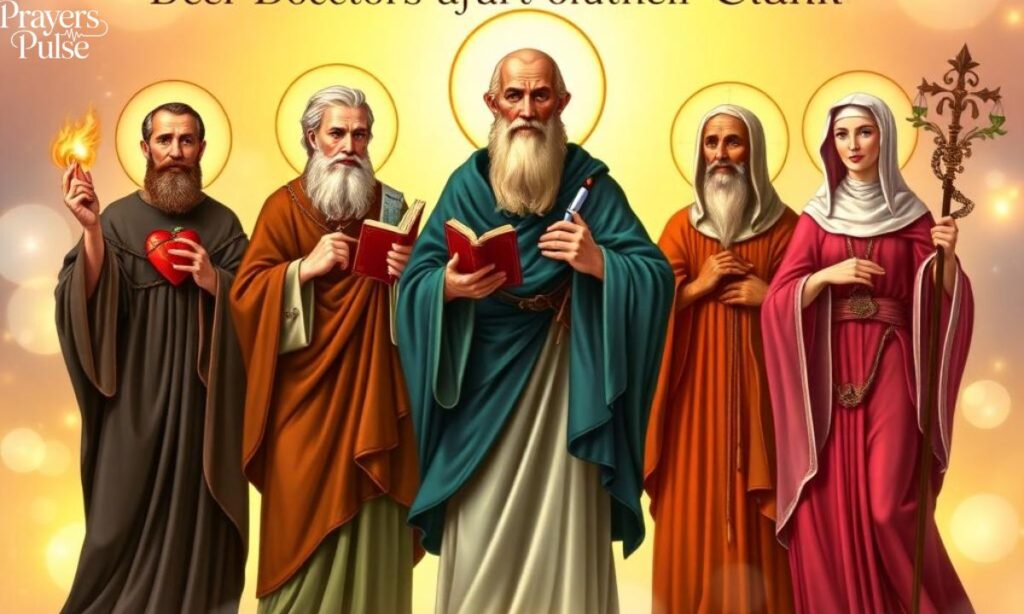
The title Doctor of the Church is special. It is not given to every saint — only to those whose writings were so deep and so helpful that the whole Church says everyone should read them. Right now there are 37 Doctors of the Church.
St. Augustine was born in North Africa in 354. His mother St. Monica was a devoted Christian but his father was not. As a young man Augustine chased pleasure, success, and every philosophy he could find. He had a son with a woman he was not married to.
He prayed the famous prayer — “Lord make me chaste, but not yet.” For years Monica prayed and cried for him every day. Eventually Augustine met a brilliant bishop named Ambrose in Milan whose preaching began to crack his resistance.
One afternoon Augustine sat in a garden, heard a child’s voice saying “pick it up and read,” opened the Bible to a letter of Paul, read one sentence — and something inside him broke open.
He was baptized, became a bishop, and wrote books that shaped Western Christianity for over a thousand years. His book Confessions is still read today and feels shockingly honest and modern.
St. Thomas Aquinas was a big, quiet man who barely spoke. His classmates called him the Dumb Ox. But his teacher said one day this ox would bellow so loudly the whole world would hear. Thomas spent his life showing that faith and reason are not enemies — they work together. His writings are still the foundation of Catholic philosophy.
St. Teresa of Ávila was a Spanish nun in the 1500s who reformed her entire religious order despite fierce opposition, illness, and even suspicion from the Inquisition. She wrote about the life of prayer in such a clear and practical way that people who have never set foot in a monastery find her books genuinely useful. She was funny, direct, and completely unafraid.
St. Thérèse of Lisieux said she was too small and too ordinary to do great things. So she decided to do every tiny thing — washing dishes, being patient with difficult people, smiling when she felt miserable — with as much love as she could manage.
She called it the Little Way. She died at 24 of tuberculosis, never having left her convent, never having done anything dramatic. The Pope later called her one of the greatest saints of modern times.
Saints with Remarkable Conversion Stories
Some saints came to faith slowly and quietly. Others were hit like lightning.
St. Paul is the most dramatic example in history. He was a highly educated Jewish scholar who believed Christians were dangerous heretics. He got official permission to travel to Damascus and arrest them. On the road, a blinding light threw him to the ground and a voice said — “Why are you persecuting me?” He asked who was speaking.
The voice said “I am Jesus.” Paul got up blind, was led into the city, and spent three days without eating or drinking. A Christian came to pray over him, his sight returned, and he was baptized. Within days he was preaching in the synagogues — the very man who had come to arrest Christians was now one of them.
He went on to write nearly half the New Testament and travel across the Roman Empire planting churches until he was beheaded in Rome.
St. Monica prayed every single day for her son Augustine for over 17 years. She wept so much that a bishop told her — “the child of so many tears cannot be lost.” She lived long enough to see Augustine baptized. She died a few weeks later, completely at peace, saying she had nothing left to ask for.
Bl. Matt Talbot was a working class man in Dublin, Ireland, in the late 1800s. He started drinking at 12 years old and by his teenage years was a severe alcoholic. One day at 28, broke and desperate, he made a pledge to stay sober.
He went to confession, started going to Mass every morning before work, and kept that pledge for the rest of his life — over 40 years.
When he died in a Dublin street, they found he was wearing chains of penance under his clothes. He had quietly transformed his entire life without anyone knowing.
Saints with Uncommon or Hard-to-Pronounce Names
The Church’s list of saints is a truly global collection spanning 2000 years. That means some names are going to sound very unfamiliar.
Cunegundes was a Polish queen and saint from the 1200s. Swithbert was an Anglo-Saxon missionary who brought Christianity to parts of Germany. Symphorian, Zosimus, Thecla, and Dubricius all appear in the calendar of saints and represent ancient Greek, Syrian, and Celtic naming traditions that have not survived into modern usage.
Saints from Africa include the great Augustine himself and Felicity and Perpetua — two women martyred in Carthage in 203 AD.
Their account of prison and death, written partly in their own words, is one of the oldest Christian documents we have. Saints from Asia, from the Middle East, from Eastern Europe, from Ireland and Scotland — all of them are part of one enormous family. The strange names are actually a beautiful thing. They are proof that the Church was never just one culture or one language.
Young Saints Who Achieved Holiness Before 25
People sometimes think you need a long life to become a saint. These young people prove otherwise.
St. Maria Goretti was born into a very poor Italian farming family. At 11 years old a young man attacked her. She fought back and told him what he was doing was a sin. He stabbed her 14 times. As she lay dying in hospital she said she forgave him and wanted him to be with her in heaven.
The man was sent to prison for 30 years. He later said that one night Maria appeared to him in a dream, offering him lilies. He woke up completely changed, asked to see her mother, begged forgiveness, and spent the rest of his life as a lay brother in a monastery.
He was still alive when Maria was canonized in 1950 and stood in the crowd next to her elderly mother.
St. Dominic Savio was a student of St. John Bosco in Turin. He was 12 when he made a simple resolution — I will not commit sin and I will go to confession often. He died at 14 of tuberculosis. Bosco later wrote his biography and described a boy who seemed to live in another world even while doing ordinary things at school.
St. Thérèse of Lisieux begged to enter Carmel at 14. The local bishop said no. She went to Rome and personally asked the Pope during a public audience — something pilgrims were strictly forbidden to do.
She was carried out by guards but the Pope told her that if God willed it, she would enter. She was in the convent by 15. She died at 24 having never left, never done anything the world would notice — and became one of the most beloved saints in history.
Saints to Invoke for Specific Intentions
Catholic tradition has always paired saints with particular needs. It is not superstition — it is friendship. You ask a friend who is closer to God to pray for you, the same way you would ask a friend on earth to pray for you.
St. Anthony of Padua is prayed to when something is lost. The tradition started when a novice stole Anthony’s prayer book. Anthony prayed, the novice was struck with fear, returned the book, and repented. People have been asking Anthony’s help ever since — and report remarkable results.
St. Jude is called the patron of hopeless causes. He was one of the 12 apostles and is mentioned very briefly in the Gospels. Because his name was similar to Judas, people avoided praying to him for centuries — which meant he had plenty of time to help desperate cases.
His feast day on October 28th fills churches with people carrying impossible petitions.
St. Dymphna was an Irish princess in the 600s whose father suffered a severe mental breakdown after the death of her mother. She fled to Belgium and was eventually tracked down and killed by her father. She became the patron of people with mental illness.
Her shrine in the town of Geel, Belgium, became so famous for healings that the townspeople began taking in mentally ill pilgrims to live with their families. That practice continued for centuries and is considered one of the earliest examples of compassionate community mental health care in history.
St. Peregrine Laziosi was a young Italian man who once slapped a priest during a political dispute. The priest turned the other cheek, Peregrine was so moved that he converted completely and joined a religious order.
He developed cancer on his leg and was scheduled for amputation. The night before the surgery he prayed all night in front of a crucifix. In the morning the cancer was gone. Doctors could not explain it. He became the patron of cancer patients.
Female Saints and the Meaning Behind Their Names
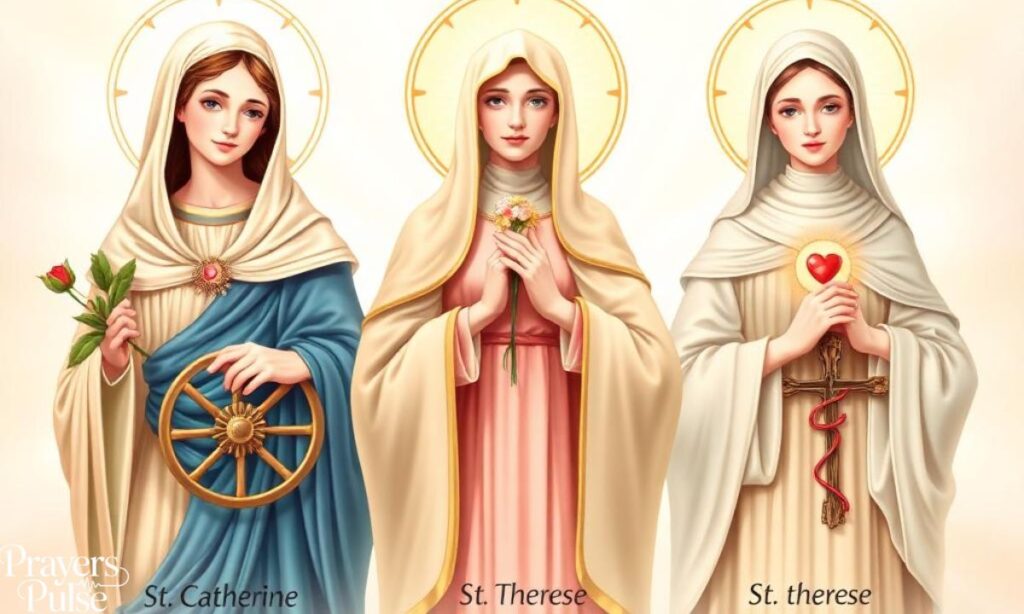
Names matter. In the Catholic tradition a name is not just what people call you — it connects you to a story, a history, and a heavenly patron.
Agnes comes from the Greek word for pure or holy. St. Agnes was a young Roman girl who refused to give up her faith or her purity and was martyred around age 12 or 13. Her name has meant courage and innocence ever since.
Lucy comes from the Latin word for light — lux. St. Lucy was a Sicilian martyr who gave away her dowry to the poor. Her name means she was a bringer of light, and she is celebrated on December 13th — historically one of the darkest days of the year in northern countries.
Clare comes from the Latin clara meaning bright or clear. St. Clare of Assisi was a friend of St. Francis who left her wealthy family to live in radical poverty. She is said to have once projected an image of the Christmas Mass on her wall when she was too sick to attend — which is why she is the patron saint of television.
Brigid is a Celtic name meaning strong or exalted. St. Brigid of Ireland is one of the country’s three patron saints alongside Patrick and Columba. She was known for extraordinary generosity — giving away everything she had, including things that did not quite belong to her.
Monica has North African roots, likely Berber in origin. It connects her to her homeland in what is now Algeria, and reminds us that some of the greatest saints in history came from Africa.
Female Saints Who Made History
These women did not wait for permission. They saw what needed to be done and did it.
St. Catherine of Siena was born in 1347, the 23rd of 25 children. She never went to school. She could not read until later in life. Yet she became the spiritual director of popes, cardinals, and kings. She wrote hundreds of letters — frank, loving, and absolutely fearless — telling powerful men when they were wrong.
When Pope Gregory XI was comfortable in Avignon, France, and reluctant to return to Rome where he belonged, Catherine wrote to him and called him out directly. He went. She is a Doctor of the Church and co-patron of Europe.
St. Hildegard of Bingen lived in Germany in the 1100s. From her monastery she composed beautiful music that is still performed today, wrote detailed books on natural medicine and healing herbs, described mystical visions in vivid and extraordinary detail, and exchanged letters with Emperor Frederick Barbarossa and Pope Eugenius III.
She traveled and preached publicly — something almost unheard of for a woman of her time. She was finally named a Doctor of the Church in 2012, 800 years after her death.
St. Josephine Bakhita was born in Sudan around 1869. When she was about 7 years old she was kidnapped by slave traders. She was beaten so badly that she forgot her own name — her captors called her Bakhita, which means lucky in Arabic, and that became her name.
She was sold multiple times. Eventually she ended up in Italy where she encountered the Catholic faith, was baptized, and became a Canossian sister.
She was gentle, joyful, and radiated peace to everyone around her. When asked if she held anger toward those who enslaved her she said she forgave them completely and even pitied them. She was canonized in the year 2000.
Choosing a Saint Name for Confirmation or Your Baby Girl
In the Catholic Church, Confirmation is the sacrament where a young person says — yes, I choose this faith for myself. As part of that, many people choose a saint’s name.
The idea is beautiful and simple: pick a saint whose life speaks to you, ask them to be your patron and companion, and carry their name as a reminder of the kind of person you want to become.
To choose well, ask yourself — whose story moves me? If you feel drawn to helping the poor, perhaps St. Martin de Porres or St. Teresa of Calcutta. If you love learning and ideas, perhaps St. Thomas Aquinas or St. Edith Stein, a philosopher who became a Carmelite nun and died in Auschwitz.
If you feel like your struggles are very ordinary, perhaps St. Thérèse — the patron of the small and the everyday.
For a baby girl’s name, parents are rediscovering beautiful saint names that had almost been forgotten. Gianna — after St. Gianna Beretta Molla, a doctor and mother who refused cancer treatment that would have harmed her unborn child and died shortly after giving birth. Zélie — after St. Zélie Martin, mother of St.
Thérèse, who was herself canonized in 2015 alongside her husband Louis — the first married couple canonized together in modern history. Faustina — after St. Faustina Kowalska, the Polish nun who spread the devotion to Divine Mercy. Gemma — after St. Gemma Galgani, a young Italian woman who bore the stigmata and died at 25.
Every one of these names carries a whole life inside it. A life of love, courage, and faith. When you give a child a saint’s name, you are not just naming her — you are handing her a story to grow into and a friend to walk beside her for life.
Frequently asked questions
What is a confirmation name?
A confirmation name is a saint’s name chosen to inspire faith and emulate virtuous qualities.
Why choose a female saint for confirmation?
Female saints provide powerful role models of courage, faith, and devotion.
How do saints’ names carry meaning?
Each saint’s name reflects their life story, virtues, or spiritual legacy.
Are there popular female saints for confirmation?
Yes—Saint Mary, Saint Therese, Saint Catherine, and Saint Joan are common choices.
Can the meaning of a saint’s name influence your life?
Yes, it serves as a spiritual guide and reminder to live with their values.
How do I select the right female saint name?
Choose a saint whose life and virtues resonate with your personal faith journey.
Are all female saints recognized by the Catholic Church?
Most are, but some may be locally venerated or recognized in specific Christian traditions.
Does a saint’s name have symbolic meaning?
Absolutely—names often represent purity, strength, wisdom, or compassion.
Can I combine my birth name with a saint’s name?
Yes, many choose a saint name as a middle name for confirmation.
Why do confirmation names matter in Christian life?
They strengthen faith, inspire moral living, and create a lifelong spiritual connection.
Conclusion
Beautiful Female Saints and Their Meanings for Your Confirmation Name inspire faith, virtue, and spiritual guidance. Choosing a saint’s name connects you to their example of holiness and courage. It reminds you to live a life of faith and devotion. Saints’ stories offer lessons for everyday Christian living.
Exploring Beautiful Female Saints and Their Meanings for Your Confirmation Name helps make your Confirmation meaningful and personal. It encourages reflection on values and character. Each name carries history, inspiration, and purpose. Selecting a saint’s name strengthens your spiritual journey.

Denzel is a passionate faith writer with four years of experience in prayer and Bible blogging. He now contributes has expertise to PrayersPulse.com, creating inspiring content that strengthens prayer life and deepens understanding of Scripture.