

The Isla meaning in Bible is symbolic rather than literal, because the name Isla does not appear directly in Scripture. Isla comes from Scottish origins and is also linked to the Spanish word isla, meaning “island.” Although it is not a biblical name, its meaning can be understood through biblical imagery and spiritual themes.
When exploring the Isla meaning in the Bible, the idea of an island often represents peace, refuge, and a place of quiet rest before God. In Scripture, secluded places are associated with reflection, protection, and renewal, giving the name Isla a gentle spiritual connection rooted in calmness, trust, and God’s presence.
What Does the Name Isla Mean? (Definition & Etymology)
The name Isla (pronounced EYE-la) is of Scottish origin, derived from the name of two Scottish rivers—the River Isla in Perthshire and another in Argyllshire—and ultimately means “island” in Spanish. The name gained popularity as a geographical reference to Islay, a Scottish island in the Inner Hebrides, though the pronunciation differs from the modern given name.
Isla combines natural beauty with simplicity, evoking imagery of peaceful waters, remote islands, and the rugged Scottish landscape that inspired its use as a feminine first name beginning in the late 19th century.
The etymology of Isla connects to both Celtic and Romance language roots, representing the convergence of Scottish heritage and Spanish vocabulary in a single, elegant name. While “isla” literally translates to “island” in Spanish, the Scottish usage as a place name predates this linguistic connection, making it a name rich with layered meanings across cultures.
Biblical Origins and History of the Name Isla
The name Isla has no biblical origins whatsoever, as it does not appear in Scripture and developed from Scottish geographical names rather than Hebrew, Aramaic, or Greek biblical languages. The name emerged in Scotland during the 19th century as a given name inspired by Scottish rivers and islands, placing its origins firmly outside of biblical or Judeo-Christian naming traditions.
While Isla has been adopted by Christian families in modern times, its history is entirely secular and geographical rather than religious or scriptural in nature.
Despite lacking biblical roots, Isla has been embraced by Christian parents who appreciate its meaning of “island” as metaphorically representing spiritual refuge, sanctuary, or a place set apart for God. The name’s popularity among believers demonstrates that biblical origin is not a requirement for a name to carry spiritual significance or be appropriate for Christian families.
Isla’s history shows how names from nature and geography can be meaningfully adopted into faith communities, with parents creating new spiritual associations for names that have no historical religious connection.
Is the Name Isla Mentioned in the Bible?
No, the name Isla is not mentioned anywhere in the Bible, as it is a Scottish geographical name that developed thousands of years after biblical texts were written and has no connection to Hebrew, Aramaic, or Greek biblical languages. The Bible contains no characters, places, or references to Isla, making it completely absent from Scripture in any form.
This absence is expected given that Isla originated in Scotland from river and island names, while biblical names come from Middle Eastern cultures and ancient Semitic or Hellenic languages with entirely different naming traditions.
The fact that Isla doesn’t appear in the Bible doesn’t diminish its value or appropriateness as a name for Christian families, just as many beloved names like Emma, Sophia, or Olivia have no biblical presence yet are widely used by believers.
The Spiritual Meaning of the Name Isla

While Isla has no inherent biblical or religious meaning, its definition as “island” carries rich spiritual symbolism that Christian parents can embrace and apply to their faith journey. An island represents a place of refuge, separation from the chaos of the mainland, sanctuary where one can find peace and solitude with God, and a distinct identity set apart from surrounding influences.
Spiritually, Isla can symbolize the believer’s call to be “in the world but not of the world,” maintaining distinct Christian identity while surrounded by secular culture, much like an island maintains its boundaries while surrounded by water.
Isla as a Place of Refuge
The spiritual meaning of Isla as “island” powerfully connects to the biblical concept of God being our refuge and safe haven in times of trouble. Psalm 46:1 declares “God is our refuge and strength, an ever-present help in trouble,” while Psalm 91:2 says “I will say of the Lord, ‘He is my refuge and my fortress, my God, in whom I trust.'”
An island serves as a natural refuge—a place of safety surrounded by protective waters—just as God surrounds and protects His children with His presence, creating a sanctuary where they can find peace regardless of external circumstances threatening to overwhelm them.
Isla as Spiritual Separation
The island symbolism in Isla represents the biblical call to holy separation, where believers are instructed to be distinct from worldly patterns while still engaging with the world for kingdom purposes. Second Corinthians 6:17 commands “Come out from them and be separate, says the Lord,” while Romans 12:2 instructs “Do not conform to the pattern of this world, but be transformed by the renewing of your mind.” Just as an island maintains clear boundaries and distinct identity while surrounded by water,
Christians named Isla can embody the balance of engaging culture without being consumed by it, maintaining spiritual distinctiveness while influencing their surroundings for good.
Isla as Foundation and Stability
An island’s firm ground amidst shifting seas symbolizes the unshakeable foundation believers have when their lives are built on Christ and His Word. Matthew 7:24-25 speaks of the wise builder who builds on rock so that when storms come, the house stands firm, while Hebrews 6:19 describes hope as “an anchor for the soul, firm and secure.
The name Isla can remind its bearer to be grounded in truth, stable in faith, and unmoved by the waves of doubt, fear, or cultural trends that seek to erode spiritual conviction—standing firm like an island regardless of what storms may rage around her.
Isla as a Symbol of Personal Growth
Beyond its spiritual meaning, Isla represents personal growth through its imagery of an island that starts small but expands through volcanic activity, sediment deposit, and natural processes over time. Just as islands grow and develop unique ecosystems, a person named Isla can embrace her name as a symbol of continuous personal development, character formation, and the journey of becoming her best self.
The island metaphor encourages embracing one’s uniqueness, cultivating inner beauty, and creating a life that offers something valuable and distinct to the world.
The process of personal growth reflected in Isla’s symbolism involves both internal development (like an island’s geological changes beneath the surface) and external expression (like the visible landscape that emerges). Personal growth requires patience with the process, acceptance that change happens gradually, resilience through challenges that shape character, and confidence in one’s unique contribution to the world.
Isla Name Meaning in Hebrew and Its Deeper Symbolism
Isla has no meaning in Hebrew because it originates from Scottish geography rather than Hebrew language or Jewish cultural traditions. The name cannot be translated into Hebrew meaningfully; it can only be transliterated phonetically as אייסלה (Isla) for use in Hebrew-speaking contexts.
Parents seeking a Hebrew name with similar thematic elements to Isla’s “island” meaning might consider Hebrew names connected to refuge, beauty, or nature, though these would be entirely different names with their own Hebrew heritage rather than translations of the Scottish name Isla.
Despite lacking Hebrew etymology, Jewish families who appreciate the name Isla sometimes choose it for its modern sound and international appeal, representing the contemporary trend of adopting names from diverse linguistic backgrounds.
How Old Is the Name Isla?
The name Isla as a given name for girls is relatively modern, emerging in Scotland during the late 19th century as parents began using geographical names as first names. While the Scottish rivers and islands bearing the name “Isla” or “Islay” have existed for thousands of years, the practice of using Isla as a personal name only became established in the 1890s-1900s.
The name remained primarily Scottish and relatively uncommon for most of the 20th century before experiencing dramatic international popularity growth in the 21st century, particularly in English-speaking countries.
Compared to ancient biblical names like Sarah, Rebecca, or David that have been in use for over 3,000 years, Isla is exceptionally young—only about 120-130 years old as a given name. The name’s youth contributes to its fresh, modern appeal while its geographical roots provide historical depth that prevents it from feeling trendy or invented.
Isla Pronunciation
The name Isla is pronounced “EYE-la” (rhymes with “sky-la”), consisting of two syllables with emphasis on the first syllable in English-speaking countries. The pronunciation is straightforward and intuitive for most English speakers, though occasional confusion arises from people unfamiliar with the name who might pronounce it phonetically as “IZ-la” or “IS-la” based on English spelling patterns.
The correct pronunciation emphasizes the long “I” sound at the beginning, making it sound like the word “eye” followed by “la,” creating an elegant and flowing name that rolls off the tongue easily.
Isla Name Meaning in the Bible
Isla has no meaning in the Bible because the name does not appear in Scripture and originates from Scottish geography rather than biblical Hebrew, Aramaic, or Greek languages. There are no biblical characters, places, or references to Isla in any form, making it completely absent from biblical text and tradition.
While the word “island” appears in Scripture—particularly in prophetic passages like Isaiah 42:10 where islands are called to praise God—these references use the Hebrew word “iy” (אִי) or Greek word “nēsos” (νῆσος), neither of which connects etymologically to the Scottish name Isla.
Christian families choosing Isla can still find biblical meaning by connecting the name’s definition to scriptural themes rather than expecting direct biblical origin.
Cultural and Religious Significance of Isla Across Traditions
| Aspect | Scottish/Western | Christian | Jewish | Spanish | General Modern |
| Primary Association | Geography, nature, heritage | Spiritual refuge, set apart | Adopted modern name | Literal word for island | Trendy, elegant name |
| Cultural Significance | Connection to Scottish islands and rivers | Metaphor for faith journey | No traditional significance | Common vocabulary word | Contemporary favorite |
| Religious Meaning | None (secular origin) | Refuge in God, spiritual sanctuary | No inherent meaning | No religious connection | Personal spiritual interpretation |
| Usage Context | Traditional Scottish, now global | Christian families seeking nature names | Progressive Jewish families | Not typically used as name | Widespread international use |
| Symbolic Meaning | Scottish pride, natural beauty | Separation from world, grounded in faith | Modern, international appeal | Geographical reference | Independence, uniqueness |
| Historical Depth | Ancient geography, modern name | No biblical history | No traditional Jewish usage | Ancient word, modern name use | Recent popularity surge |
Nicknames and Variations of the Name Isla
Isla, despite being a short name, has generated several nickname possibilities and spelling variations that provide options for personalization and different contexts. Common nicknames include Izzy, Isy, Isi, and even creative options like Issy or Lala, though many parents and children prefer using the full name Isla given its brevity and beauty.
Spelling variations are less common but include Iyla, Eyla, Aila, Isla-Rose (hyphenated combination), and cultural adaptations like Isola (Italian) or Insula (Latin), though most families stick with the traditional Scottish spelling that has become internationally recognized.
The simplicity of Isla means that elaborate nicknames are rarely necessary, with most variations serving as affectionate diminutives during childhood rather than permanent alternatives.
Isla Name Popularity and Global Usage Trends
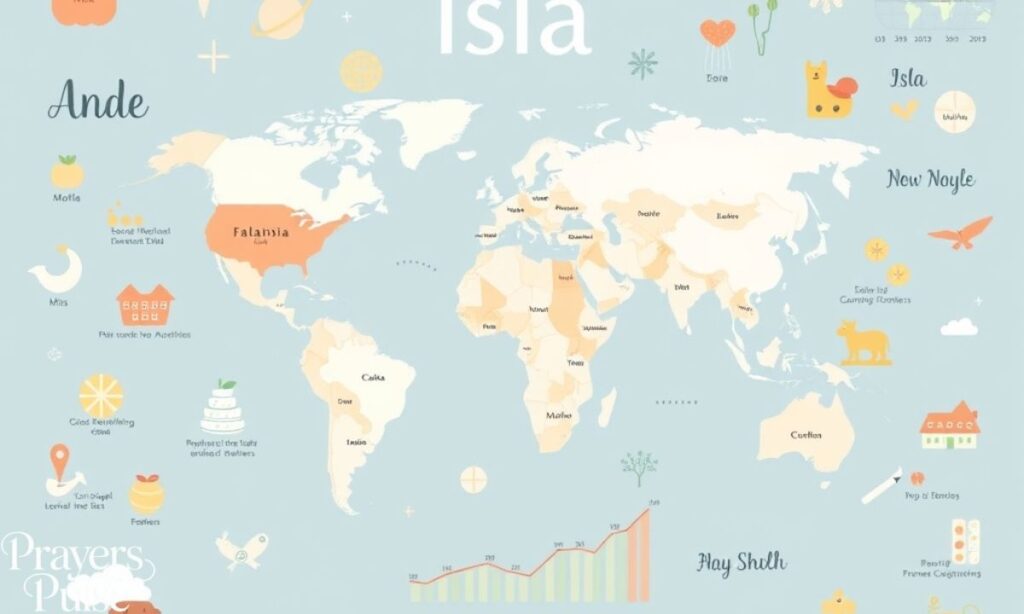
The name Isla has experienced explosive growth in popularity over the past two decades, rising from relative obscurity to become one of the most popular girls’ names in English-speaking countries worldwide. In Scotland, Isla consistently ranks in the top 10 girls’ names, honoring its Scottish heritage, while in England and Wales it reached #3 in recent years, demonstrating remarkable appeal beyond its country of origin.
The United States has seen Isla climb from outside the top 1000 in the early 2000s to the top 100 by the 2010s, with continued upward trajectory driven by celebrity influence, literary references, and parents’ desire for names that are both distinctive and accessible.
Globally, Isla’s popularity spans Australia (where it regularly appears in the top 10), New Zealand, Canada, and increasingly in European countries as English names gain international traction.
Famous People Named Isla
Several notable individuals named Isla have brought prominence to the name across entertainment, arts, sports, and other fields, contributing to its rising popularity and positive associations. Australian actress Isla Fisher is perhaps the most famous bearer of the name, known for her roles in “Wedding Crashers,” “Confessions of a Shopaholic,” and numerous other films, bringing the name into international consciousness through her successful Hollywood career.
British fashion model Isla Fisher (different person) and Scottish Olympic rower Isla Phillips have also elevated the name’s profile in their respective fields.
The name Isla appears less frequently among historical figures given its relatively recent use as a given name, though this is changing as the current generation of Islas grows up and makes their mark in various professions.
What Does Isla Represent in Christian Faith?
In Christian faith, Isla represents the concepts of refuge, sanctuary, spiritual separation, and being grounded in truth despite surrounding chaos or cultural pressures. Though not a biblical name, its meaning of “island” provides rich metaphorical material for teaching Christian values about being set apart for God’s purposes while remaining engaged with the world, finding rest and safety in God’s presence, and maintaining firm spiritual foundation when storms of life threaten to overwhelm.
Isla can symbolize the Christian journey of living distinctively in accordance with biblical values while surrounded by secular culture that may flow in different directions.
Beautiful Middle Names That Pair Well with Isla
Isla pairs beautifully with a wide variety of middle names due to its short, two-syllable structure that flows well with both longer, more elaborate names and simple, classic choices. Longer middle names create elegant balance with Isla’s brevity—options like Isla Catherine, Isla Elizabeth, Isla Josephine, Isla Evangeline, or Isla Penelope provide sophisticated combinations where the middle name adds substance and family connection possibilities.
Classic middle names like Isla Grace, Isla Rose, Isla Mae, Isla Jane, or Isla Claire offer timeless simplicity that honors traditional naming patterns while maintaining overall elegance.
For parents seeking more unique or nature-inspired pairings, combinations like Isla Wren, Isla Sage, Isla Pearl, Isla Autumn, or Isla Violet create cohesive nature themes that complement Isla’s geographical origins.
Frequently Asked Questions
What does the name Isla mean in the Bible?
The name Isla does not appear directly in the Bible.
Is Isla a biblical name?
No, Isla is not a biblical name found in Scripture.
What is the origin of the name Isla?
Isla has Scottish and Spanish origins, meaning “island.”
Does Isla appear in the Old Testament?
No, Isla is not mentioned in the Old Testament.
Does Isla appear in the New Testament?
No, Isla does not appear in the New Testament.
Can Isla have a spiritual meaning in the Bible?
Spiritually, Isla can symbolize peace, refuge, and separation for God.
Is Isla similar to any biblical word or name?
Isla is sometimes loosely connected to biblical themes of islands or coastlands.
What biblical verse reflects the meaning of Isla?
“Be still, and know that I am God.” — Psalm 46:10 (symbolic connection).
Is Isla a good Christian baby name?
Yes, many Christians choose Isla for its gentle and peaceful meaning.
What is a biblical blessing for someone named Isla?
“May Isla walk in God’s peace, protection, and grace.”
Conclusion
The name Isla does not appear directly in the Bible and does not have a specific biblical or Hebrew origin. It is commonly associated with meanings such as “island” or “calm waters,” which symbolically connect with biblical themes of peace, refuge, and rest. In Scripture, islands and waters often represent places of renewal, God’s creation, and His sustaining presence, giving the name Isla a gentle spiritual connection.
From a biblical perspective, Isla can symbolize serenity, beauty, and trust in God’s provision. While not a biblical name by origin, its meaning aligns with scriptural values of peace, stillness, and reliance on God. The name Isla reflects a quiet strength and grace, reminding believers of God’s promise to be a refuge and source of peace in every season of life.

Denzel is a passionate faith writer with four years of experience in prayer and Bible blogging. He now contributes has expertise to PrayersPulse.com, creating inspiring content that strengthens prayer life and deepens understanding of Scripture.