

May Allah Bless You in Arabic: True Meaning Revealed explores the beautiful Islamic expressions used to send prayers, kindness, and blessings to others. One of the most common phrases is “بارك الله فيك” (BarakAllahu Feek), which means “May Allah bless you.” It is often used to express gratitude, goodwill, and sincere prayers for someone’s success and happiness.
When reflecting on May Allah Bless You in Arabic: True Meaning Revealed, these words carry deep spiritual warmth and a sense of compassion within Islamic culture. Such phrases strengthen bonds, spread positivity, and remind people of faith and gratitude. They are more than simple words—they represent respect, love, and heartfelt الدعاء for blessings in life. 🤍✨
How Do You Say “May Allah Bless You” in Arabic?
There is not just one way to express this sentiment in Arabic. The language of Islamic blessing is rich, layered, and context-sensitive. Here are the most important and commonly used phrases:
بَارَكَ اللهُ فِيكَ — Barak Allahu Feek
Transliteration: Barak Allahu Feek (to a male) / Barak Allahu Feeki (to a female)
Literal meaning: May Allah place blessing in you
This is the most widely used phrase for “May Allah bless you” in Arabic. The word barak comes from the root ب-ر-ك (B-R-K), which carries the meaning of blessing, abundance, and growth. The root itself is ancient and deep — it connects to the idea of something settling and multiplying, like water that gathers and sustains life.
When you say Barak Allahu Feek, you are not just wishing someone well in a general sense. You are asking Allah to place His barakah — His divine blessing — within that person. It is intimate, specific, and sincere.
This phrase is used:
- When someone gives you a gift
- When someone helps you with a task
- In response to a compliment
- After receiving good news from someone
- As a general expression of appreciation and goodwill
جَزَاكَ اللهُ خَيْرًا — Jazak Allahu Khayran
Transliteration: Jazak Allahu Khayran (to a male) / Jazaki Allahu Khayran (to a female) / Jazakum Allahu Khayran (to a group)
Literal meaning: May Allah reward you with goodness
This phrase goes even deeper than a simple blessing. It acknowledges that the good someone has done for you is beyond what you can repay yourself, so you are turning the matter over to Allah — asking Him to give them something better than anything you could offer in return.
The Prophet Muhammad (peace be upon him) said that whoever has a good deed done for them and responds with Jazak Allahu Khayran has given the greatest thanks. This phrase is considered one of the most complete expressions of gratitude in Islam.
It is used:
- When someone does you a significant favor
- After receiving Islamic knowledge or advice
- When thanking a teacher, scholar, or mentor
- In written messages and letters
- Any time you want to express deep, sincere gratitude
اللهُ يُبَارِكُ فِيكَ — Allah Yubarik Feek
Transliteration: Allah Yubarak Feek
Literal meaning: May Allah bless you / Allah blesses you
This is a slightly more conversational and colloquially used version of the blessing, common in spoken Arabic across many Arab countries. It carries the same spiritual weight but has a warmer, more everyday tone. You will hear this in markets, homes, and casual conversations as a natural expression of goodwill.
بَارَكَ اللهُ لَكَ — Barak Allahu Lak
Transliteration: Barak Allahu Lak (to a male) / Barak Allahu Laki (to a female)
Literal meaning: May Allah bless you / May Allah bless what is yours
This version shifts the preposition slightly — from fi (in) to li (for/to) — and changes the nuance. Where Barak Allahu Feek asks for blessing to be placed within the person, Barak Allahu Lak asks for blessing to be granted to them or for their benefit. It is often used in the context of congratulations — for a new marriage, a new home, a new child, or a new beginning.
The full marriage blessing in Islamic tradition is:
بَارَكَ اللهُ لَكَ وَبَارَكَ عَلَيْكَ وَجَمَعَ بَيْنَكُمَا فِي خَيْرٍ
Barak Allahu laka wa barak alayka wa jama’a baynakuma fi khayr
Which means: May Allah bless you, and may Allah shower blessings upon you, and may He unite you both in goodness.
اللهُ يُسَلِّمَكَ — Allah Ysalmak
Transliteration: Allah Yusallimak
Literal meaning: May Allah keep you safe / May Allah grant you peace
This phrase is used as a warm, gracious response when someone says something kind to you or does you a favor. It comes from the root salam — peace and safety. When you say this, you are invoking divine safety and wholeness over a person.
حَفِظَكَ اللهُ — Hafiz Allah
Transliteration: Hafizak Allah
Literal meaning: May Allah protect you
This is a blessing specifically asking for divine protection over someone. It is used when someone is about to travel, face a difficulty, or go through a challenging time. It is a prayer that God will guard them from harm.
What Is Barakah and Why Does It Matter?
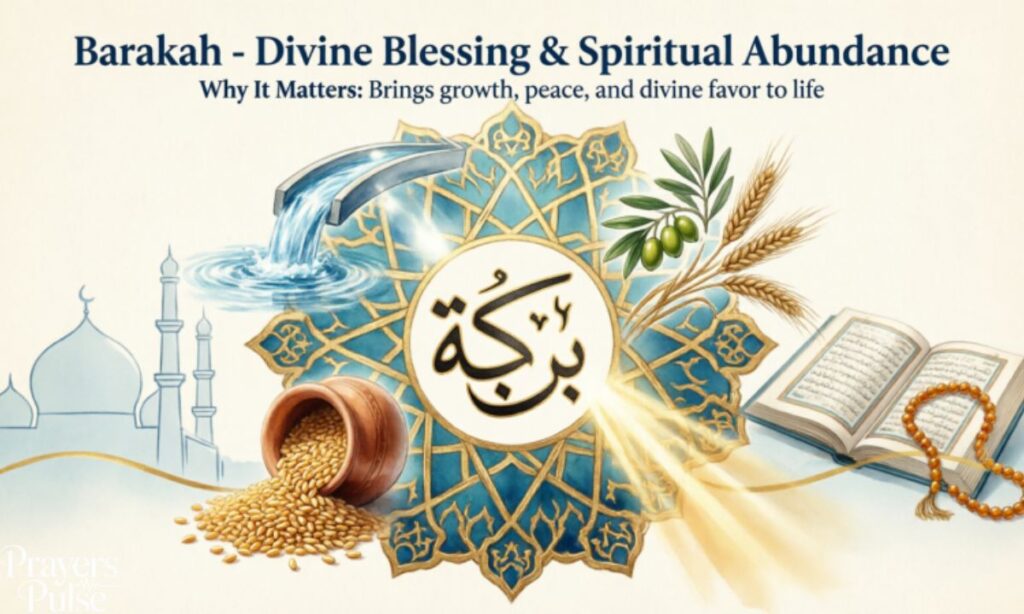
To truly understand these phrases, you need to understand the concept of barakah — because it is the heart of Islamic blessing.
Barakah is not simply luck or good fortune in the Western sense. It is a divine quality — an invisible increase and abundance that Allah places in things, people, time, and actions. Something with barakah gives more than its outward quantity suggests. A meal with barakah feeds more people than it should. Time with barakah accomplishes more than the hours allow. Money with barakah stretches further and brings more benefit.
When you ask Allah to place His barakah in someone, you are asking for something immeasurable and incomparable. You are asking that their life, their efforts, their relationships, and their time all carry that divine increase.
This is why Barak Allahu Feek is such a powerful thing to say. It is not a social nicety. It is a genuine supplication on behalf of another person.
When Do Muslims Use These Blessings?
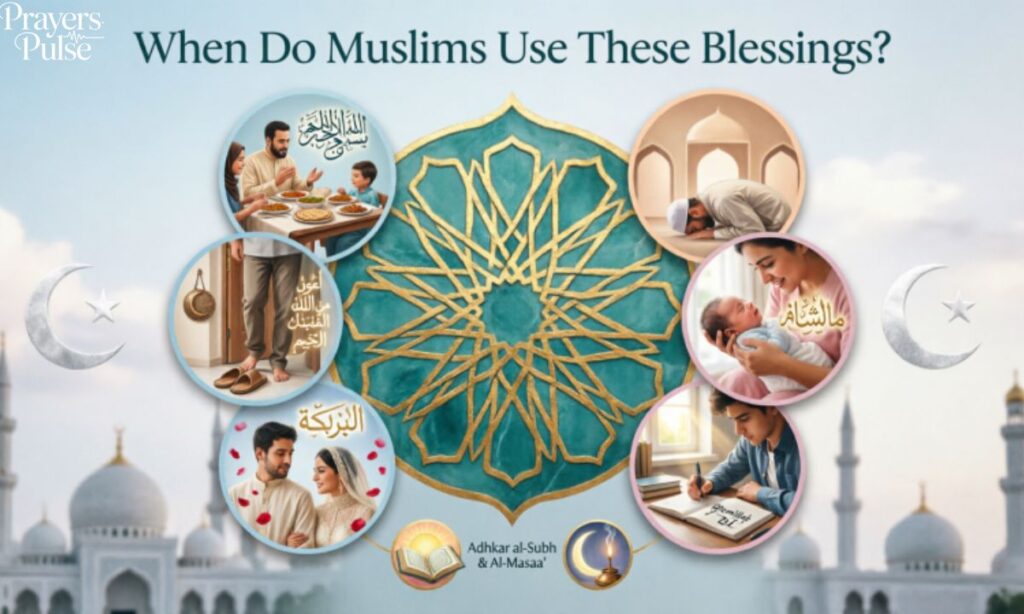
Islamic culture is saturated with invocations of divine blessing in everyday life. These phrases are not reserved for religious occasions or formal settings. They are part of the texture of daily conversation.
You will hear them:
- When receiving a gift or favor — the natural Islamic response is Barak Allahu Feek or Jazak Allahu Khayran
- At weddings and celebrations — Barak Allahu Lak is the traditional congratulatory blessing
- When someone sneezes — the person says Alhamdulillah (praise be to Allah) and those around respond Yarhamuk Allah (may Allah have mercy on you), to which the person replies Yahdikum Allah (may Allah guide you)
- When parting from someone — blessings of safety, protection, and divine care are offered
- In letters and messages — written Arabic communication, even in the modern era, is often filled with these invocations
- After receiving Islamic knowledge — scholars and students use Jazak Allahu Khayran as a mark of deep respect
- When someone does charitable work — the community blesses the person who gives
The Difference Between Barak Allahu Feek and Jazak Allahu Khayran
Both phrases are commonly translated as expressions of gratitude and blessing, but they carry distinct meanings worth understanding.
Barak Allahu Feek is primarily a blessing — you are asking Allah to enrich the person themselves with His divine favor. It can be said in many contexts and is a generous, all-encompassing wish.
Jazak Allahu Khayran is primarily an expression of gratitude — you are acknowledging that someone has done something good for you that you cannot repay, and you are asking Allah to reward them in your place. It implies a specific act of goodness that was done for you.
In practice, both are used interchangeably in many Muslim communities, but the distinction in meaning gives each phrase its own spiritual texture.
Responding to These Blessings
In Islamic etiquette, when someone says Barak Allahu Feek to you, the proper response is:
وَفِيكَ بَارَكَ اللهُ — Wa feeka Barak Allah
Meaning: And may Allah also bless you.
This is a beautiful exchange — blessing returned with blessing, prayer met with prayer. It reflects the Islamic value of reciprocating goodness not merely in kind but in spiritual currency.
When someone says Jazak Allahu Khayran to you, the response is:
وَإِيَّاكَ — Wa iyyak
Meaning: And you as well.
Or more fully:
وَجَزَاكَ اللهُ خَيْرًا — Wa jazak Allahu khayran
Meaning: And may Allah reward you with goodness too.
The Spiritual Logic Behind Islamic Blessings
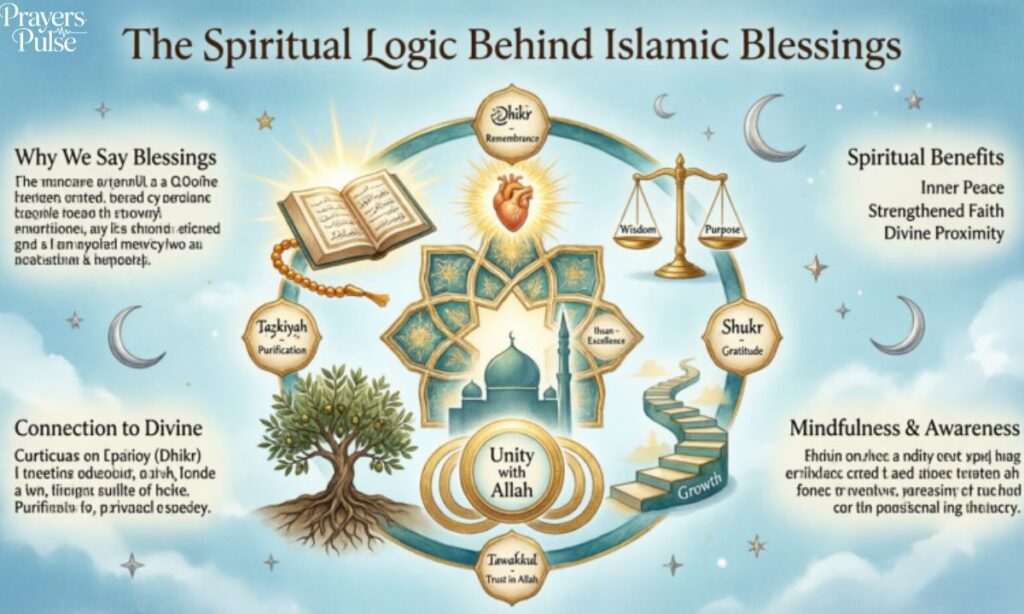
One of the most remarkable things about Islamic blessing culture is the theology embedded in it. When a Muslim says May Allah bless you instead of simply thank you, they are making a profound statement:
I cannot repay you adequately. Only Allah can. So I am turning to Him on your behalf.
This is not false modesty or a failure to appreciate the person in front of you. It is a recognition that true goodness, true reward, and true blessing come from a source beyond any human being. It places the interaction in a cosmic frame — even a small act of kindness is seen as something worthy of divine reward, not just human acknowledgment.
It also reflects a community-oriented spirituality. When you pray for someone, you are not just being polite. According to hadith tradition, when a Muslim sincerely prays for their brother or sister in their absence, the angels say Ameen, and may you have the same. The act of blessing someone is an act that circles back to the one who gives it.
How to Write “May Allah Bless You” in Arabic
For those who want to use these phrases in writing — in cards, messages, letters, or social media — here are the correct Arabic scripts:
| Phrase | Arabic | Transliteration |
| May Allah bless you (m) | بَارَكَ اللهُ فِيكَ | Barak Allahu Feek |
| May Allah bless you (f) | بَارَكَ اللهُ فِيكِ | Barak Allahu Feeki |
| May Allah reward you with good | جَزَاكَ اللهُ خَيْرًا | Jazak Allahu Khayran |
| May Allah bless you (casual) | اللهُ يُبَارِكُ فِيكَ | Allah Yubarak Feek |
| May Allah protect you | حَفِظَكَ اللهُ | Hafizak Allah |
| May Allah keep you safe | اللهُ يُسَلِّمَكَ | Allah Yusallimak |
Arabic is written right to left, and the script is connected — each letter joins the next within a word. When writing these phrases by hand or in digital format, using the full diacritical marks (the small symbols above and below letters that indicate vowels) ensures correct pronunciation and preserves the beauty of the script.
These Phrases Across the Muslim World
While classical Arabic is the liturgical language of Islam and these phrases originate there, Muslim communities around the world have woven them into their local languages and cultures.
In South Asia — across Pakistan, India, and Bangladesh — you will hear Jazak Allah and Allah Hafiz used daily in Urdu and Bengali conversations, often mixed naturally with the local language.
In Turkey, Allah razı olsun (may Allah be pleased with you) carries a similar meaning and function.
In Persian-speaking communities, the Arabic phrases are often used directly, given their religious status, alongside Persian equivalents.
In West Africa, particularly in Senegal, Mali, and Nigeria, Islamic blessing phrases are central to everyday greetings and farewells, deeply embedded in Wolof, Hausa, and other local languages.
In Southeast Asia, across Indonesia and Malaysia, Barakallah and Jazakallah are commonly used among Muslim communities alongside local-language expressions.
The universality of these phrases across such diverse cultures and languages reflects the unifying power of the Arabic Quran and the global reach of Islamic spiritual tradition.
Why Non-Muslims Should Know These Phrases Too
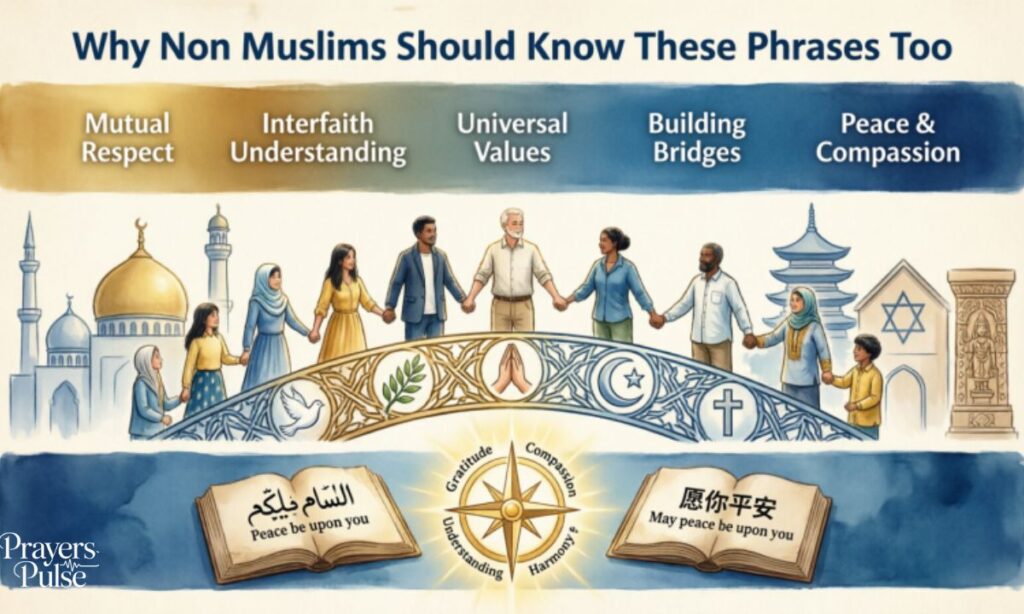
Understanding what these phrases mean is valuable for anyone who has Muslim friends, colleagues, neighbors, or family members. When a Muslim says Barak Allahu Feek to you, knowing that they are sincerely praying for divine blessing over your life — not just saying a polite formula — changes how you receive it.
It is also a window into a worldview where the sacred and the everyday are not separated. In Islamic culture, there is no domain of life too small for divine invocation. Even a glass of water is drunk with bismillah (in the name of Allah) and followed with alhamdulillah (praise be to Allah). Gratitude and blessing are not reserved for big moments. They are the vocabulary of every ordinary day.
When someone says May Allah bless you to you in Arabic, they are giving you something real — a sincere prayer offered on your behalf to the God they love and trust. It costs them nothing materially and means everything spiritually.
Receiving it gracefully, understanding its weight, and perhaps one day returning it — Wa feeka Barak Allah — is one of the small but genuine ways that human beings across different faiths and cultures can meet each other with dignity and warmth.
A Final Word on the Power of These Words
Language shapes reality. The words we use to greet, thank, and bless each other reveal what we believe about the world and about each other. In Arabic Islamic tradition, the language of blessing assumes that the divine is present, that goodness deserves acknowledgment, that human effort is noble but insufficient, and that the best thing one person can do for another is pray for them.
Barak Allahu Feek. May Allah place His blessing in you.
Four words in Arabic. A complete theology in miniature. A prayer wrapped in a thank you. A small act of love directed upward on behalf of someone else.
That is what these phrases are. That is why they matter. And that is why they have endured, unchanged in meaning and spirit, across fourteen centuries of Islamic civilization and billions of human hearts.
Frequently asked questions
What Does “May Allah Bless You” Mean in Arabic?
The common Arabic phrase is “بارك الله فيك” which means “May Allah bless you.”
How Do Muslims Commonly Say “May Allah Bless You”?
Many Muslims say “بارك الله فيك” as a kind and respectful prayer.
Is “بارك الله فيك” Used for Both Men and Women?
Yes, but the ending slightly changes depending on the person being addressed.
How Do You Say It to a Woman in Arabic?
You say “بارك الله فيكِ” when speaking to a female.
Can “May Allah Bless You” Be Used in Daily Conversation?
Yes, it is commonly used to show gratitude, kindness, and good wishes.
Is This Phrase Mentioned in Islamic Culture Often?
Absolutely, it is widely used in Islamic greetings and respectful conversations.
What Is the English Translation of “بارك الله فيك”?
It translates directly to “May Allah bless you.”
Can Non-Arabic Speakers Use This Phrase?
Yes, many Muslims around the world use it regardless of their native language.
Why Is This Phrase Spiritually Meaningful?
It expresses a heartfelt prayer for blessings, goodness, and mercy from Allah.
Are There Other Similar Islamic Blessing Phrases?
Yes, phrases like “جزاك الله خيرًا” and “الله يحفظك” are also commonly used.
Conclusion
May Allah Bless You in Arabic: True Meaning Revealed reflects a beautiful expression of kindness, prayer, and goodwill deeply rooted in Islamic culture. Phrases such as “بارك الله فيك” carry heartfelt wishes for blessings, peace, and prosperity. These words strengthen bonds and spread positivity through sincere faith and compassion.
Ultimately, May Allah Bless You in Arabic: True Meaning Revealed highlights the spiritual depth and cultural beauty behind everyday Islamic expressions. Such phrases remind people of gratitude, respect, and the importance of praying for others. This makes them a meaningful way to share blessings and goodwill in daily life.

Denzel is a passionate faith writer with four years of experience in prayer and Bible blogging. He now contributes has expertise to PrayersPulse.com, creating inspiring content that strengthens prayer life and deepens understanding of Scripture.