

What Is the Biblically Accurate Satan? Exploring His True Role and Appearance in Scripture examines how Satan is actually described in the Bible and what his role represents. In Scripture, Satan is not presented with a detailed physical form but rather as a spiritual adversary, often called “the accuser” or “the tempter.” His main role is to oppose God’s will and lead people away from righteousness through deception and temptation.
When reflecting on What Is the Biblically Accurate Satan? Exploring His True Role and Appearance in Scripture, the focus is more on his symbolic and spiritual nature than a visual appearance. The Bible portrays him as a fallen being who tests faith, spreads lies, and challenges human obedience to God. This understanding emphasizes his role as a moral and spiritual opposition rather than a clearly defined physical entity.
Biblically Accurate Satan: What Scripture Actually Says
Most people picture Satan as a red-skinned figure with horns, a pointed tail, and a pitchfork. That image has nothing to do with the Bible. It comes from medieval art, Dante’s poetry, and centuries of cultural mythology layered on top of each other until the fictional version completely replaced the scriptural one.
The biblical Satan is far more complex, far more disturbing, and far more interesting than the cartoon villain most people imagine. This article strips away the mythology and goes straight to what the Bible actually says — about who Satan is, what he looks like, what he does, and what his ultimate fate is.
Where Does Satan First Appear in the Bible?
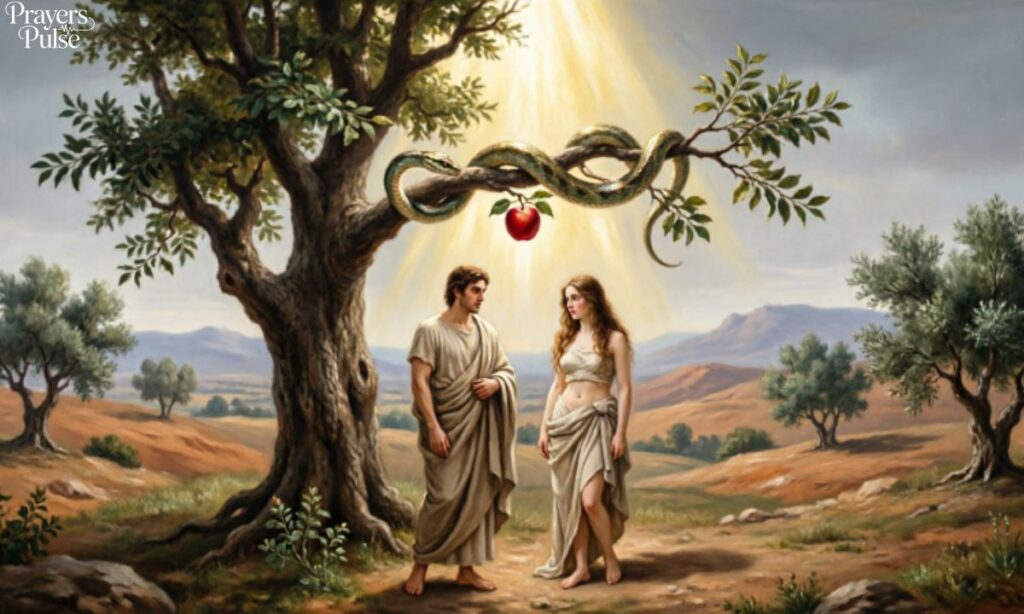
Satan does not appear in Genesis in the form most people expect. The serpent in the Garden of Eden is described simply as a serpent — the most cunning of animals. The direct identification of that serpent as Satan comes much later in Revelation 12:9, which refers to “that ancient serpent called the devil, or Satan.”
The first time a figure explicitly named Satan appears with clear personality and agency is in the Book of Job. Here, Satan is not a rebel ruling hell. He is in the divine council, standing before God, having a conversation. He roams the earth and reports back. God asks him where he has been. Their dialogue. Satan challenges God’s assessment of Job’s faith.
This is a profoundly different picture than what most people expect. Satan in Job is not imprisoned, not cast out, not powerless. He has access to the divine presence and operates with a kind of divine permission.
What Does the Name Satan Actually Mean?
The Hebrew word Satan (שָּׂטָן) simply means adversary or accuser. It is not originally a proper name — it is a title or a role. In the Old Testament, the word is sometimes used to describe human adversaries and even angels acting as opponents in a legal or military sense.
The specific figure known as “the Satan” — with the definite article — appears most clearly in Job and Zechariah. In Zechariah 3, Satan stands at the right hand of the high priest Joshua to accuse him. This is a legal metaphor. Satan is functioning like a prosecuting attorney in a divine court.
The name Lucifer comes from the Latin Vulgate translation of Isaiah 14:12 — lucifer, meaning “morning star” or “light bearer.” It was the Latin word for the planet Venus at dawn. Whether that passage refers to Satan at all is a matter of serious scholarly debate, as it was originally addressed to the King of Babylon. The name Lucifer as a personal name for Satan is largely a later theological development, not a biblical fact.
Diabolos — the Greek word translated as “devil” — means slanderer or false accuser. Together, Satan and the devil paint a picture not of a monster but of a legal and rhetorical adversary — a being whose primary weapon is accusation, deception, and slander.
What Does the Bible Say Satan Looks Like?
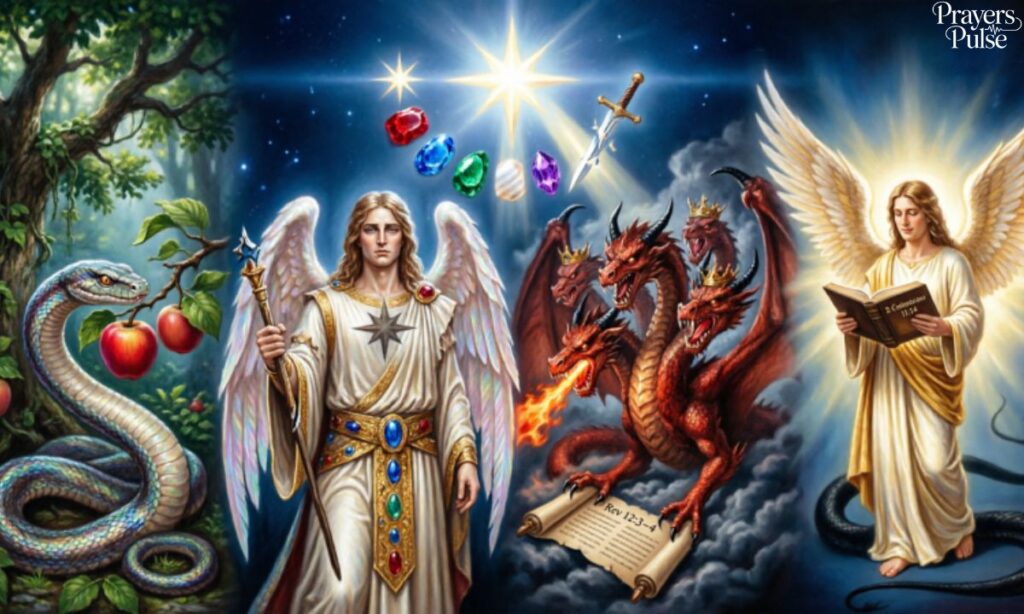
This is where things get genuinely surprising. The Bible gives very little physical description of Satan. What it does give is extraordinary.
Ezekiel 28 — The Covering Cherub
The most detailed physical and positional description of a being widely associated with Satan comes from Ezekiel 28. The passage is addressed to the King of Tyre but shifts into language that most theologians read as describing a supernatural being behind the king — something beyond any human monarch.
The passage describes a being who was:
- Perfect in beauty — not ugly, not monstrous, not frightening in appearance
- In Eden, the garden of God — present at the beginning
- Covered in precious stones — sardius, topaz, diamond, beryl, onyx, jasper, sapphire, emerald, carbuncle, and gold
- The anointed cherub who covers — a guardian figure of the highest rank, placed on the holy mountain of God
- Blameless from the day of creation until wickedness was found
This is not a picture of a monster. This is a picture of a being of astonishing beauty, dignity, and closeness to God. The fall of this being was not a fall from ugliness into beauty — it was a fall from breathtaking glory into corruption.
Isaiah 14 — The Morning Star
Isaiah 14:12-15, whether or not it directly refers to Satan, gives language that has shaped theology significantly. The figure described:
- Was called the son of the dawn, the brightest star
- Sought to ascend above the clouds and make himself like the Most High
- Was brought down to Sheol, the depths of the pit
The pride described here — the desire to ascend, to be like God, to claim divine status — is the theological engine behind what Christians call the fall of Satan. It is not an ugly ambition. It is the ambition of a magnificent being who could not accept a subordinate role.
2 Corinthians 11:14 — Angel of Light
Paul writes in 2 Corinthians 11:14 that Satan masquerades as an angel of light. This single verse dismantles the horns-and-pitchfork image completely. The biblical Satan does not look frightening. He looks radiant. He is convincing precisely because he is beautiful. His danger lies not in his ugliness but in his luminosity.
This is biblically consistent. A being that can deceive the entire world does not do so by looking like a monster. He does it by looking trustworthy, wise, and full of light.
What Is Satan’s Role in the Old Testament?
In the Old Testament, Satan functions differently than in the New Testament and very differently from popular imagination.
In Job, he is a member of the divine council — a body of heavenly beings that appear before God. He is not cast out. He is not ruling a dark kingdom. He is an active, roaming figure who challenges God and is given permission to test Job within limits. He operates under divine authority, not in opposition to it.
In Zechariah 3, he stands as an accuser in a heavenly court. Again, this is a legal function. He is making a case against a human being before God. He is not winning — God rebukes him — but the role itself is significant. He is a prosecuting attorney, not a war general.
In 1 Chronicles 21, Satan incites David to take a census of Israel — an action considered sinful. This is one of the clearest Old Testament pictures of Satan influencing human behavior toward wrongdoing.
What is notable is that in all of these, Satan is not a fully autonomous evil power. He operates within a framework where God remains sovereign. He asks permission. He is rebuked. He has limits.
What Is Satan’s Role in the New Testament?
The New Testament dramatically expands Satan’s profile. He moves from a figure in the divine court to an active cosmic adversary of humanity and of Jesus.
The temptation of Jesus in Matthew 4 and Luke 4 shows Satan as a sophisticated theological debater who can quote scripture accurately and offer real things — kingdoms, power, spectacle. He is not raving. He is calm, intelligent, and strategic. Jesus does not overpower him physically. He defeats him with scripture and refusal.
As “the ruler of this world” — a title Jesus uses in John 12:31, 14:30, and 16:11 — Satan holds genuine authority over earthly systems. Paul calls him “the god of this age” in 2 Corinthians 4:4, blinding the minds of unbelievers. The prince of the power of the air in Ephesians 2:2. These are not flattering metaphors given to an enemy to flatter him. They reflect a real understanding of Satan’s operational domain.
As an accuser — Revelation 12:10 calls him “the accuser of our brothers and sisters, who accuses them before God day and night.” Even in the New Testament, right up to the end, his primary function is accusation. He is in the business of building legal cases against human beings before the divine.
As a deceiver — Revelation 12:9 calls him “the one who leads the whole world astray.” This is enormous in scope. Not some people. The whole world. His primary weapon is not power but deception.
As a murderer and liar — Jesus describes him in John 8:44 in the most direct characterization in all of scripture: “He was a murderer from the beginning, not holding to the truth, for there is no truth in him. When he lies, he speaks his native language, for he is a liar and the father of lies.” This is Jesus himself defining Satan’s fundamental nature. He is not primarily a torturer or a ruler of the damned. He is a deceiver. Lying is what he is.
Did Satan Fall? What Actually Happened?
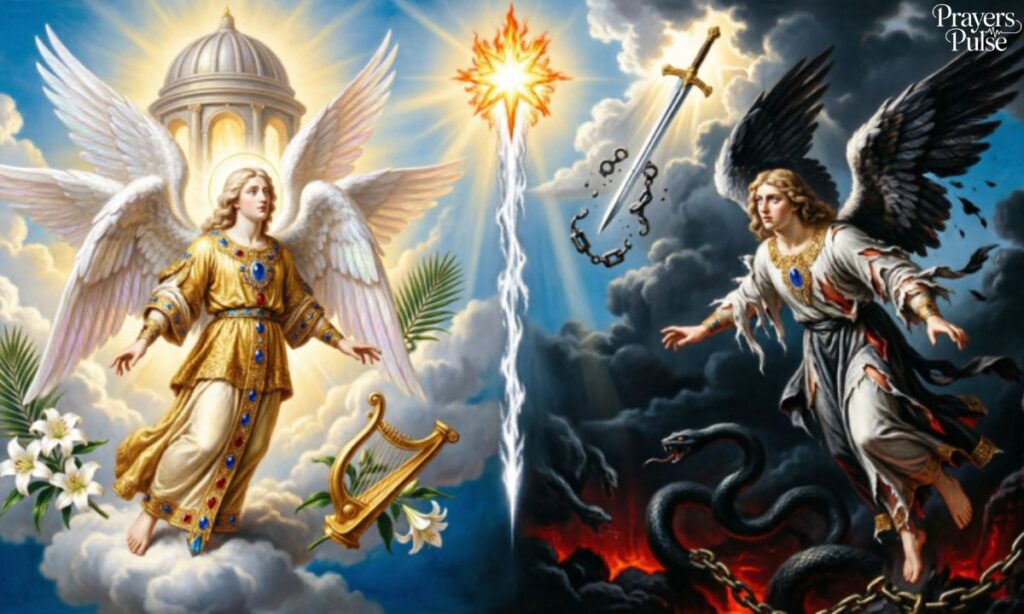
The popular narrative of Satan’s fall — a dramatic war in heaven, a rebel angel leading a third of the angels in revolt against God and being cast down — is partly biblical and partly interpretive tradition.
Luke 10:18 — Jesus says “I saw Satan fall like lightning from heaven.” This is one of the most direct statements about a fall, though scholars debate whether it refers to a prehistoric event or to a moment happening in the ministry of Jesus.
Revelation 12:7-9 describes war in heaven — Michael and his angels fighting the dragon and his angels. The dragon is cast to the earth along with his angels. This text is heavily debated. Some read it as a past event, some as future, some as a symbolic description of a spiritual reality.
Isaiah 14 and Ezekiel 28 are the passages most often used to describe the original fall, though both were addressed to human kings and their application to Satan is a matter of theological interpretation rather than explicit statement.
What the Bible clearly establishes is this:
- Satan was once in a position of glory and closeness to God
- Pride and the desire to exalt himself were the root of his corruption
- He was cast down from his original position
- He now operates in the world as an adversary to humanity
The mechanics of exactly when, how, and what the war in heaven looked like are not laid out in neat sequential detail anywhere in the Bible.
Does Satan Rule Hell?
This is one of the most persistent and most completely unbiblical ideas in popular culture. Satan does not rule hell in the Bible. He is destined for it.
Hell — or more precisely, the lake of fire described in Revelation — is not Satan’s domain. It is his punishment. Revelation 20:10 says the devil will be thrown into the lake of burning sulfur, where he will be tormented day and night forever and ever.
Satan is not the warden of hell. He is its future prisoner.
The Bible’s Satan roams the earth. He has access to the heavenly court in Job. He tempts Jesus in the wilderness. He works through human systems and structures. He is not sitting on a dark throne beneath the earth presiding over the suffering of the damned. That image comes from Dante’s Inferno and similar literary and artistic sources, not from scripture.
What Does Satan Actually Do According to Scripture?
Stripping away the mythology, here is what the Bible says Satan actively does:
- Accuses human beings before God — his most consistent biblical role
- Deceives — his most dangerous weapon
- Tempts — offering what people want in exchange for compromising what they believe
- Blinds minds — keeping people from seeing truth, particularly spiritual truth
- Roams — 1 Peter 5:8 says he prowls like a roaring lion looking for someone to devour
- Afflicts — he was given permission to afflict Job physically
- Influences — he entered Judas according to Luke 22:3
- Schemes — Paul warns about his schemes in Ephesians 6:11, suggesting a calculated, strategic adversary
- Masquerades — presenting himself as something he is not, as light rather than darkness
What he does not do, biblically speaking, is preside over hell, torture the dead, carry a pitchfork, or look frightening. His power is not brute force. It is deception, accusation, and strategic manipulation.
What Is Satan’s Ultimate Fate?
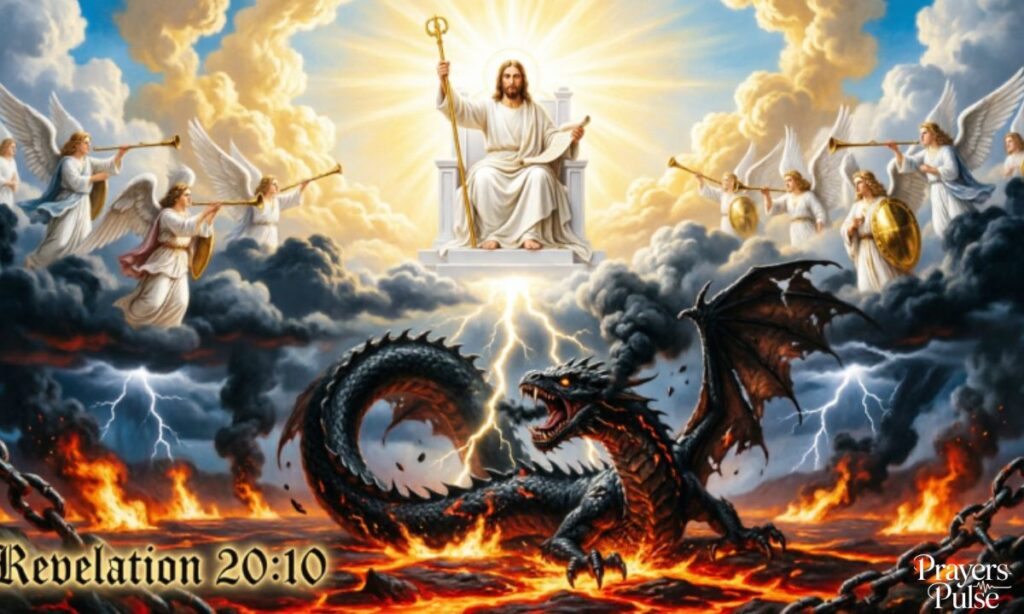
The Bible is clear on this point. Satan does not win. His ultimate end is laid out in Revelation 20:
- He is bound for a thousand years and thrown into the Abyss
- After a period of release, he deceives the nations one final time
- He is then thrown into the lake of fire and sulfur
- He is tormented there forever
There is no redemption arc for Satan in the Bible. There is no hint that he repents or changes. The trajectory of the biblical Satan from beginning to end is one of a magnificent being who chose corruption and whose corruption becomes more and more fully expressed until final judgment.
He is not tragic in a sympathetic sense. He is not misunderstood. He is not merely rebellious. He is, by the clear language of Jesus himself, a murderer and the father of lies. His end is sealed.
Why Does the Accurate Biblical Picture Matter?
Understanding the biblical Satan rather than the cultural caricature matters for several reasons.
First, a being you underestimate because he looks ridiculous is a being you are unprepared to recognize. The biblical warning about Satan is not that he is hideous — it is that he is convincing. He looks like an angel of light. He quotes scripture accurately. He offers real things. Picturing a cartoon villain does nothing to prepare you for that.
Second, the biblical Satan reveals something important about the nature of evil itself. Evil in scripture is not primarily monstrous and obvious. It is deceptive, strategic, and beautiful on the surface. It comes as wisdom, as opportunity, as logic. That is a far more sobering and useful picture of how evil actually operates in the world.
Third, the biblical picture is richer and more theologically serious than the pop culture version. A being of staggering original beauty who chose pride over relationship, who became the great accuser and deceiver, who roams a world under his temporary influence but faces certain ultimate defeat — that is a story with genuine weight.
The horned red figure with a pitchfork is not in the Bible. What is in the Bible is stranger, older, more luminous, and far more worth taking seriously.
Frequently asked questions
What Does “Biblically Accurate Satan” Mean?
It refers to how Satan is actually described in the Bible, rather than modern artistic depictions.
Is Satan Described as a Red Horned Figure in the Bible?
No, the Bible does not describe Satan as a red, horned, or pitchfork-holding being.
What Form Does Satan Take in Scripture?
He is often described symbolically as a serpent, a fallen angel, or a deceiver.
Is Satan a Fallen Angel According to the Bible?
Yes, many interpretations based on passages like Isaiah 14 and Ezekiel 28 suggest this idea.
Does the Bible Describe Satan’s Appearance Clearly?
No, his physical appearance is not clearly detailed in most biblical texts.
Why Is Satan Often Shown Differently in Art?
Artists added horns and red imagery over time based on cultural and mythological influences.
What Is Satan’s Role in the Bible?
He is portrayed as an adversary who tempts, deceives, and opposes righteousness.
Is Satan the Same as the Devil in the Bible?
Yes, “Satan” and “the Devil” are often used to refer to the same being.
Can Satan Take Different Forms in Scripture?
Yes, he is sometimes described as appearing in disguises or deceptive forms.
Why Is “Biblically Accurate Satan” So Misunderstood?
Because popular culture has reshaped the image far beyond the original biblical descriptions.
Conclusion
What Is the Biblically Accurate Satan? Exploring His True Role and Appearance in Scripture shows that Satan is primarily described in the Bible as a spiritual adversary, tempter, and accuser rather than a detailed physical being. His role is focused on challenging faith, misleading humanity, and opposing God’s will across various scriptures. The Bible emphasizes his actions more than a fixed visual appearance.
Ultimately, What Is the Biblically Accurate Satan? Exploring His True Role and Appearance in Scripture highlights that interpretations of his form are largely symbolic and varied across texts. What remains consistent is his function as a test of human faith and moral strength. This understanding encourages deeper reflection on scripture and spiritual awareness

Denzel is a passionate faith writer with four years of experience in prayer and Bible blogging. He now contributes has expertise to PrayersPulse.com, creating inspiring content that strengthens prayer life and deepens understanding of Scripture.