

Tristan Name Meaning in the Bible 2026: Origin, Biblical Significance & Spiritual Meaning explores the history, symbolism, and Christian perspective surrounding the name Tristan. Although Tristan is not mentioned directly in the Bible, it has gained popularity among Christian families because of its noble sound and the positive qualities often associated with it.
When reflecting on Tristan Name Meaning in the Bible 2026: Origin, Biblical Significance & Spiritual Meaning, many believers connect the name with virtues such as loyalty, courage, perseverance, and faithfulness. While its roots are traditionally linked to Celtic and medieval traditions rather than biblical texts, its symbolic meaning aligns well with many Christian values.
Tristan Meaning in Bible: Where It All Starts
- The search for Tristan’s meaning in the Bible is one that thousands of Christian parents begin every year when this beautiful name catches their attention and their heart at the same time.
- The starting point for understanding this name from a biblical perspective requires separating two important questions — does the name appear in Scripture, and does the name carry biblical meaning — because the answers to those two questions are completely different.
- Tristan does not appear anywhere in the biblical text, but its meaning, its themes, and its spiritual associations connect deeply and genuinely to the core of what the Bible teaches about the human experience of faith.
- The name most directly traces to the Celtic root Drust or Drustan, which carries the primary meaning of noise or tumult, and to the Old French word triste meaning sad or sorrowful which shaped how medieval Christian Europe understood the name.
- Christianity has never taught that sorrow is something to be avoided or ashamed of — in fact, the Bible treats sorrow as one of the most spiritually significant experiences a human being can have when it is processed through faith.
- Matthew 5:4 says plainly — “Blessed are those who mourn, for they will be comforted” — which reframes grief not as a spiritual problem but as a condition God specifically and personally meets.
- The starting place for understanding Tristan biblically is therefore not disappointment that the name lacks a scriptural address, but genuine appreciation for how deeply its themes resonate with the Bible’s most important teachings about suffering, endurance, transformation, and hope.
- Many of the most beloved Christian names used by believers throughout history — Trinity, Grace, Faith, Hope — do not appear as personal names in Scripture but carry profound biblical truth within their meaning.
- Tristan belongs in exactly that category — a name without a biblical address but with a biblical soul that resonates through centuries of Christian use and reflection.
- Where it all starts is in the honest recognition that this name carries themes the Bible treats with extraordinary seriousness and extraordinary tenderness at the same time.
Tristan Name Meaning Bible: Sorrow, Boldness, and Scripture
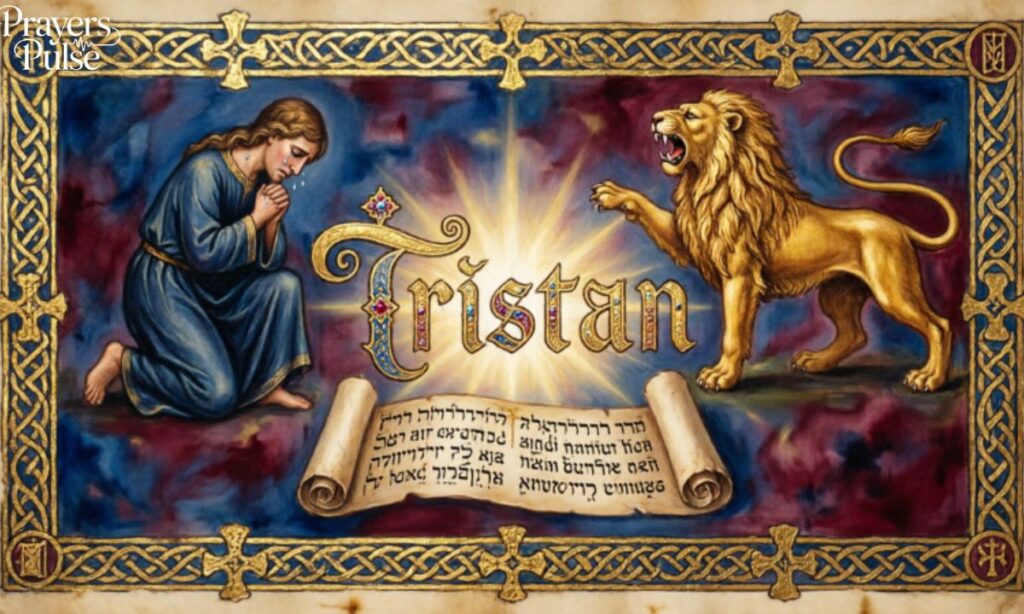
- The full spiritual picture of Tristan requires holding two seemingly opposite qualities together — sorrow and boldness — and understanding how Scripture consistently presents these two qualities not as opposites but as partners in genuine faith.
- The sorrow dimension of the name is the more immediately obvious one, rooted in the French triste and reinforced by the legendary story of Tristan and Isolde which is at its heart a story about love that costs everything.
- But the Celtic warrior root of the name carries an equally powerful dimension — tumult, noise, boldness, and the energy of someone who moves through the world with force and intention.
- These two qualities together — the capacity for deep sorrow and the courage for bold action — describe precisely what the Bible presents as the character of genuine, mature, tested faith.
- David wrote psalms of profound, raw, unashamed grief and also led armies with extraordinary courage — both were expressions of the same authentic relationship with God.
- Jeremiah wept openly over the destruction of Jerusalem and also stood boldly before kings who wanted him silenced — sorrow and boldness coexisting in the same faithful heart.
- Paul described being sorrowful yet always rejoicing in 2 Corinthians 6:10 — one of the Bible’s clearest statements that these two qualities not only coexist but actually need each other.
- The boldness dimension of Tristan connects also to the Ephesians 6 description of spiritual warfare — believers are called to stand firm, to put on the full armor of God, to resist with active and courageous faith.
- A warrior who feels deeply and fights bravely — that is the full picture the name Tristan paints when you hold both its Celtic and its French dimensions in view simultaneously.
- Scripture supports this complete picture from beginning to end — the heroes of faith in Hebrews 11 were people who experienced profound suffering and demonstrated extraordinary courage, often in the same season of their lives.
How Sorrow and Boldness Work Together in Biblical Faith
- In biblical faith, sorrow often deepens dependence on God, while boldness empowers believers to trust His promises and move forward with courage despite their struggles.
| Biblical Figure | Experience of Sorrow | Expression of Boldness | Scripture Reference |
| David | Wept deeply over Absalom and personal failure | Led armies and declared God’s faithfulness with passion | 2 Samuel 18:33, Psalm 27 |
| Jeremiah | Wept over Jerusalem and his own suffering | Stood before kings and proclaimed truth under threat | Lamentations 1:16, Jeremiah 26:12 |
| Paul | Described himself as sorrowful yet always rejoicing | Preached boldly in every city despite repeated imprisonment | 2 Corinthians 6:10, Acts 28:31 |
| Jesus | Was described as a man of sorrows and wept at Lazarus’s tomb | Cleansed the temple, confronted religious leaders, and went to the cross voluntarily | Isaiah 53:3, John 11:35, John 2:15 |
| Job | Lost everything and expressed raw anguish before God | Declared “though he slay me yet will I trust him” with absolute conviction | Job 1:20–21, Job 13:15 |
- This table shows that the combination of deep feeling and courageous action is not a contradiction in the biblical worldview — it is the consistent character of people walking in genuine and tested faith.
- The name Tristan carries both of these qualities within it, making it a name of genuine biblical resonance even without appearing on a single page of Scripture.
Tristan in the Bible: Is the Name Actually There?
- Let us address this question with complete clarity and honesty because parents deserve a straight answer — the name Tristan does not appear anywhere in the Bible.
- You will not find it in Genesis or Revelation, in the Gospels or the Epistles, in the historical books or the prophets — it is simply not there, and no creative interpretation changes that fact.
- The reason is straightforward and linguistic — the Bible was written in Hebrew, Aramaic, and Greek, and its names reflect the cultures of the ancient Middle East and Mediterranean world, not the Celtic cultures of Britain and northwestern France where Tristan originated.
- The name’s earliest form as Drustan or Drystan emerged in 5th-century Celtic Britain — roughly the same period when the biblical canon was being formally established, but in a completely separate cultural and linguistic world.
- However — and this is where the answer becomes genuinely interesting — the absence of a name from Scripture is not the same as the absence of biblical significance.
- The Bible contains a great deal of teaching about names, identity, and what names mean, and that teaching does not restrict Christian naming to a list of approved biblical names.
- What Scripture cares about regarding names is captured in passages like Genesis 2:19, Isaiah 43:1, and Revelation 2:17 — names matter, God knows people by name, and meaningful naming is a good and biblical practice.
- The question that actually matters for Christian parents is not whether Tristan appears in the concordance but whether choosing it honors God, reflects biblical values, and carries meaning worth declaring over a child’s life.
- By every one of those measures, Tristan qualifies completely — it carries themes of perseverance, transformation, faithful endurance, and the sorrow-to-joy arc that runs through Scripture from Genesis to Revelation.
- The New Testament name Christian does not appear in the Bible as a personal name before Acts 11:26 where followers of Jesus were first called Christians — yet Christians have used it as a given name for centuries without any theological controversy.
Names Commonly Used by Christians That Do Not Appear in the Bible
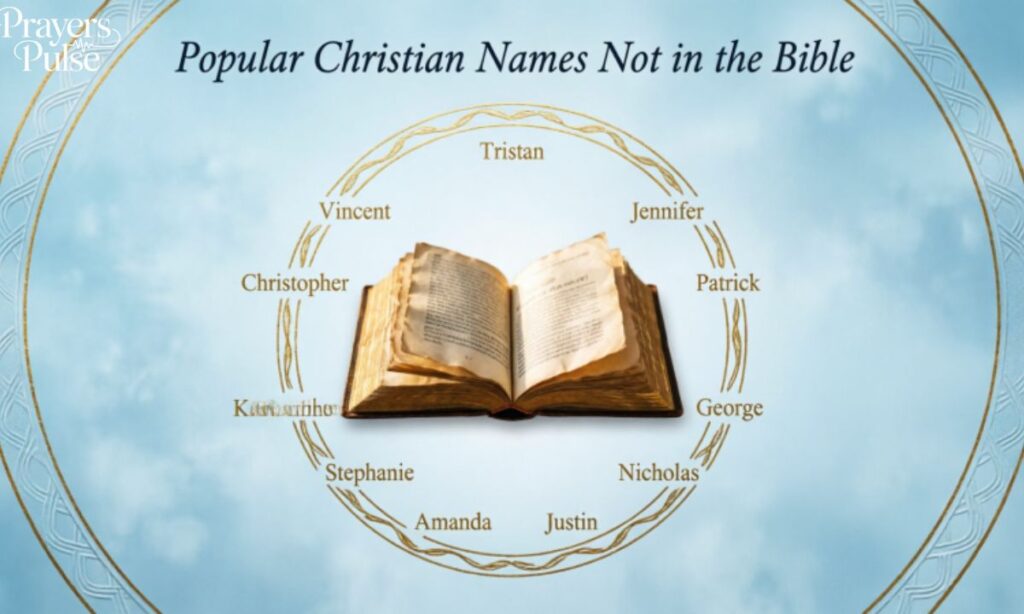
- Many names commonly used by Christians today—such as Tristan, Caleba, Madison, and Ethaniel—are not found in the Bible but are valued for their positive meanings, cultural significance, or Christian associations.
| Name | Meaning | Why Christians Use It | Biblical Principle It Reflects |
| Tristan | Sorrow / Tumult | Medieval Christian heritage, perseverance themes | Romans 5:3–5 — suffering produces character |
| Trinity | The threefold nature of God | Reflects core Christian doctrine | Matthew 28:19 — Father, Son, Holy Spirit |
| Christian | Follower of Christ | Directly declares faith identity | Acts 11:26 — disciples called Christians |
| Grace | Unmerited divine favor | Reflects central gospel concept | Ephesians 2:8 — saved by grace through faith |
| Faith | Trust in God | Names the foundational Christian virtue | Hebrews 11:1 — faith is the substance of things hoped for |
| Hope | Confident expectation in God | Names the theological virtue | Romans 8:24–25 — hope that is seen is not hope |
- This table demonstrates that Tristan is in genuinely excellent company — surrounded by names that Christians use widely and confidently despite none of them appearing as personal names in the biblical text itself.
Meaning of Tristan in the Bible: The Theology Behind the Name
- When you look at what the name Tristan means and then look at what the Bible teaches, what you find is not a gap between them but a remarkable and detailed alignment.
- The theology behind the name Tristan is essentially the theology of redemptive suffering — the biblical teaching that God does not waste pain, that difficulty has divine purpose, and that sorrow processed through faith produces something extraordinary.
- This is not a minor or peripheral biblical theme — it is one of the most central and consistently taught doctrines across both Old and New Testaments.
- The Old Testament builds this theology through the stories of Abraham, Joseph, Moses, David, Elijah, Jeremiah, and Job — every major figure experiences profound suffering that becomes the very ground from which their greatest contributions grow.
- The New Testament intensifies this theology through the cross — the central event of all human history which is simultaneously the greatest act of suffering ever endured and the greatest act of love ever demonstrated.
- 1 Peter 1:6–7 articulates it clearly — “In all this you greatly rejoice, though now for a little while you may have had to suffer grief in all kinds of trials. These have come so that the proven genuineness of your faith — of greater worth than gold, which perishes even though refined by fire — may result in praise, glory and honor when Jesus Christ is revealed.”
- The fire refining gold image is precisely the theological picture behind the name Tristan — not that the person named will be defined by sorrow, but that the sorrow they encounter will be the very thing God uses to refine them into something of extraordinary value.
- James 1:2–4 adds another dimension — “Consider it pure joy whenever you face trials of many kinds, because you know that the testing of your faith produces perseverance. Let perseverance finish its work so that you may be mature and complete, not lacking anything.”
- The word translated “complete” or “mature” in that passage is the Greek word teleios — it means brought to its intended end, fully formed, lacking nothing — and that is the destination the theology behind Tristan points toward.
- Hebrews 12:11 completes the picture — “No discipline seems pleasant at the time, but painful. Later on, however, it produces a harvest of righteousness and peace for those who have been trained by it.”
- The theology behind the name is therefore a theology of harvest — present pain that produces future abundance, present sorrow that produces future joy, present refining that produces future glory.
- No parent naming their child Tristan needs to apologize for choosing a name whose meaning includes sorrow — the Bible treats that sorrow as sacred ground where God consistently does His most significant work.
Tristen Name Meaning Bible: Same Soul, Different Spelling
- Tristen is simply an alternate spelling of Tristan that has developed primarily in American naming culture over the past few decades, and it carries identical meaning, identical origin, and identical spiritual significance.
- The spelling Tristen emerged as parents sought slight visual variation while maintaining the name’s essential sound and character — it is a common pattern in American naming where traditional spellings are adapted to feel more distinctive or more phonetically intuitive.
- From a biblical and spiritual perspective, there is absolutely no difference between Tristan and Tristen — the soul of the name, which is what matters theologically, remains completely unchanged across both spellings.
- Both spellings trace to the same Celtic root Drust or Drustan, both carry the sorrow and tumult meanings, both connect to the legend of Tristan and Isolde, and both resonate with the same biblical themes of perseverance, transformation, and endurance through faith.
- The spelling Tristen is sometimes chosen specifically for female bearers of the name because it visually reads as slightly softer and more gender-ambiguous than the more clearly historical Tristan spelling.
- Other spelling variations that parents encounter include Tristin, Tristyn, and Trystan — each representing a slightly different visual interpretation of the same fundamental name with the same foundational meaning.
- Trystan deserves particular mention because it is actually the closest to the original Welsh spelling, making it the most historically and linguistically authentic variation for families wanting to honor the name’s Celtic roots most directly.
- For Christian parents, the practical advice is clear — choose the spelling that feels most natural for your family, most comfortable to write and say, and most fitting for the child’s last name and family heritage.
- The biblical themes, the spiritual resonance, and the Christian significance do not belong to one spelling over another — they belong to the name itself in all its forms and variations.
- Whether you write Tristan, Tristen, Tristin, or Trystan on a birth certificate, you are giving your child a name with the same beautiful depth, the same rich history, and the same profound connection to the theology of transformation through trials.
Biblical Interpretations in Dreams or Real Life

- Some people encounter the name Tristan not through a naming decision but through a dream, a significant encounter, or a moment where the name appears in an unexpectedly meaningful way — and they want to understand what that might mean spiritually.
- The Bible takes the spiritual dimension of names very seriously — God renamed Abraham, Jacob, and others at pivotal moments of transformation, and names in Scripture frequently carry prophetic or interpretive significance beyond their surface meaning.
- If the name Tristan appears significantly in a dream or a meaningful life encounter for a believer, the most biblically grounded interpretation would center on the name’s core themes — sorrow giving way to joy, tumult resolving into peace, and struggle producing transformed character.
- This kind of encounter might be spiritually interpreted as a reminder that a current season of difficulty is purposeful, that the sorrow being experienced is not the end of the story, or that transformation is actively underway even when it is not yet visible.
- The sorrow dimension of the name appearing in a dream context might carry a message similar to Psalm 30:5 — “Weeping may stay for the night, but rejoicing comes in the morning” — an encouragement to hold on through the darkness because dawn is genuinely coming.
- The tumult or noise dimension might speak to a season of upheaval and change that feels chaotic but is actually the sound of God doing something significant — rearranging circumstances, breaking old patterns, or preparing the person for something larger.
- The warrior dimension might appear as a call to spiritual alertness and active resistance — a reminder from Ephesians 6 that the battle is real, the armor is available, and the believer has everything needed to stand firm.
- Dreams involving names should always be weighed carefully against Scripture, prayed over with sincerity, and if significant, discussed with a trusted pastor or spiritual mentor who can provide wisdom and accountability.
- The Bible does not provide a systematic dream dictionary, but it does teach that God communicates through various means including dreams — Numbers 12:6 says “I speak to them in dreams” — and that spiritual discernment applied to personal experience is both valid and encouraged.
- Whether the name appears in a dream, is being considered for a child, or is encountered in some other meaningful context, its spiritual message remains consistent — sorrow acknowledged, strength engaged, and transformation promised by the God who works all things together for good.
Practical Lessons and Faith Insights
- The name Tristan offers more than a pleasant sound and an interesting history — it contains practical spiritual lessons that are worth living by regardless of whether you personally carry the name or simply find its meaning compelling.
- Lesson one — embrace emotional honesty in faith. The sorrow embedded in Tristan’s meaning is a rebuke to the cultural pressure within some Christian circles to always appear fine, always project positivity, and never acknowledge struggle. The Bible never demands this pretense and the name Tristan quietly refuses it.
- Lesson two — sorrow is not the opposite of faith. Some believers feel that experiencing deep sadness is evidence of insufficient trust in God — but Tristan’s meaning, understood through Scripture, declares the opposite. Jesus wept. The Psalms are full of lament. Grief and faith coexist consistently and honestly throughout Scripture.
- Lesson three — noise and tumult can be divine. The tumult meaning of the name suggests that the most significant seasons of life are often the loudest, most disruptive, and most uncomfortable ones. God frequently does His deepest work in the seasons that feel most chaotic and least controlled.
- Lesson four — character is produced through trials, not around them. Romans 5 does not say that God protects believers from suffering but that He works through suffering to produce something genuinely valuable — perseverance, proven character, and hope. Tristan’s meaning points directly at this process.
- Lesson five — warrior faith is a legitimate and biblical expression. The Celtic warrior dimension of Tristan’s origin, reinterpreted through Ephesians 6, reminds believers that genuine Christian faith is not passive or gentle in the face of spiritual opposition. It is active, armed, and fully engaged.
- Lesson six — the destination of sorrow is joy. Tristan is not ultimately a sad name — it is a transformational name. The sorrow in its meaning is the beginning of the story, not the end. The end, according to Scripture, is rejoicing, restoration, and the morning joy that follows the night of weeping.
- Lesson seven — your story is part of a larger story. Every person who has carried the name Tristan through history has added to its accumulated meaning — and every believer whose life follows the pattern of sorrow to joy adds to the great testimony that God is faithful and His promises are true.
- These practical lessons are not attached specifically to people named Tristan — they are available to every believer willing to sit with the name’s meaning long enough to let its spiritual wisdom work its way into their understanding of how God moves and works in human lives.
Spiritual Meaning of the Name Tristan in Christianity
- The spiritual meaning of Tristan in Christianity is multi-layered, carefully built by centuries of Christian usage, theological reflection, and the accumulated testimony of believers who carried this name through seasons of genuine difficulty and genuine triumph.
- At the first and most foundational level, the spiritual meaning is transformation through suffering — the distinctively Christian conviction that God does not remove His people from difficulty but meets them in it, works through it, and uses it to produce something that ease and comfort could never create.
- At the second level, the spiritual meaning is the warrior’s devotion — the combination of Celtic warrior heritage and Christian spiritual warfare imagery that gives the name a quality of active, engaged, courageous faith rather than passive endurance.
- At the third level, the spiritual meaning is sacrificial love — drawn directly from the legend of Tristan and Isolde and its themes of devotion that costs everything, which medieval Christian thinkers saw as a reflection of Christ’s own self-giving love for humanity.
- At the fourth level, the spiritual meaning is honest emotional depth — a rejection of surface-level faith in favor of the kind of genuine, tested, sometimes raw relationship with God that the Psalms model throughout their 150 chapters.
- At the fifth level, the spiritual meaning is prophetic hope — declaring through a child’s name that whatever sorrow comes, whatever tumult arises, the story does not end there because the God of resurrection always has the final word.
- Together these five spiritual dimensions create a name that is genuinely rich in Christian meaning — not despite lacking a biblical address but because its themes so deeply and consistently align with what the Bible actually teaches about the life of faith.
- The spiritual meaning of Tristan in Christianity is ultimately the spiritual meaning of the gospel itself — that sorrow is real, that God meets us in it, that transformation is the purpose, and that joy is the destination.
Five Spiritual Dimensions of Tristan and Their Biblical Foundations
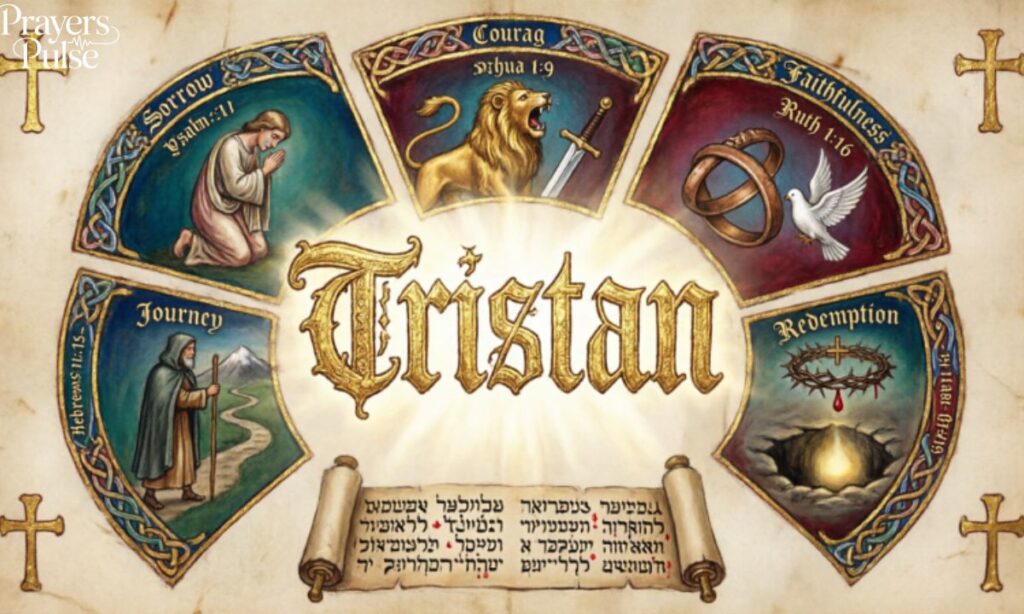
- The name Tristan can be linked to five spiritual dimensions—perseverance, courage, faith, redemption, and hope—each reflecting biblical principles demonstrated through the lives of God’s faithful servants.
| Spiritual Dimension | What It Means | Key Scripture |
| Transformation through suffering | God uses difficulty to produce character and hope | Romans 5:3–5 |
| The warrior’s devotion | Active, courageous, fully engaged faith in spiritual battle | Ephesians 6:10–18 |
| Sacrificial love | Self-giving devotion that mirrors Christ’s love for the church | John 15:13 |
| Honest emotional depth | Authentic, unperformed faith that brings everything to God | Psalm 62:8 — pour out your hearts to him |
| Prophetic hope | Declaring through the name that sorrow never has the final word | Psalm 30:5 |
Bible Verses That Reflect the Meaning of Tristan
- Even though the name Tristan does not appear in Scripture, specific Bible verses reflect its meaning so powerfully and so directly that they function almost as the name’s spiritual reference points.
- Romans 5:3–5 — “We also glory in our sufferings, because we know that suffering produces perseverance; perseverance, character; and character, hope.” — This is perhaps the single most relevant passage to what the name Tristan declares over a life. It is the complete arc from sorrow to hope in four connected steps.
- Isaiah 53:3 — “He was despised and rejected by mankind, a man of suffering, and familiar with pain.” — Christ himself bore the quality embedded in this name’s meaning, making sorrow not shameful but sacred and redeemed.
- Psalm 30:5 — “Weeping may stay for the night, but rejoicing comes in the morning.” — The entire Tristan story — sorrow that gives way to joy — in a single verse of extraordinary beauty and comfort.
- James 1:2–4 — “Consider it pure joy whenever you face trials of many kinds, because you know that the testing of your faith produces perseverance. Let perseverance finish its work so that you may be mature and complete.” — Testing produces maturity — exactly the spiritual promise embedded in the name.
- 2 Corinthians 12:9 — “My grace is sufficient for you, for my power is made perfect in weakness.” — Strength emerging from the very weakness the name acknowledges — God’s power revealed precisely in the sorrow and tumult the name carries.
- John 16:33 — “In this world you will have trouble. But take heart! I have overcome the world.” — Both realities held together — the trouble is real and the victory is certain — which is exactly what Tristan declares.
- Lamentations 3:22–23 — “The steadfast love of the Lord never ceases; his mercies never come to an end; they are new every morning.” — Written by Jeremiah, the prophet of sorrow, in the middle of Jerusalem’s greatest catastrophe — yet declaring God’s faithfulness with absolute conviction.
- Genesis 50:20 — “You intended to harm me, but God intended it for good.” — Joseph’s declaration after years of sorrow, injustice, and seemingly abandoned promises — the ultimate biblical statement of redemptive transformation.
- 1 Peter 1:6–7 — “Though now for a little while you may have had to suffer grief in all kinds of trials… so that your faith — of greater worth than gold, which perishes even though refined by fire — may result in praise, glory and honor.” — Gold refined through fire — the image of a life purified and made valuable precisely through the process the name Tristan symbolizes.
- Revelation 21:4 — “He will wipe every tear from their eyes. There will be no more death or mourning or crying or pain, for the old order of things has passed away.” — The ultimate destination of every experience of sorrow — complete and eternal healing in the presence of God.
Character Traits Associated With the Name Tristan
- Names shape perception — both the perception others have of a person and the perception a person develops of themselves over time — and Tristan consistently evokes a specific and genuinely admirable set of character qualities.
- Emotional depth is the most universally associated quality — people named Tristan are consistently perceived as individuals who feel things at a level that goes beyond surface experience and who process their lives with genuine thoughtfulness and reflection.
- Loyalty appears just as consistently — the legendary association with Tristan’s devoted love for Isolde has given the name a permanent association with faithfulness, commitment, and the kind of devotion that does not waver under pressure.
- Creative intelligence is another trait commonly associated with the name — perhaps because of its deep connection to literary and musical tradition, Tristans are frequently perceived as imaginative, expressive, and drawn toward artistic or creative forms of engagement with the world.
- Quiet confidence rounds out the perception — not the loud, attention-seeking confidence of someone performing for an audience but the settled, composed assurance of someone who knows who they are and does not need external validation to maintain that knowledge.
- Resilience is closely connected to the sorrow dimension of the name’s meaning — people intuitively associate Tristan with someone who has been through real difficulty and come through it with their character intact and their faith strengthened.
- Sensitivity without fragility is perhaps the most nuanced trait — the name suggests someone capable of deep feeling who is not destated by that sensitivity but rather made stronger and more compassionate through it.
- From a Christian character perspective, these traits align beautifully with what Galatians 5:22–23 calls the fruit of the Spirit — love, joy, peace, patience, kindness, goodness, faithfulness, gentleness, and self-control — qualities that grow specifically through the tested, refined, sorrow-to-joy journey the name represents.
- The warrior dimension adds complementary traits — courage, determination, the willingness to engage rather than retreat, and the spiritual boldness that Ephesians 6 calls every believer to express.
- Together, the character portrait associated with Tristan is of someone emotionally honest, courageously faithful, creatively engaged, deeply loyal, and increasingly mature through the trials they encounter and navigate with God’s grace.
Is Tristan a Good Christian Name for a Baby?
- The honest, considered, and thoroughly supported answer to this question is — yes, absolutely, and with confidence.
- Tristan is a genuinely excellent Christian name for a baby for multiple overlapping reasons that hold up under theological, practical, and cultural examination.
- Theologically, the name carries themes of perseverance, transformation, endurance, sacrificial love, and the sorrow-to-joy arc that is essentially the shape of the gospel story itself.
- Historically, the name has been carried by Christian families across multiple centuries and multiple denominational traditions without controversy or theological concern.
- Practically, the name is immediately pronounceable, consistently spelled correctly by new acquaintances, and works effectively across every social, educational, and professional context a person will encounter across a lifetime.
- Culturally, Tristan occupies the ideal space for a name in 2026 — distinctive enough to be memorable and personal, familiar enough to be received comfortably, and not so trendy that it will feel dated in a decade.
- Spiritually, naming a child Tristan is an act of honest, courageous faith — it acknowledges that life will include difficulty while simultaneously declaring that God transforms every difficulty into something that serves His extraordinary purposes.
- Some parents hesitate because of the sorrow dimension of the meaning, but those parents benefit from understanding the name through Romans 5 rather than through a purely secular interpretation of sadness as purely negative.
- In Christian theology, sorrow is not the enemy — it is the terrain through which some of God’s greatest work in human lives consistently takes place, and a name that carries that awareness is not a burden but a blessing.
- Parents who value emotional honesty, spiritual depth, historical richness, and a faith that does not pretend life is always easy will find Tristan to be one of the most theologically aligned and personally resonant name choices available to them.
- The name will serve a child well in every season of life — it carries enough depth for the hard times, enough beauty for the good times, and enough character to age gracefully through every decade between them.
- Choose it with confidence, pray over it with sincerity, and give it to your child as a declaration that their life will be one of genuine faith — tested, transformed, and ultimately triumphant.
Final Thoughts on Tristan Name Meaning in the Bible
- The journey through Tristan’s biblical and spiritual meaning arrives at a destination that is genuinely richer and more beautiful than most people expect when they begin the search.
- What begins as a question — does this name have biblical roots — becomes a discovery that the name’s themes are woven through Scripture from beginning to end, even though the name itself never appears on a biblical page.
- Tristan teaches a lesson that extends far beyond naming — it teaches that biblical significance is not limited to biblical vocabulary, that God’s truth is wide enough and deep enough to be reflected in names, stories, and traditions that emerged far beyond the geographic and cultural boundaries of the ancient Near East.
- The sorrow meaning that initially gives some Christian parents pause is, when understood through Romans 5, James 1, and 1 Peter 1, not a weakness in the name but its greatest spiritual strength.
- A name that acknowledges the reality of pain while pointing toward the certainty of transformation is a name that tells the truth about human experience and about God’s response to that experience — and telling the truth is always a biblical and holy act.
- The warrior dimension adds a complementary boldness that prevents the name from being merely melancholy — it is sorrow combined with strength, grief combined with courage, sensitivity combined with the active, engaged, armored faith that Ephesians 6 calls every believer to live.
- The centuries of Christian history behind this name — the monks who preserved its legend, the knights who carried it into battle, the families across every generation and every denomination who gave it to their sons and daughters — add a weight and a richness that no newly invented name can replicate or approximate.
- In 2026, when authentic faith is increasingly valued over performed religion and emotional honesty is recognized as a spiritual strength rather than a spiritual failure, Tristan is precisely the kind of name that reflects where the most thoughtful Christian families are in their faith journey.
- If you are choosing this name for your child, you are giving them something genuinely rare — a name that will feel true on the easy days and even truer on the hard ones, a name with a story worth telling, and a name whose deepest meaning points consistently and reliably toward the God who transforms sorrow into joy.
Frequently asked questions
What Does Tristan Mean in the Bible in 2026?
Tristan does not have a direct biblical meaning because the name is not mentioned in Scripture.
Is Tristan a Biblical Name?
No, Tristan is not found in the Bible and is not considered a traditional biblical name.
What Is the Origin of the Name Tristan?
The name Tristan is believed to have Celtic and medieval European origins.
Does Tristan Have a Hebrew Meaning?
No, Tristan does not have a recognized Hebrew origin or meaning in biblical texts.
Can Tristan Have a Christian Meaning?
Yes, many Christians associate the name with qualities such as loyalty, courage, and perseverance.
Why Do People Search for Tristan’s Biblical Meaning?
They often want to know if the name has spiritual significance or a connection to Christian values.
Is Tristan a Good Name for Christian Families?
Yes, many Christian parents choose Tristan because of its strong character associations and timeless appeal.
Are There Bible Characters Similar to Tristan’s Traits?
Biblical figures known for faithfulness, bravery, and integrity share qualities often linked to Tristan.
What Personality Traits Are Associated With Tristan?
The name is commonly associated with strength, honor, determination, and compassion.
What Is the Main Biblical Perspective on the Name Tristan?
Although Tristan is not a biblical name, it can still reflect virtues and values that align with Christian teachings.
Conclusion
Tristan Name Meaning in the Bible 2026: Origin, Biblical Significance & Spiritual Meaning explores the rich background of a name that continues to captivate people with its timeless appeal. Although Tristan is not mentioned directly in the Bible, many associate it with qualities such as courage, loyalty, strength, and perseverance—virtues that are deeply valued in Christian teachings.
Ultimately, Tristan Name Meaning in the Bible 2026: Origin, Biblical Significance & Spiritual Meaning highlights how a name can carry both cultural heritage and spiritual inspiration. By connecting its origin with biblical values and Christian insights, Tristan becomes more than just a name—it becomes a reflection of noble character and faith-driven principles.

Denzel is a passionate faith writer with four years of experience in prayer and Bible blogging. He now contributes has expertise to PrayersPulse.com, creating inspiring content that strengthens prayer life and deepens understanding of Scripture.