

Tristan Meaning in the Bible: Biblical Significance, Spiritual Symbolism & Christian Insights explores whether the name Tristan has a direct connection to Scripture and what spiritual lessons can be drawn from it. While Tristan does not appear in the Bible, many Christians appreciate the name for its associations with courage, loyalty, and enduring faith. Its timeless appeal has made it a meaningful choice for families seeking a name with positive values.
When reflecting on Tristan Meaning in the Bible: Biblical Significance, Spiritual Symbolism & Christian Insights, the focus is often on the character traits the name can represent rather than a specific biblical reference. Many believers connect Tristan with qualities such as strength, devotion, perseverance, and integrity—virtues that align with Christian teachings. These symbolic meanings allow the name to carry spiritual significance while encouraging a life rooted in faith, wisdom, and godly character.
What Does the Name Tristan Mean?
- The core meaning of Tristan centers on two powerful and interrelated concepts — sorrow and tumult — depending on which linguistic tradition you follow.
- At first hearing, sorrow sounds like a heavy thing to attach to a baby’s name, but Christian theology sees this very differently from how the secular world does.
- Romans 5:3–5 teaches directly that suffering produces perseverance, perseverance produces character, and character produces hope — making sorrow not an endpoint but a beginning.
- The name does not declare that your child will live a sad life — it declares that your child will be someone who has the depth, resilience, and faith to walk through difficulty and emerge transformed.
- Think of Joseph in Genesis — sold into slavery by his own brothers, wrongly imprisoned for years, yet ultimately elevated to a position that saved entire nations from starvation.
- His story is the perfect living illustration of what Tristan symbolizes — the journey from genuine darkness into extraordinary, God-orchestrated light.
- Most people in the Western world first encounter the name through the medieval legend of Tristan and Isolde — one of history’s most enduring romantic stories built on themes of loyalty, sacrifice, and devoted love.
- These are qualities that Christian parents deeply value — faithfulness, self-giving love, and the courage to remain devoted even when circumstances become extraordinarily difficult.
- The spiritual meaning of Tristan encompasses emotional authenticity, resilience through hardship, genuine transformation through trials, noble character development, and faithful endurance through seasons that do not make immediate sense.
- Parents who choose this name often do so precisely because they refuse to pretend that life with God is always easy — they want a name that reflects honest, tested, and ultimately victorious faith.
Etymology and Historical Origins of Tristan
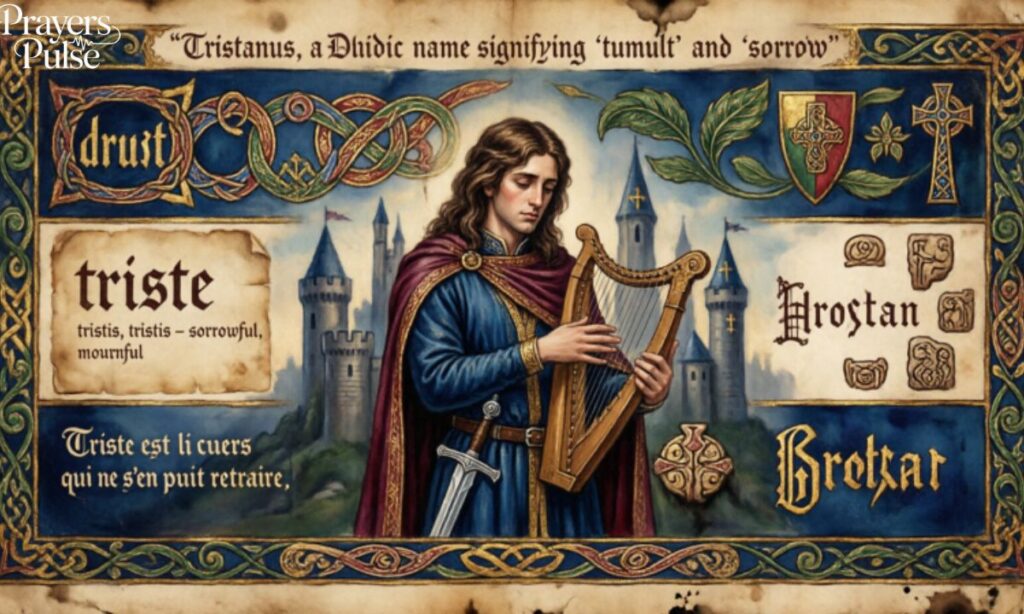
- The name’s linguistic journey is genuinely fascinating and covers well over a thousand years of development across multiple cultures and faith traditions.
- Its earliest documented form is Drystan or Drustan, emerging from Celtic Wales and Cornwall during the 5th century — a period when Celtic Britain was undergoing profound transformation through the arrival of Christian missionaries.
- French medieval scholars later adapted the name and connected it to the Latin word tristis, meaning sad or sorrowful — and this Latin meaning became deeply embedded in how the name was understood throughout medieval Europe.
- Importantly, medieval Christian communities did not view sorrow negatively — Jesus himself said in Matthew 5:4, “Blessed are those who mourn, for they will be comforted,” which reframes grief as something God specifically honors and meets.
- The name traveled through Christian monasteries where monks preserved Celtic legends while simultaneously infusing them with Christian symbolism and theological reflection.
- These monastic scholars saw in the Tristan story a genuine reflection of Christian truths — sacrifice, devotion, and love that costs everything — and preserved it accordingly.
Timeline of the Name’s Development
| Period | Form of Name | Region | Primary Influence |
| 5th Century | Drystan / Drustan | Celtic Britain | Pre-Christian Celtic warrior culture |
| 12th Century | Tristran | France | Latin adaptation through Arthurian romance literature |
| 14th Century | Tristan | Across Europe | Medieval Christian literary tradition |
| 19th Century | Tristan | Europe and beyond | Wagner’s revolutionary opera Tristan und Isolde |
| Modern Era | Tristan | Global | Contemporary Christian and secular naming culture |
- The Celtic warrior origin is also spiritually significant because Ephesians 6 describes believers as soldiers of Christ equipped for spiritual warfare — a warrior name fits this theological picture beautifully.
- Each era added layers of meaning to the name without erasing what came before, creating the remarkably rich and complex name that Christian families encounter today.
Is Tristan Mentioned in the Bible?
- The direct and honest answer is clear — no, Tristan is not mentioned anywhere in the Bible, neither in the Old Testament nor the New Testament.
- The Bible was written entirely in Hebrew, Aramaic, and Greek — not Celtic languages — and the names it contains reflect Middle Eastern and Mediterranean cultures rather than European Celtic traditions.
- However, the absence of a name from Scripture absolutely does not diminish its spiritual value or its suitability for Christian families, and church history confirms this clearly.
- Many deeply beloved Christian names are not found anywhere in Scripture — consider Trinity, which represents core Christian doctrine, or Grace and Faith, which are biblical virtues rather than biblical people.
- The Protestant Reformation never established a requirement that children must be named after biblical figures — what matters is whether a name’s meaning and themes align with biblical principles and Christian values.
- David, Job, and Jeremiah are biblical names that appear throughout Scripture — Tristan is not — but the themes those biblical figures embodied — suffering, perseverance, and ultimate triumph through God — are exactly the themes Tristan carries.
- Catholic and Anglican traditions have always embraced saints’ names that never appeared in the Bible itself — Saint Patrick, whose name has no biblical origin, is honored by Christians worldwide without any controversy.
- The key question is not whether a name appears in a Bible concordance but whether it reflects Christian character, biblical values, and a faith perspective that honors God — and Tristan passes that test comprehensively.
Spiritual Significance of the Name Tristan
- The spiritual meaning of Tristan connects powerfully and directly to core Christian theology in ways that repay careful reflection.
- Isaiah 53:3 describes Jesus Christ himself as “a man of sorrows, acquainted with deepest grief” — meaning that sorrow, far from being un-Christian, is embedded in the very character of the Savior.
- This redemptive suffering is not an embarrassing footnote to Christianity — it is the very foundation of the entire gospel story, the cross before the resurrection, the Friday before the Sunday.
- Romans 5:3–4 is perhaps the most directly relevant passage — “We also glory in our sufferings, because we know that suffering produces perseverance; perseverance, character; and character, hope.”
- The name Tristan, understood through this theological lens, is not a declaration of sadness but a declaration of the entire arc from struggle to character to hope — which is the Christian journey itself.
- Consider the pattern running through every major biblical figure and you will see the same story Tristan symbolizes — sorrow that leads not to defeat but to transformation and ultimate victory.
- Job declared “though he slay me, yet will I trust in him” — perseverance through pain that produced restoration beyond what he could have imagined.
- Joseph endured betrayal, slavery, and false imprisonment before being elevated to save nations — every year of suffering was God’s preparation, not God’s abandonment.
- David fled from Saul for years, lived in caves, and experienced profound personal failure — yet became the man after God’s own heart whose throne God promised to establish forever.
- Psalm 30:5 captures the entire arc in a single verse — “Weeping may stay for the night, but rejoicing comes in the morning” — and that verse is essentially the spiritual biography of the name Tristan.
Christian Symbolism and Faith Connections
- Tristan carries Christian symbolism at multiple levels that become richer the more carefully you examine them.
- The cross itself is the ultimate symbol of transformation through suffering — what looked like Friday’s defeat became Sunday’s resurrection, and this exact pattern is what the name Tristan embodies and declares.
- The medieval Christian interpretation of the Tristan and Isolde legend was not merely romantic in the surface sense — monks and theologians saw it as a picture of the soul’s deep longing for divine union with God.
- 2 Corinthians 12:9 gives one of the Bible’s most powerful statements about strength through weakness — God told Paul, “My grace is sufficient for you, for my power is made perfect in weakness” — and that verse is the theological heart of what this name represents.
- 1 Peter 1:7 uses the image of gold refined through fire to describe how trials purify faith — and that same refining fire symbolism is embedded in the entire spiritual tradition surrounding the name.
- The progression of Christian symbolism within the name works through five clear stages — acknowledgment that life includes genuine sorrow, endurance sustained by faith, transformation as God works all things together for good, victory as overcoming produces maturity, and testimony as the story encourages others.
- Ephesians 6 describes believers as armored soldiers prepared for spiritual warfare — and Tristan’s Celtic warrior heritage merges beautifully with this New Testament military symbolism in a way that gives the name additional theological depth.
- Augustine of Hippo, one of Christianity’s greatest thinkers, wrote extensively about the journey from restlessness to rest, from sorrow to peace — and the spiritual arc he described matches precisely what the name Tristan represents across its centuries of use.
Tristan in Biblical History and Tradition
- There is an important distinction worth establishing clearly — biblical history covers events recorded in Scripture, while Christian tradition encompasses the church’s 2,000 years of development beyond those recorded events.
- Tristan does not appear in biblical history, but it has a genuinely rich place in Christian tradition — and that tradition deserves respect and recognition.
- Celtic Christianity was one of the most spiritually significant movements in the history of Western European faith — the church that developed in Ireland, Scotland, and Wales shaped an entire continent’s relationship with God.
- The monks who preserved the Arthurian legends, including the story of Tristan, were not doing something contrary to their faith — they were applying their faith’s interpretive lens to cultural narratives and finding genuine Christian truth within them.
- Medieval Christian communities saw the Tristan story through the lens of loyalty reflecting devotion to Christ, sacrificial love mirroring Christ’s own sacrifice, moral struggle representing spiritual warfare, redemption themes echoing the gospel, and noble character development reflecting the fruit of the Spirit.
- The Protestant Reformation never rejected non-biblical names — Martin Luther and John Calvin both emphasized biblical principles over biblical precedents, and that distinction created space for names like Tristan to flourish in Protestant communities.
- Throughout the medieval period, the name appeared among both nobility and common families across Celtic regions of Europe, and each generation that carried it added to its accumulated Christian legacy.
Key Bible Verses That Connect With the Name Tristan
- Even though Tristan does not appear in Scripture, specific biblical passages resonate so powerfully with its meaning that they almost serve as the name’s spiritual foundation.
- Romans 5:3–5 — “We also glory in our sufferings, because we know that suffering produces perseverance; perseverance, character; and character, hope.” This is perhaps the single most directly relevant passage to what the name declares.
- Isaiah 53:3 — “He was despised and rejected by mankind, a man of suffering, and familiar with pain.” The Savior himself bears the qualities embedded in this name’s meaning.
- Psalm 30:5 — “Weeping may stay for the night, but rejoicing comes in the morning.” The entire arc from sorrow to joy that Tristan embodies in a single verse.
- 2 Corinthians 12:9 — “My grace is sufficient for you, for my power is made perfect in weakness.” Strength through the very struggles the name acknowledges.
- James 1:2–4 — “Consider it pure joy whenever you face trials of many kinds, because you know that the testing of your faith produces perseverance.” The testing that produces mature faith — this is the name’s spiritual promise.
- John 16:33 — “In this world you will have trouble. But take heart! I have overcome the world.” Jesus promises both the reality of difficulty and the certainty of ultimate victory.
- Lamentations 3:22–23 — “The steadfast love of the Lord never ceases; his mercies never come to an end; they are new every morning.” The prophet of sorrow who still proclaims God’s faithfulness.
- Genesis 50:20 — “You intended to harm me, but God intended it for good.” Joseph’s declaration that reframes every experience of sorrow as part of God’s larger redemptive purpose.
Biblical Names Similar to Tristan
- While Tristan does not appear in Scripture, several biblical figures embodied the exact themes the name carries — and examining their stories deepens the spiritual meaning considerably.
Comparison of Biblical Characters Whose Stories Mirror Tristan’s Themes
| Biblical Figure | Name Meaning | Core Theme | Connection to Tristan |
| Job | Persecuted | Suffering refined by unwavering faith | Sorrow endured without abandoning God |
| Jeremiah | God will uplift | Prophetic sorrow mixed with unshakeable hope | Weeping that still declares God’s faithfulness |
| Joseph | He will add | The pit-to-palace transformation journey | Darkness that becomes God’s platform for destiny |
| Thomas | Twin | Honest doubt that leads to profound faith | The journey from confusion to clear conviction |
| Lazarus | God has helped | Death to life resurrection symbolism | Sorrow that ends in miraculous restoration |
| David | Beloved | Suffering and failure that produce wisdom | A heart tested and proven through years of difficulty |
- Job provides the clearest biblical parallel — he lost everything that mattered, expressed his anguish with complete honesty before God, and never abandoned his faith even in the darkest valley.
- Jeremiah, known as the weeping prophet, delivered the most heartbreaking messages imaginable and suffered rejection, imprisonment, and profound loneliness — yet he wrote Lamentations 3:22 declaring that God’s mercies never end.
- Joseph is the ultimate sorrow-to-joy story — betrayed by family, enslaved, falsely accused, forgotten in prison — yet telling his brothers that what they intended for harm, God intended entirely for good.
- Thomas shows that honest struggle with doubt is not the opposite of faith but can become its most powerful expression — his declaration “My Lord and my God” came directly out of his willingness to wrestle honestly with what he did not yet understand.
The Origin of Tristan in Celtic and Christian Culture
- The relationship between Celtic culture and Christian faith is one of the most beautiful stories in church history — not a story of erasure but a story of transformation and redemption.
- When Christianity arrived in Celtic Britain during the 5th century, missionaries like Saint Patrick did not demand that existing culture be completely abandoned and replaced with foreign traditions.
- Instead, they did something profoundly wise — they redeemed and transformed what was already there, finding the places where Celtic values aligned with Christian truth and building from those points of genuine connection.
- Patrick famously used the shamrock to explain the Trinity — he did not import a foreign image but transformed a local one into a vehicle for eternal truth.
- The name Tristan followed exactly this pattern — a Celtic warrior name that carried values of strength, loyalty, and courage was gradually reinterpreted through Christian faith to carry those same values in a spiritual rather than purely physical sense.
How Celtic Cultural Values Were Transformed Into Christian Virtues
| Pre-Christian Celtic Value | Christian Reinterpretation | Biblical Basis |
| Warrior physical strength | Spiritual warfare and armor of God | Ephesians 6:10–18 |
| Tribal loyalty and devotion | Faithfulness to Christ above all else | Ruth’s devotion to Naomi |
| Physical courage in battle | Moral fortitude in spiritual struggle | David standing before Goliath |
| Noble lineage and heritage | Royal priesthood in Christ | 1 Peter 2:9 |
| Honor through sacrifice | Cross and resurrection symbolism | Luke 9:23 |
- Celtic Christian names that followed this same pattern of cultural transformation include Brendan, Columba, Aidan, and Patrick — all of them names with pre-Christian roots that became thoroughly Christian through use, meaning, and the lives of the people who bore them.
- The Apostle Paul demonstrated this cultural transformation approach at Mars Hill in Acts 17 — engaging with existing culture rather than dismissing it, and finding the place where it pointed toward the God it did not yet fully know.
- Tristan’s journey from Celtic warrior culture into Christian naming tradition is itself a beautiful example of the gospel’s transforming power.
Tristan Name Meaning in Hebrew and Greek
- While Tristan has no direct biblical Hebrew or New Testament Greek equivalent, the concepts and themes it carries are richly expressed in both biblical languages in ways that illuminate its spiritual depth.
Hebrew Concepts That Resonate With Tristan’s Meaning
- עָצַב (atsab) — This Hebrew verb meaning “to hurt” or “to grieve” appears when describing genuine human suffering in Scripture, acknowledging pain while recognizing God’s sovereign presence within it.
- חֹזֶק (chozeq) — Meaning “strength” or “might,” this word appears throughout Scripture as God repeatedly instructs His people to be strong and courageous — genuine strength that emerges specifically through trials.
- גִּבּוֹר (gibbor) — Meaning “mighty warrior” or “hero,” this was the title given to David’s most courageous soldiers — connecting powerfully to Tristan’s warrior heritage reinterpreted through the lens of spiritual courage.
- תְּשׁוּעָה (teshuah) — Meaning “salvation” or “deliverance,” this word represents the hope that makes enduring sorrow not just possible but genuinely meaningful and purposeful.
Greek Spiritual Terms That Illuminate the Name’s Meaning

- θλῖψις (Thlipsis) — “Tribulation” or “affliction,” the exact word Paul uses in Romans 5:3 when he says believers rejoice in their sufferings — active, meaningful engagement with difficulty rather than passive resignation.
- ὑπομονή (Hypomone) — “Patient endurance” or “steadfastness,” the quality James 1:2–4 says testing produces — the same quality embedded in the name Tristan’s spiritual meaning.
- δοκιμή (Dokime) — “Proven character” — the gold-refined-through-fire quality that comes specifically from endurance, not from ease or comfort.
- χαρά (Chara) — “Joy” — the transformation’s destination, not circumstantial happiness but deep-rooted confidence in God’s goodness that cannot be shaken by changing circumstances.
- νικάω (Nikao) — “To overcome” or “to conquer,” the victory language used repeatedly in Revelation for those who endure faithfully — the warrior’s ultimate triumph.
- μεταμορφόω (Metamorphoo) — “To transform” or “to transfigure,” appearing in Romans 12:2 to describe the complete spiritual transformation that is the ultimate destination of the sorrow-to-joy journey Tristan represents.
The Cultural and Religious Impact of the Name Tristan
- The name Tristan has influenced not just individual families but broader Christian cultural conversations about naming, identity, and the relationship between faith and cultural heritage.
- Its popularity in Christian communities reflects a growing desire among believers for names that feel emotionally authentic and spiritually honest rather than artificially cheerful or surface-level positive.
- Regional patterns in Christian communities show interesting and consistent trends — Southern United States families appreciate its Celtic heritage and traditional values, Midwestern families value its meaningful depth, Australian families maintain the British cultural connection, Canadian bilingual communities appreciate its natural French resonance, and European families particularly in Ireland, Scotland, and Wales maintain its deepest roots.
- The name has achieved something rare — cross-denominational acceptance that works equally well in evangelical Protestant, Catholic, Anglican, and nondenominational contexts without carrying any denominational baggage.
- Every denomination and tradition within Christianity recognizes the theological truth that trials produce character, and that shared recognition gives Tristan universal Christian resonance.
- Youth ministry leaders consistently report positive associations with the name — it carries no negative cultural baggage, no problematic associations, and no social friction that creates difficulty for young people navigating peer relationships.
- Academic research on name psychology suggests that names perceived as carrying strength and emotional depth correlate with positive identity formation in children — Tristan scores well on both dimensions.
What the Bible Teaches About Names and Identity
- Scripture reveals that names are far more than convenient labels — they carry weight, reflect character, declare destiny, and participate in the larger story God is writing through individual lives.
- Genesis 2:19–20 shows God bringing the animals to Adam for naming — this was not a trivial exercise but an expression of the authority, creativity, and image-bearing capacity God built into humanity.
- God takes naming so seriously that He personally names people throughout Scripture — He called Abraham by name, called Moses from the burning bush, called Samuel repeatedly in the night, and Jesus called Lazarus out of the tomb by name.
- Isaiah 43:1 declares one of Scripture’s most intimate promises — “I have called you by name, you are mine” — God’s knowledge of us by name is a statement of belonging, relationship, and covenant love.
- Some of the most significant moments in biblical history involved God renaming someone to reflect a transformation that had occurred or was about to occur.
- Abram became Abraham — from “exalted father” to “father of many nations” — a name change declaring a promise larger than anything the man’s circumstances suggested at the time.
- Jacob became Israel — from “supplanter” to “one who wrestles with God” — a name change acknowledging an encounter that permanently altered both his walk and his identity.
- Simon became Peter — from “reed” to “rock” — a name change declaring what Jesus saw in the man that the man did not yet see in himself.
- Saul became Paul — from a persecutor defined by his violent past to an apostle defined by his transforming encounter with the risen Christ.
- These renamings consistently follow the same pattern — God sees beyond present reality to future transformation, and the new name declares the destination before the journey is complete.
- Parents who name their son Tristan participate in this deeply biblical tradition of choosing a name that reflects not just a pleasant sound but a meaningful declaration about the life being named.
- Ultimately, Romans 12:2 reminds believers that the deepest identity transformation — the one that matters most — comes through the renewing of the mind in Christ, and no earthly name can substitute for or compete with the identity found in Him.
Why Christian Parents Choose the Name Tristan
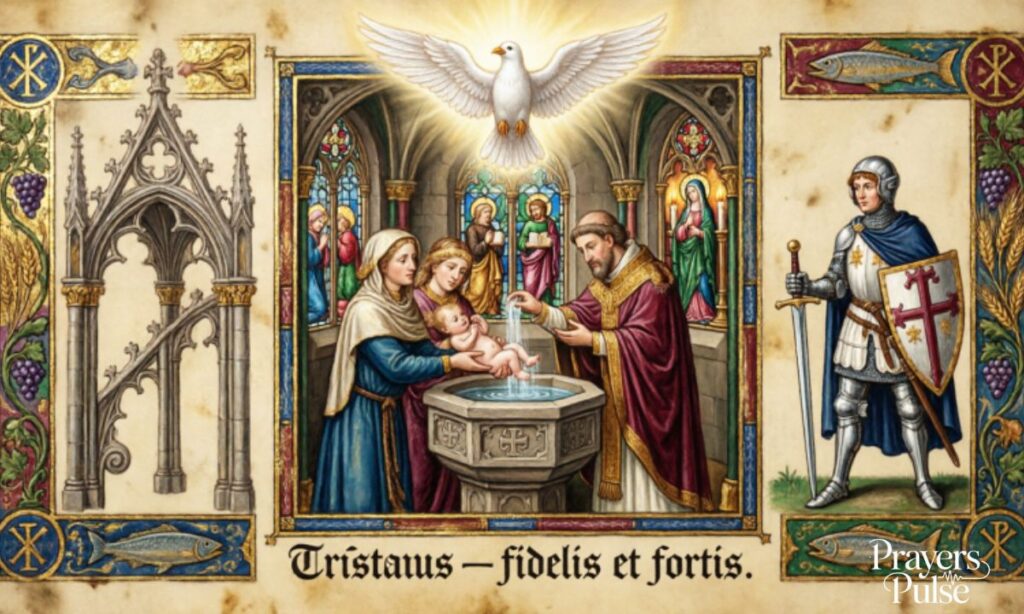
- Thousands of Christian families choose Tristan every year and their reasons consistently reveal something important about where the modern Christian faith is heading.
- There is a growing rejection of what some Christian thinkers call “toxic positivity” in faith culture — the pretense that following God means everything will be easy, comfortable, and uniformly pleasant.
- Tristan pushes back against that pretense directly and honestly — it says that life brings genuine sorrow, that faith does not eliminate difficulty, and that this is not a problem to be fixed but a truth to be embraced.
- The families who choose this name are often those who have themselves walked through real difficulty and emerged with a faith that is deeper, more honest, and more resilient precisely because it was tested.
- They want to give their child a name that will feel true across the entire arc of a human life — not just in the easy seasons but in the hard ones when shallow positivity collapses and only genuine faith sustains.
- Biblical principles for choosing any name include praying earnestly for wisdom as James 1:5 instructs, considering what the name means and declares over the child, embracing authenticity over performance, trusting God’s ability to work through all circumstances, and pointing the name toward His redemptive purposes.
- A child’s worth and identity are ultimately found in Christ, not in their name — but choosing a name thoughtfully and prayerfully honors the biblical pattern of meaningful, intentional naming that runs throughout Scripture.
- The spiritual significance of naming a child Tristan is essentially this — you are acknowledging life’s inevitable difficulties while simultaneously declaring faith in the God who transforms every difficulty into something that serves His extraordinary purposes.
Tristan Across Different Christian Traditions
- One of the name’s most remarkable qualities is how effectively it works across the full spectrum of Christian denominational traditions without creating friction in any of them.
- In evangelical Protestant communities, the name is valued for its biblical themes of perseverance, transformation, and authentic faith that does not flinch from acknowledging the reality of struggle.
- In Catholic communities, the name’s medieval Christian heritage is deeply appreciated — it was carried by Christian knights and nobility throughout the Middle Ages and has centuries of Catholic cultural presence.
- In Anglican and Episcopal communities, the name resonates with the Celtic Christian heritage that forms part of the British church’s historical foundation and continues to shape Anglican spirituality.
- In Orthodox Christian communities, the themes of suffering, endurance, and spiritual transformation that the name embodies connect directly to Orthodox theology’s emphasis on theosis — the process of being conformed to the image of Christ through a life of disciplined, often difficult faith.
- In nondenominational communities, the name works simply and powerfully as a name with emotional authenticity, spiritual depth, and a meaning that aligns beautifully with the core gospel message without requiring denominational explanation or justification.
- What makes Tristan genuinely special from a cross-denominational perspective is that its meaning speaks to something every Christian tradition agrees on — that God works through suffering, that trials produce character, and that sorrow is never the final word in a life surrendered to Christ.
Practical Guidance for Parents Choosing the Name Tristan
- If you are seriously considering Tristan for your child, here is practical, faith-grounded guidance for making and living with that decision confidently and joyfully.
- Pray specifically about it — James 1:5 promises that if anyone lacks wisdom and asks God for it, He will give it generously without finding fault — naming a child is exactly the kind of decision worth bringing to God in specific prayer.
- Say the name aloud repeatedly — say it as a parent calling a child to dinner, as a teacher reading it on a register, and as a professional introducing someone — Tristan passes all three tests comfortably and consistently.
- Consider your family name — Tristan works with most surnames because of its two-syllable rhythm, but spend time saying the full name combination aloud to confirm the flow feels natural.
- Embrace the meaning honestly — do not hide from the sorrow aspect of the name’s meaning, but understand it theologically as Romans 5 frames it — as the beginning of a journey toward perseverance, character, and hope.
- Prepare a simple explanation — when curious relatives ask about the meaning, you have one of the richest, most interesting naming stories available — the Celtic warrior roots, the medieval Christian tradition, the legend of devoted love, and the biblical themes of transformation.
- Consider middle name pairings carefully — classic combinations like Tristan James, Tristan Alexander, or Tristan William provide strong, stable balance, while modern options like Tristan Eli, Tristan Finn, or Tristan Jude offer a fresher feel.
- Rest in the decision — ultimately, your child’s identity is found in Christ, not in their name, and a name chosen prayerfully and thoughtfully with genuine faith is a blessing, not a burden.
Frequently asked questions
What Is the Meaning of Tristan in the Bible?
Tristan does not have a direct meaning in the Bible because it is not a biblical name.
Is Tristan Mentioned in the Bible?
No, the name Tristan does not appear in any book of the Bible.
Does Tristan Have a Biblical Origin?
No, Tristan is generally believed to have Celtic and medieval European origins rather than biblical roots.
Can Tristan Have a Spiritual Meaning for Christians?
Yes, many Christians associate the name with qualities such as courage, loyalty, and perseverance.
Why Do Some People Search for Tristan’s Biblical Meaning?
They often want to know whether the name has a connection to Scripture or Christian values.
Is Tristan a Good Christian Baby Name?
Yes, many Christian parents choose Tristan because of its positive character associations and timeless appeal.
Does the Name Tristan Have a Hebrew Meaning?
No, Tristan does not have a known Hebrew origin or biblical-language meaning.
Are There Christian Qualities Associated With the Name Tristan?
People commonly connect it with faithfulness, strength, honor, and noble character.
How Does Tristan Compare to Traditional Biblical Names?
Unlike biblical names, Tristan comes from Celtic legend, but it can still reflect positive values admired by Christians.
What Is the Main Takeaway About Tristan in the Bible?
While Tristan is not a biblical name, it can still carry meaningful qualities that align with Christian principles.
Conclusion
Tristan Meaning in the Bible: Biblical Significance, Spiritual Symbolism & Christian Insights explores the spiritual themes and values that many Christians associate with the name Tristan. While Tristan does not appear directly in the Bible, its connections to qualities such as courage, loyalty, perseverance, and noble character can align with important biblical principles. These symbolic meanings give the name a deeper spiritual dimension for believers.
Ultimately, Tristan Meaning in the Bible: Biblical Significance, Spiritual Symbolism & Christian Insights highlights how names can inspire faith-based reflection and personal growth. By examining biblical values and Christian perspectives, the name Tristan can be appreciated not only for its history but also for the virtues it may represent. This makes it a meaningful and inspiring choice for those seeking a name with spiritual significance.

Denzel is a passionate faith writer with four years of experience in prayer and Bible blogging. He now contributes has expertise to PrayersPulse.com, creating inspiring content that strengthens prayer life and deepens understanding of Scripture.