

Biblically accurate demons are described in Scripture as spiritual beings that oppose God and work against His will, often associated with deception, temptation, and evil influence. The Bible does not usually focus on giving detailed physical descriptions of demons, but it does present them as real, intelligent spiritual entities led by Satan, who seeks to lead people away from God.
In biblical accounts of demons, they are shown as forces that can oppress or influence individuals, but they are always portrayed as being under God’s ultimate authority. Jesus is shown casting out demons, demonstrating His power over them and affirming that they cannot overcome God’s kingdom. These passages emphasize spiritual warfare, faith, and the victory of good over evil rather than focusing on visual depictions.
Want to uncover the biblical truth about demons?
Understanding Biblical Terminology: Biblically Accurate Hebrew and Greek Words for Demons
The Bible uses several distinct Hebrew and Greek terms to describe demonic beings, each carrying specific theological meaning that modern translations sometimes collapse into the single word demon.
In Hebrew the primary terms include shed referring to foreign gods associated with idol worship appearing in Deuteronomy and Psalms, and sair meaning hairy one or goat demon connected to wilderness spirits in Leviticus.
The Greek New Testament employs daimonion as the most common term for the beings Jesus cast out, pneuma akatharton meaning unclean spirit, and diabolos referring specifically to Satan as the chief adversary and accuser throughout the Gospel accounts.
Hebrew Terms for Evil Spirits
Hebrew scripture uses several terms to describe malevolent spiritual beings, including ruach ra’ah (evil spirit) and shedim (demons). These words appear in narrative and poetic contexts, often linked to affliction or idolatry.
The term se’irim (literally “hairy ones” or “goat-demons”) refers to wilderness spirits mentioned in Levitical and prophetic texts. Such terms reflect ancient Near Eastern beliefs about spiritual forces inhabiting desolate places.
| Hebrew Term | Transliteration | Literal Meaning | Biblical References | Associated Practices |
| רוּחַ רָעָה | Ruach ra’ah | Evil spirit | 1 Samuel 16:14, 1 Samuel 18:10 | Tormented Saul; linked to divine judgment |
| שֵׁדִים | Shedim | Demons | Deuteronomy 32:17, Psalm 106:37 | Associated with idolatrous sacrifices |
| שְׁעִירִים | Se’irim | Hairy ones / goat-demons | Leviticus 17:7, Isaiah 13:21, 34:14 | Wilderness spirits, forbidden worship |
| לִילִית | Lilith | Night creature | Isaiah 34:14 | Associated with desolation and ruin |
| עֲזָאזֵל | Azazel | Goat-demon / wilderness spirit | Leviticus 16:8-10 | Recipient of scapegoat ritual on Day of Atonement |
Greek Words in the New Testament
The New Testament primarily uses daimonion (demon) and pneuma akatharton (unclean spirit) to describe evil spiritual entities. These terms appear frequently in the Gospels, especially in healing and exorcism narratives.
Another key term, diabolos (devil, slanderer), designates a chief adversarial figure distinct from lesser demonic spirits. Greek vocabulary here reflects both Jewish thought and Hellenistic influences on early Christian writing.
| Greek Term | Transliteration | Literal Meaning | Biblical References | Associated Practices |
| δαιμόνιον | Daimonion | Demon / lesser spirit | Matthew 8:31, Luke 8:30 | Possession, exorcism by Jesus |
| πνεῦμα ἀκάθαρτον | Pneuma akatharton | Unclean spirit | Mark 1:23, Mark 5:8 | Causes illness or impurity; cast out in healing |
| διάβολος | Diabolos | Slanderer / devil | Matthew 4:1, 1 Peter 5:8 | Temptation, accusation, opposition to believers |
| Σατανᾶς | Satanas | Adversary | Mark 1:13, Revelation 12:9 | Chief adversarial figure, source of temptation |
| Βεελζεβούλ | Beelzeboul | Lord of the flies/dung (title) | Matthew 12:24, Luke 11:15 | Identified as ruler of demons |
Why This Linguistic Understanding Matters
Understanding the original Hebrew and Greek terminology helps readers grasp distinctions that English translation often flattens into a single generic word. Recognizing that shed, sair, daimonion, and pneuma akatharton each carry different connotations allows for more careful interpretation of specific passages.
This precision matters for serious theological study and for ministry contexts where understanding the nature of what scripture describes shapes pastoral response.
Finally, this kind of study reflects a broader principle of sound biblical interpretation: meaning is best understood in its original linguistic and cultural context. Just as understanding agricultural or legal terms illuminates other passages, understanding spiritual vocabulary clarifies how biblical writers and their audiences actually conceived of these beings.
Complete Biblical Taxonomy of Demons and Evil Entities
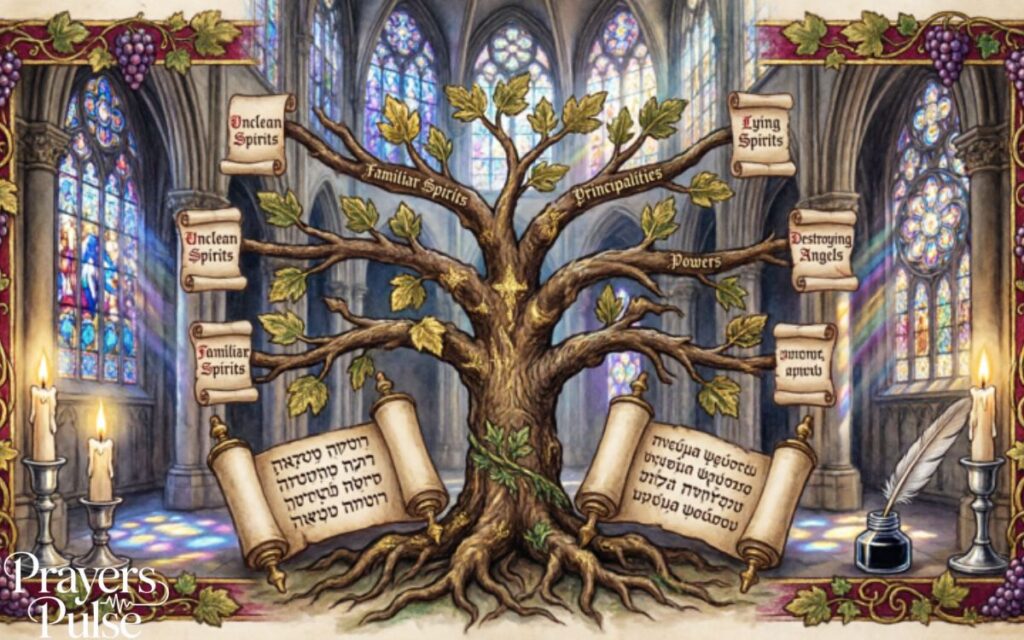
Scripture presents demonic and evil entities across distinct categories rather than as a single undifferentiated group, with terminology and behavior shifting between Old and New Testament contexts.
Organizing these references into a coherent taxonomy helps clarify which texts describe possession-capable spirits, which describe territorial or idol-associated beings, and which describe higher-order spiritual adversaries like Satan himself.
This structure draws on the full canon, tracing how each category is introduced, described, and ultimately confronted.
Category 1: New Testament Demons (Unclean Spirits)
Characteristics of New Testament demons:
- Sentient and intelligent — they recognized Jesus immediately (Mark 1:24: “I know who you are the Holy One of God!”)
- Capable of speech — demons communicate with both Christ and their victims
- Seek embodiment — they desire to inhabit human or animal bodies (Matthew 8:28-32)
- Cause afflictions — physical symptoms (muteness, seizures) and psychological torment
- Organized hierarchically — Matthew 12:45 mentions some demons being stronger than others
- Subject to Christ’s authority — Luke 10:17-20 shows disciples successfully casting them out in Jesus’ name
The Gerasene demoniac story (Mark 5:1-20) provides the most detailed account. Legion, a demon identifying itself by a Roman military unit, inhabited one man. This reveals demons can operate in groups and possess supernatural knowledge of contemporary culture.
Another crucial example appears in Mark 9:17-29. A father brings his son, afflicted by a mute spirit that causes seizures and self-harm. The disciples failed to cast it out. Jesus explained that this kind required prayer to be driven out, indicating different demons require different levels of spiritual authority.
The Python spirit in Acts 16:16-18 demonstrates demons can enable supernatural abilities. This slave girl practiced divination through demonic power. Paul finally commanded the spirit out after being greatly annoyed for many days, showing restraint and discernment rather than impulsive demon-hunting.
| New Testament Demon Encounter | Key Passage | Defining Feature |
| Gerasene demoniac (Legion) | Mark 5:1-20 | Multiple demons in one host |
| Boy with mute spirit | Mark 9:17-29 | Required prayer, not just command |
| Slave girl with Python spirit | Acts 16:16-18 | Enabled divination ability |
| Capernaum demoniac | Mark 1:21-28 | Demon recognized Jesus’ identity instantly |
Category 2: Old Testament Shedim (Foreign Gods and Idol Spirits)
The Hebrew term shedim appears in Deuteronomy 32:17 and Psalm 106:37, where Israel’s sacrifices to foreign gods are described as sacrifices made to shedim rather than to God. This term connects demonic beings directly to idolatry and the worship practices of neighboring nations.
Unlike the New Testament’s possession narratives, shedim are not described as entering or controlling individual bodies but rather as beings worshipped through ritual and sacrifice, often associated with territorial or national gods of surrounding cultures like Babylon, Canaan, and Moab.
| Old Testament Term | Hebrew Word | Primary Association |
| Foreign gods | Shedim | Idol worship, child sacrifice |
| Goat demons | Sair | Wilderness spirits, Leviticus rituals |
| Night creature | Lilith | Isaiah 34:14, desolate places |
Category 3: Satan and Chief Adversarial Beings
Satan occupies a distinct category as the singular chief adversary named throughout both testaments, appearing in Job as a prosecutorial figure before God’s court, in Zechariah as an accuser, and in the Gospels as the direct tempter of Christ in the wilderness.
Unlike lesser demons who operate locally and are subject to immediate exorcism, Satan is portrayed with broader authority and a more extensive role across the biblical narrative arc.
Revelation expands this category further, describing Satan alongside named or numbered beings like Abaddon/Apollyon, the angel of the abyss in Revelation 9:11, suggesting a hierarchy among evil spiritual beings that parallels the angelic hierarchy described elsewhere in scripture.
| Adversarial Being | Key Passage | Role Described |
| Satan | Job 1-2, Matthew 4 | Accuser, tempter |
| Abaddon/Apollyon | Revelation 9:11 | Angel of the abyss |
| The dragon | Revelation 12 | Symbolic of ultimate cosmic evil |
Category 4: Territorial and National Spirits
Daniel 10:13 introduces the concept of territorial spiritual opposition, describing a “prince of the kingdom of Persia” who withstood an angelic messenger for twenty-one days until Michael intervened. This passage suggests certain spiritual beings are associated with specific nations or regions rather than individual people.
Paul’s language in Ephesians 6:12 about “rulers,” “authorities,” and “powers of this dark world” builds on this Old Testament concept, framing spiritual conflict as occurring not merely against individual demons but against an organized structure of opposition operating at a territorial or systemic level.
Category 5: Apocalyptic and Symbolic Beings
Revelation and portions of Daniel describe entities that function more symbolically than as straightforward possession-capable spirits, including locusts with scorpion tails in Revelation 9, the beast from the sea in Revelation 13, and various composite creatures representing kingdoms or systems of opposition to God rather than individual personal demons.
These beings are typically interpreted through apocalyptic literary conventions, where vivid imagery represents historical empires, future events, or cosmic spiritual realities rather than describing literal possession-style demons encountered in the Gospel narratives.
Category 6: Disputed and Ambiguous Old Testament References
Several Hebrew terms remain genuinely debated among scholars regarding whether they describe demonic beings, mythological poetic imagery, or simply wild animals using figurative language, including Lilith in Isaiah 34:14, the “goat demons” (sair) of Leviticus 17:7, and references to Rahab and Leviathan as chaos monsters in Job and the Psalms.
These ambiguous references highlight why careful linguistic and contextual study matters: translators and scholars continue to disagree on whether certain passages describe literal evil spirits, poetic personifications of chaos, or simply unfamiliar desert creatures described in the cultural language available to ancient Hebrew writers.
What Does the Bible Call Demons?
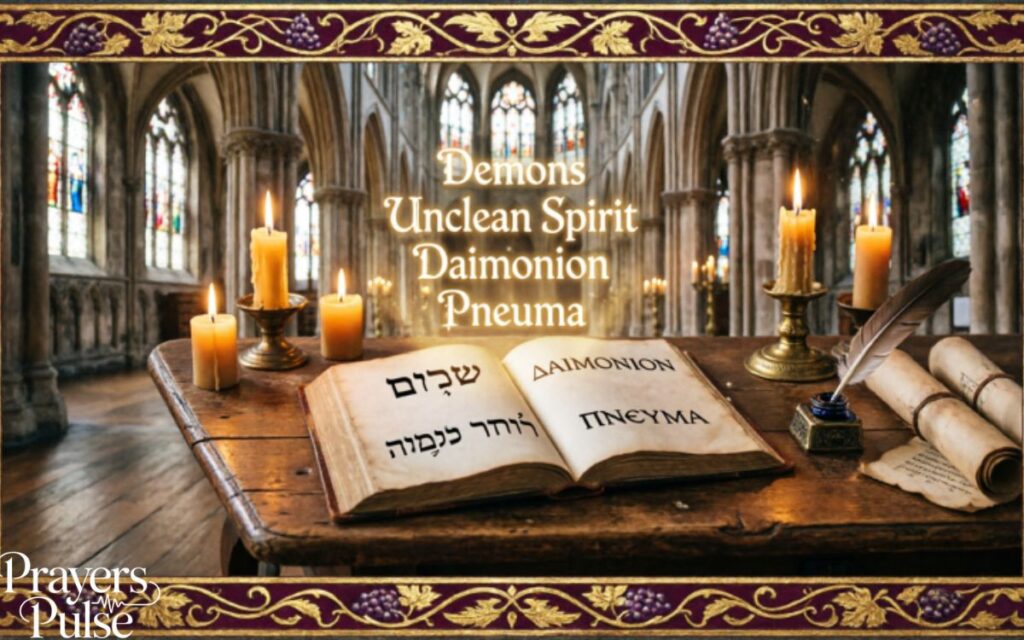
Scripture employs multiple distinct terms rather than a single word for demons, including the Hebrew shedim (foreign gods, Deuteronomy 32:17), sair (goat demons, Leviticus 17:7), and the Greek daimonion, the most common New Testament term used throughout the Gospels.
The English word demon itself derives from this Greek root but has absorbed centuries of folkloric and cultural meaning not present in the original text. Translators must therefore choose carefully between rendering these terms literally or interpretively, since each carries different theological weight.
Understanding this terminological diversity matters because each Hebrew or Greek word carries specific connotations about origin, behavior, or function that English translations often flatten.
A reader working only from an English Bible may miss meaningful distinctions between a territorial spirit, an unclean spirit causing possession, and Satan as the singular chief adversary, all of which scripture treats somewhat differently.
| Original Term | Language | Primary Meaning |
| Shedim | Hebrew | Foreign gods, idols |
| Sair | Hebrew | Goat demon, wilderness spirit |
| Daimonion | Greek | General term for demon |
| Pneuma akatharton | Greek | Unclean spirit |
| Stoicheia | Greek | Elemental spiritual forces |
The Origin of Demons: Fallen Angels or Something Else?
The most widely held Christian view traces demons to angels who rebelled against God alongside Satan, drawing primarily from Revelation 12:4 and 2 Peter 2:4, which describe angels who sinned being cast down and held for judgment.
This fallen angel theory explains demonic intelligence, supernatural knowledge, and organized hierarchy as residual characteristics from their original angelic nature before their rebellion.
A second theory, drawn from a more controversial reading of Genesis 6:1-4 alongside 1 Enoch (a non-canonical text), suggests demons originated as the disembodied spirits of the Nephilim, offspring of fallen “sons of God” and human women, destroyed in the flood but left as wandering spirits.
This view remains debated since Genesis itself does not explicitly connect the Nephilim to later demonic activity.
A third, more minimalist position holds that scripture simply does not specify demon origins with certainty, and that readers should avoid over-systematizing fragmentary references into a complete origin story.
Job, Genesis, and Revelation each offer glimpses of cosmic rebellion without forming one unified, explicit narrative of how evil spirits came to exist.
- The fallen angel view rests primarily on Revelation 12 and 2 Peter 2:4.
- The Nephilim spirit view draws from Genesis 6 and the non-canonical Book of Enoch.
- Many scholars hold that scripture leaves demon origins deliberately unresolved.
Physical Appearance of Demons in Scripture
The Bible is notably restrained in describing what demons actually look like, with most New Testament accounts focusing entirely on their behavior and effects rather than any visual description, since demons are portrayed primarily as spiritual rather than physical beings. The Gerasene demoniac account, for example, describes the man’s behavior and the demons’ speech in detail but gives no description of the demons’ appearance at all.
Where physical imagery does appear, it tends to be symbolic rather than literal, as in Revelation 9’s locusts with human faces, lion’s teeth, and scorpion tails, which most scholars interpret as apocalyptic symbolism representing destructive forces rather than literal demon anatomy.
Isaiah 13:21 and 34:14 mention creatures like “satyrs” or “goat-demons” dancing in ruins, language scholars debate as either mythological imagery or references to actual wild animals.
Much of the popular modern imagery of demons (horns, red skin, pitchforks) derives from medieval art, Dante’s Inferno, and later folklore rather than from any biblical text.
Scripture’s relative silence on physical appearance is itself theologically significant, emphasizing demonic activity and spiritual danger over visual horror.
Demons and Their Activities: Possession, Deception, and Influence
Demonic activity in scripture spans a spectrum from full possession, where a spirit controls a person’s body and speech, to subtler influence through deception, temptation, and false teaching that does not require physical possession at all.
Mark and Luke describe clear possession cases with physical symptoms like seizures, muteness, and supernatural strength, while Paul’s epistles more often describe demonic deception working through false doctrine and spiritual confusion.
| Type of Demonic Activity | Example Passage | Manifestation |
| Physical possession | Mark 5:1-20 | Supernatural strength, self-harm |
| Causing affliction | Mark 9:17-29 | Seizures, muteness |
| Enabling false power | Acts 16:16-18 | Divination ability |
| Doctrinal deception | 1 Timothy 4:1 | False teaching, deceiving spirits |
| Temptation | Matthew 4:1-11 | Direct testing of Jesus |
Paul’s warning in 1 Timothy 4:1 that “some will depart from the faith, giving heed to deceiving spirits and doctrines of demons” frames demonic activity as operating through ideas and false teaching, not only through bodily possession.
This broader category suggests scripture views demonic influence as something believers can encounter through deception just as much as through dramatic possession.
Jesus’ Authority Over Demons: Key Gospel Accounts
The Gospels consistently portray Jesus exercising immediate and unquestioned authority over demons, contrasting sharply with the failed attempts of his own disciples in passages like Mark 9:14-29, where they could not cast out a particularly resistant spirit.
This authority is demonstrated not through ritual or lengthy incantation but through simple, direct command, as in Mark 1:25 when Jesus says “Be quiet! Come out of him!”
Luke 10:17-20 records the seventy-two disciples returning with joy, reporting that even demons submitted to them in Jesus’ name, prompting Jesus’ famous response that he saw “Satan fall like lightning from heaven.” This passage establishes that Christ’s authority over demons could be extended to his followers when exercised specifically in his name and not through their own independent power.
- Jesus cast out demons through direct verbal command, not ritual (Mark 1:25).
- The disciples’ authority was explicitly tied to using Jesus’ name (Luke 10:17).
- Some demons required prayer and fasting, indicating varying levels of resistance (Mark 9:29).
- Jesus’ authority extended even over legions of demons simultaneously (Mark 5:1-20).
- Demonic recognition of Jesus’ identity was immediate and involuntary (Mark 1:24).
Biblically Accurate Understanding of Ambiguous Entities and Satan
Scripture contains a final tier of beings whose nature remains genuinely contested among scholars, occupying the space between clearly defined New Testament demons and the more symbolic apocalyptic imagery found in prophetic literature.
These ambiguous references resist easy categorization, requiring careful attention to genre, original language, and surrounding context rather than assumptions imported from later tradition.
Category 7: Ambiguous Entities
Several Hebrew terms occupy genuinely disputed territory among scholars, including Lilith in Isaiah 34:14, the sair or “goat demons” of Leviticus 17:7, and the chaos figures Rahab and Leviathan referenced in Job and the Psalms.
Debate centers on whether these terms describe literal spiritual beings, poetic personifications of chaos and desolation, or simply unfamiliar wild creatures described using the cultural and mythological vocabulary available to ancient Hebrew writers.
| Ambiguous Term | Passage | Scholarly Debate |
| Lilith | Isaiah 34:14 | Demon, night creature, or poetic image |
| Sair | Leviticus 17:7 | Goat demon or wild goat |
| Rahab/Leviathan | Job 41, Psalm 74 | Chaos monster or literal sea creature |
- Lilith appears only once in the entire Hebrew Bible, limiting interpretive certainty.
- Leviathan is described in both poetic and seemingly literal terms within Job 41.
- Most modern scholars favor caution over confident demonic identification for these terms.
Category 8: Satan – Prince of Demons
Satan appears across both testaments as a singular figure rather than one demon among equals, introduced in Job as a prosecutorial member of the heavenly council who tests Job’s faithfulness with God’s permission.
The Gospels later identify him directly as the tempter confronting Jesus in the wilderness and the prince of demons referenced by religious leaders in Matthew 12:24, a title Jesus does not dispute even while correcting their accusation.
- Satan is called the “prince of demons” by religious leaders in Matthew 12:24.
- Job 1-2 portrays Satan operating with limited permission under God’s sovereignty.
- Revelation 12 and 20 trace Satan’s defeat as the culmination of the entire biblical narrative.
Satan’s Origin and Fall
Scripture offers no single systematic account of Satan’s origin, though Ezekiel 28 and Isaiah 14 are traditionally read as describing his fall through pride, despite being addressed primarily to human kings. These passages, combined with Revelation 12, form the basis for the widely held view that Satan was once a high-ranking angel cast down for rebellion against God.
Ezekiel 28:14-17 describes a guardian cherub in Eden cast out for corruption tied to his own beauty, while Isaiah 14:12-15 depicts a figure called “Day Star, son of Dawn” cast down for seeking to ascend above God. Both passages are debated regarding whether they refer literally to Satan or use his imagery to describe earthly rulers.
| Passage | Traditional Application | Key Detail |
| Ezekiel 28:11-19 | King of Tyre / Satan | Guardian cherub cast from Eden |
| Isaiah 14:12-15 | King of Babylon / Satan | “Day Star” cast down for pride |
| Revelation 12:7-9 | Satan directly named | War in heaven, dragon cast to earth |
| Luke 10:18 | Satan directly referenced | Jesus describes seeing him “fall like lightning” |
Satan’s Nature and Limitations
Despite popular portrayals of Satan as nearly equal to God, scripture consistently presents him as a created being operating under strict and ultimately temporary permission rather than independent power. Job 1-2 makes this explicit, showing Satan unable to act against Job without first receiving God’s authorization and remaining bound by clearly defined limits.
The New Testament reinforces this subordinate status, describing Satan as already defeated through Christ’s death and resurrection even while still active, and ultimately destined for final judgment in Revelation 20.
- Satan cannot act without God’s permission, as shown explicitly in Job 1:12 and 2:6.
- He is called the “god of this age” in 2 Corinthians 4:4, indicating limited, not ultimate, authority.
- 1 Peter 5:8 portrays him as a roaring lion seeking prey, suggesting predatory rather than omnipotent power.
- James 4:7 instructs believers to resist him, implying his influence can be successfully opposed.
- Revelation 20:10 describes his final, permanent defeat and judgment.
- John 12:31 calls him “the ruler of this world,” a title Jesus says is being cast out through his own ministry.
- Satan is described as capable of deception (2 Corinthians 11:14) but not capable of overriding human will entirely.
- His knowledge appears limited compared to God’s omniscience, evidenced by his need to “test” rather than simply know outcomes.
- Hebrews 2:14 states Christ’s death was specifically to destroy “him who holds the power of death,” framing Satan’s power as already broken.
- The consistent biblical pattern shows Satan operating within boundaries God sets, never outside them.
The Two Physical Descriptions in Scripture
Scripture provides only two passages offering anything resembling direct physical description of a demonic or satanic figure, both occurring in apocalyptic literature rather than narrative accounts.
Revelation 9:7-10 describes locust-like beings with human faces, women’s hair, lion’s teeth, and scorpion tails, while Revelation 12:3 depicts the great dragon as having seven heads, ten horns, and seven crowns.
Both descriptions function symbolically within their apocalyptic genre rather than offering literal anatomical detail, using composite and exaggerated imagery typical of prophetic visions to convey destructive power and cosmic threat.
Outside these two passages, scripture remains silent on demonic appearance, leaving popular imagery like horns or red skin entirely outside the biblical text itself.
How Non-Biblical Tradition Shaped Popular Demon Imagery
Much of the demonology familiar to modern readers, including detailed hierarchies, names, and physical descriptions of demons, derives from extra-biblical sources rather than scripture itself. Tracing this development clarifies which ideas come directly from the biblical text and which were added over centuries through interpretation, theology, and creative literature.
This layered history matters because popular culture, sermons, and even casual Christian conversation often blend these sources together without distinguishing biblical content from later tradition. Understanding each contributing source allows readers to separate what scripture actually says from what accumulated around it afterward.
The Book of Enoch’s Massive Influence
The non-canonical Book of Enoch significantly shaped early ideas about fallen angels and their offspring, expanding briefly on the obscure Genesis 6 account into an elaborate narrative involving two hundred rebellious angels called Watchers. Though never accepted into the Hebrew or Protestant canon, Enoch’s influence persisted through Jewish apocalyptic tradition and even appears referenced in the New Testament book of Jude.
- Enoch names specific fallen angels and assigns them distinct roles and sins.
- The Watchers narrative expands Genesis 6 into a detailed mythology absent from the original text.
- Jude 1:14-15 directly quotes material attributed to Enoch, complicating its canonical status.
- Enoch remains canonical in the Ethiopian Orthodox Church but not in mainstream Protestant or Catholic tradition.
Church Fathers’ Interpretive Contributions
Early Christian theologians including Origen, Augustine, and Tertullian developed systematic theological frameworks around demons that went considerably further than scripture’s relatively sparse direct statements. These writers debated demon origins, hierarchy, and capabilities, often drawing on philosophical categories from Greek thought alongside biblical material.
- Origen speculated extensively on angelic and demonic ranks using Platonic philosophical frameworks.
- Augustine’s City of God shaped Western Christian thinking on the nature and origin of evil spirits.
- Tertullian connected demons explicitly to pagan idolatry and Greco-Roman religious practice.
- These patristic writings, while influential, are theological reflection rather than scriptural revelation.
| Church Father | Key Contribution |
| Origen | Speculative angelic/demonic hierarchy |
| Augustine | Theological framework in City of God |
| Tertullian | Linked demons to pagan worship |
Medieval Demonology’s Elaborations
Medieval theologians and popular folklore dramatically expanded demonic taxonomy, producing detailed hierarchies, named princes of hell, and specific associated sins that have no direct scriptural basis whatsoever. Texts like grimoires and demonological manuals catalogued dozens of named demons with assigned ranks, appearances, and powers.
- Medieval grimoires assigned specific names, ranks, and sigils to individual demons.
- Demons became associated with the seven deadly sins in popular medieval theology.
- Physical depictions with horns, hooves, and red skin emerged primarily from this period’s art and folklore.
- These elaborate systems reflect medieval imagination far more than biblical textual support.
Literary Influence: Dante and Milton
Dante’s Inferno and Milton’s Paradise Lost profoundly shaped popular Western imagination regarding hell’s geography, demonic personality, and Satan’s character, blending biblical fragments with extensive poetic invention. These literary works are widely mistaken for biblical content despite being creative theological fiction.
- Dante organized hell into structured circles with assigned demons, entirely his own literary invention.
- Milton’s sympathetic, complex portrayal of Satan in Paradise Lost shaped centuries of cultural perception.
- Both works draw loosely on scripture while adding extensive original narrative and characterization.
- Modern phrases and images about hell and Satan often trace to these poems rather than to the Bible.
| Literary Work | Author | Major Contribution to Popular Imagery |
| Inferno | Dante Alighieri | Structured hell, circles, named demons |
| Paradise Lost | John Milton | Complex, sympathetic portrayal of Satan |
Why This Historical Context Matters
Recognizing these layered, non-biblical contributions allows readers to distinguish scripture’s relatively restrained statements about demons from the elaborate traditions built up over centuries afterward. This distinction matters for anyone seeking to ground their theology specifically in the biblical text rather than inherited cultural imagination.
- Most popular demon imagery (horns, pitchforks, red skin) has no scriptural basis at all.
- Distinguishing biblical text from tradition strengthens careful theological interpretation.
- Many believers unknowingly treat Dante, Milton, or medieval folklore as if it were scripture.
- This awareness encourages returning directly to the biblical text for doctrinal claims about demons.
Distinguishing Demonic Possession from Oppression in Biblically Accurate Terms
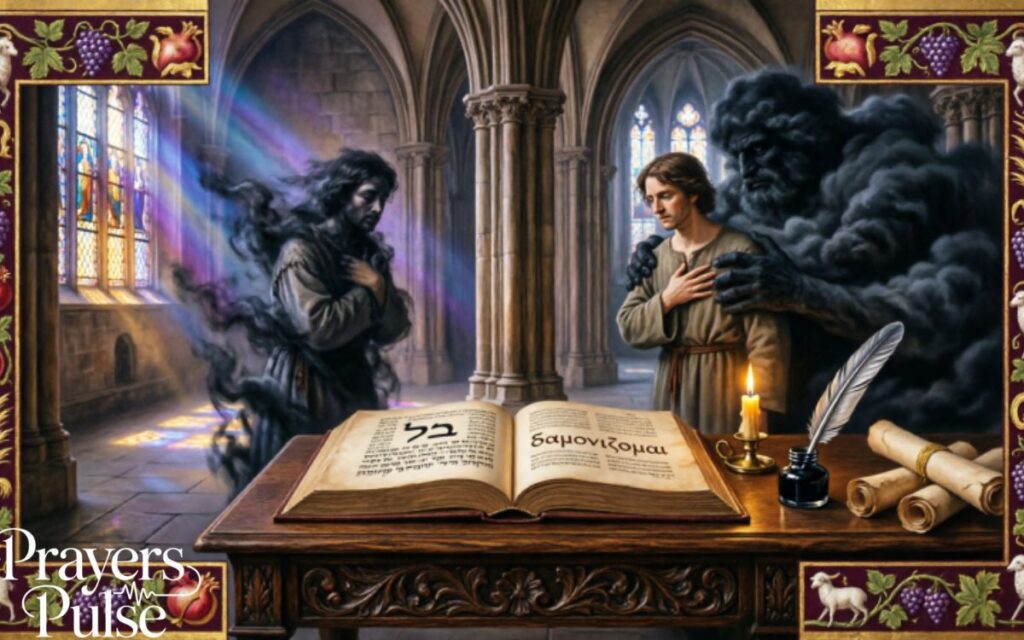
Scripture distinguishes between demonic possession, where a spirit directly controls a person’s body and speech, and oppression, a broader category involving external demonic harassment, temptation, or influence without internal control.
This distinction matters significantly for both theological accuracy and pastoral practice, since the two conditions require different responses.
Confusion between these categories often leads to misapplied teaching, particularly regarding whether genuine Christians can experience either condition.
Defining Possession vs. Oppression
Possession in the Gospels typically translates the Greek phrase daimonizomai, meaning to be demonized, describing cases where a spirit directly controls speech, movement, or physical symptoms as seen in the Gerasene demoniac account. Oppression, by contrast, describes external harassment, temptation, or affliction without internal control, closer to Paul’s description of a “messenger of Satan” buffeting him in 2 Corinthians 12:7.
This terminological distinction is not merely academic, since the biblical authors consistently use different language and describe different remedies for each condition throughout the Gospels and epistles.
| Category | Greek/Biblical Term | Defining Feature | Example Passage |
| Possession | Daimonizomai | Direct internal control | Mark 5:1-20 |
| Oppression | Messenger of Satan, fiery darts | External harassment/temptation | 2 Corinthians 12:7, Ephesians 6:16 |
Can Christians Be Possessed?
This question remains genuinely debated among theologians, with most arguing that full possession, in the sense of complete internal control demonstrated in Gospel accounts, is incompatible with the Holy Spirit’s indwelling presence described in passages like 1 Corinthians 6:19.
- 1 Corinthians 6:19 describes believers’ bodies as temples of the Holy Spirit, central to this argument.
- No New Testament epistle explicitly describes a believer as fully possessed by a demon.
- Most theologians distinguish this from oppression, which scripture does describe affecting believers.
Can Christians Be Oppressed?
Unlike possession, scripture more clearly supports the idea that believers can experience demonic oppression, including temptation, spiritual attack, and harassment, without losing their salvation or spiritual standing before God.
- Paul describes a “messenger of Satan” sent to torment him despite his clear faith in 2 Corinthians 12:7.
- Ephesians 6:10-18 instructs believers to put on spiritual armor against “flaming arrows,” implying ongoing external attack.
- 1 Peter 5:8 warns believers generally to be watchful since the devil “prowls around” seeking opportunity.
Forms of Demonic Oppression Against Believers
Scripture and pastoral theology generally describe demonic oppression as affecting believers across several overlapping dimensions rather than a single uniform experience. These categories help distinguish genuine spiritual attack from ordinary human struggle, mental health conditions, or circumstantial hardship.
Categories of demonic oppression:
Mental/Emotional:
- Persistent condemning thoughts beyond normal conscience
- Irrational fears and debilitating anxieties
- Oppressive depression (distinct from clinical depression)
- Intrusive blasphemous thoughts
Physical:
- Unexplained fatigue or heaviness resisting normal rest
- Recurring illness without clear medical cause
- Physical sensations of pressure or restriction during prayer
Spiritual:
- Sudden, intense resistance to prayer, scripture, or worship
- Persistent doubt undermining settled faith convictions
- A sense of spiritual “static” or disconnection from God’s presence
Relational:
- Recurring conflict or division within families or close relationships
- Sudden unexplained hostility from others toward one’s faith
- Patterns of isolation pulling a believer from community
Circumstantial:
- Repeated, unusual obstacles when pursuing godly goals
- Patterns of “coincidental” setbacks at spiritually significant moments
- Financial or practical hardship clustering around ministry efforts
Behavioral:
- Sudden uncharacteristic temptation toward specific destructive sin
- Compulsive patterns resistant to normal willpower or accountability
- Cyclical struggles that seem to intensify after spiritual growth
Protection and Response for Believers
Scripture frames the believer’s response to oppression primarily through resistance, submission to God, and reliance on Christ’s finished authority rather than fear-driven reaction or elaborate ritual. James 4:7 offers the clearest pattern, instructing believers to submit to God first and then resist the devil, with the promise that he will flee.
Practical responses drawn from scripture include prayer, scriptural truth, confession, and Christian community rather than isolated self-effort against oppression.
- James 4:7 establishes the foundational pattern: submit to God, then resist the devil.
- Ephesians 6:10-18 describes spiritual armor (truth, righteousness, faith, the Word) as the primary defense.
- 1 Peter 5:8-9 calls for sober vigilance and resisting “firm in the faith,” alongside the reminder that fellow believers face similar struggles.
Clarifying Contemporary Misunderstandings: Pop Culture vs. Biblical Truth
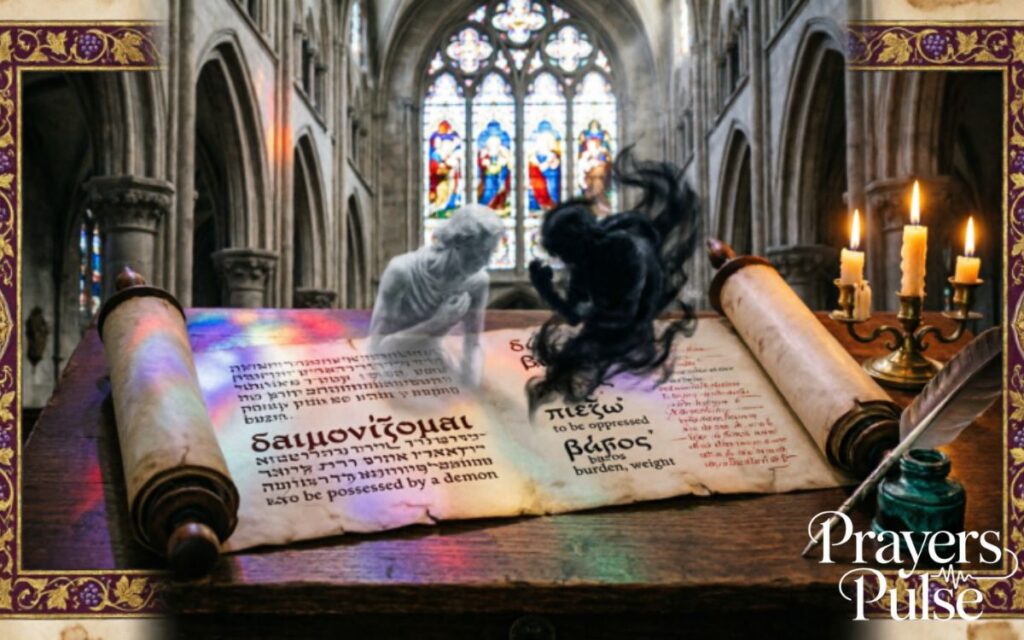
Modern entertainment has shaped popular ideas about demons far more thoroughly than most believers realize, blending horror films, video games, and folklore into a composite image rarely matching scripture’s actual descriptions.
Separating these cultural assumptions from biblical text helps believers ground their understanding in what is actually written rather than inherited cinematic imagery.
This comparison matters because misconceptions can distort both fear responses and theological confidence, leading people to either dismiss demonic reality as mere fiction or to fear exaggerated powers scripture never attributes to these beings.
Physical Appearance: Fiction vs. Scripture
| Element | Pop Culture Depiction | Biblical Reality |
| Skin/color | Red, black, or scaled skin | Not described in scripture at all |
| Horns/hooves | Standard demonic features | No biblical text attributes these |
| Wings | Bat-like wings common | Not mentioned for demons specifically |
| General form | Monstrous, grotesque humanoid | Spiritual beings, generally formless |
| Visual symbolism | Pitchforks, fire, tails | Absent from biblical demon descriptions |
| Exception | N/A | Revelation 9’s locust-like apocalyptic imagery |
Power Level: Exaggeration vs. Reality
Popular media routinely portrays demons as nearly omnipotent forces capable of overpowering anyone at will, contradicting scripture’s consistent portrayal of demons as limited beings subject to clear constraints and divine authority.
- Demons require permission to act, as shown explicitly in Job 1:12 and 2:6 regarding Satan himself.
- Scripture never depicts demons as omniscient, only as possessing limited supernatural knowledge.
- Demons are consistently shown submitting instantly to Christ’s spoken command (Mark 1:25).
- James 4:7 promises demons will flee when believers resist them, indicating defeatable, not invincible, power.
- 1 John 4:4 declares “greater is He who is in you than he who is in the world,” framing believers as spiritually stronger.
- Revelation 20 describes Satan’s ultimate and total defeat, undermining any portrayal of unstoppable demonic power.
Demonic Possession: Hollywood vs. Scripture
| Element | Hollywood Depiction | Biblical Reality |
| Onset | Often sudden, dramatic, ritualistic trigger | Circumstances rarely detailed; focus on the affliction itself |
| Symptoms | Levitation, extreme contortion, supernatural voice changes | Seizures, muteness, self-harm, unusual strength (Mark 5, 9) |
| Exorcism process | Elaborate ritual, prolonged battle, priestly formula | Often immediate, by simple spoken command (Mark 1:25) |
| Resistance to faith | Violent reaction to crosses, holy water | Demons react to Christ’s authority and presence, not religious objects |
| Outcome | Frequently ambiguous or victim dies | Consistently full deliverance when Christ intervenes |
| Authority required | Special exorcist training/ritual | Authority tied to Jesus’ name, not specialized ritual expertise (Luke 10:17) |
Satan’s Role: Misconceptions Clarified
Many believers mistakenly view Satan as God’s direct opposite or equal counterpart, an idea scripture never supports since Satan is consistently portrayed as a created, limited being operating under God’s ultimate sovereignty. He is not omnipresent, omniscient, or omnipotent, and his activities throughout scripture occur only within boundaries God permits.
Clarifying misconceptions about Satan’s role:
- Satan is not God’s equal opposite; he is a created being, not a co-eternal cosmic rival.
- He cannot be everywhere at once, unlike God’s omnipresence described throughout scripture.
- His knowledge is limited, requiring him to “test” situations rather than simply knowing outcomes.
- He operates under permission, as shown explicitly in Job 1-2’s heavenly court scene.
- He is already defeated through Christ’s death and resurrection, even while still active (Hebrews 2:14).
- His final judgment is certain and described explicitly in Revelation 20:10.
Why These Misunderstandings Matter
Confusing pop culture imagery and theological misconceptions with biblical truth can produce either excessive fear of demonic power or careless dismissal of genuine spiritual realities scripture describes. Both extremes distort healthy Christian discipleship and pastoral care.
| Misunderstanding | Resulting Problem | Biblical Correction |
| Satan as God’s equal | Excessive fear, spiritual paralysis | Satan is created and limited (Job 1-2) |
| Demons as omnipotent | Believers feel powerless against attack | “Greater is He who is in you” (1 John 4:4) |
| Possession confused with oppression | Misapplied deliverance teaching to believers | Scripture distinguishes the two conditions |
| Hollywood imagery as biblical fact | Misplaced fear of physical appearance | Scripture offers minimal physical description |
| Ignoring spiritual reality entirely | Underestimating real spiritual conflict | Ephesians 6:12 affirms genuine spiritual battle |
Spiritual Warfare: Practical Protection and Authority
Scripture frames spiritual warfare not as fearful confrontation but as confident, equipped engagement grounded in Christ’s already-secured victory rather than uncertain battle.
Practical elements of biblical spiritual warfare:
- Spiritual warfare is real but conducted from a position of victory, not uncertainty (Colossians 2:15).
- Believers are instructed to “stand firm” rather than aggressively seek out conflict (Ephesians 6:13).
- Prayer is consistently presented as a primary weapon in spiritual conflict (Ephesians 6:18).
- Scripture itself functions as an offensive weapon, described as “the sword of the Spirit” (Ephesians 6:17).
- Community and mutual accountability strengthen believers against spiritual attack (1 Peter 5:8-9).
- Authority over demons is tied specifically to Christ’s name, not personal spiritual power (Luke 10:17).
- Resisting temptation and submission to God work together as the basic pattern (James 4:7).
- Discernment, not fear, is the recommended posture toward spiritual opposition (1 John 4:1).
The Reality of Spiritual Warfare
Paul explicitly states in Ephesians 6:12 that believers’ struggle is not against flesh and blood but against spiritual forces of evil, framing ordinary conflicts and temptations within a larger unseen spiritual context. This passage establishes spiritual warfare as a genuine biblical category rather than a metaphor or cultural add-on to Christian teaching.
This reality does not mean every difficulty is directly demonic, but it does mean scripture takes unseen spiritual conflict seriously enough to instruct believers on specific preparation and response rather than leaving the subject unaddressed.
The Armor of God (Ephesians 6:13-18)
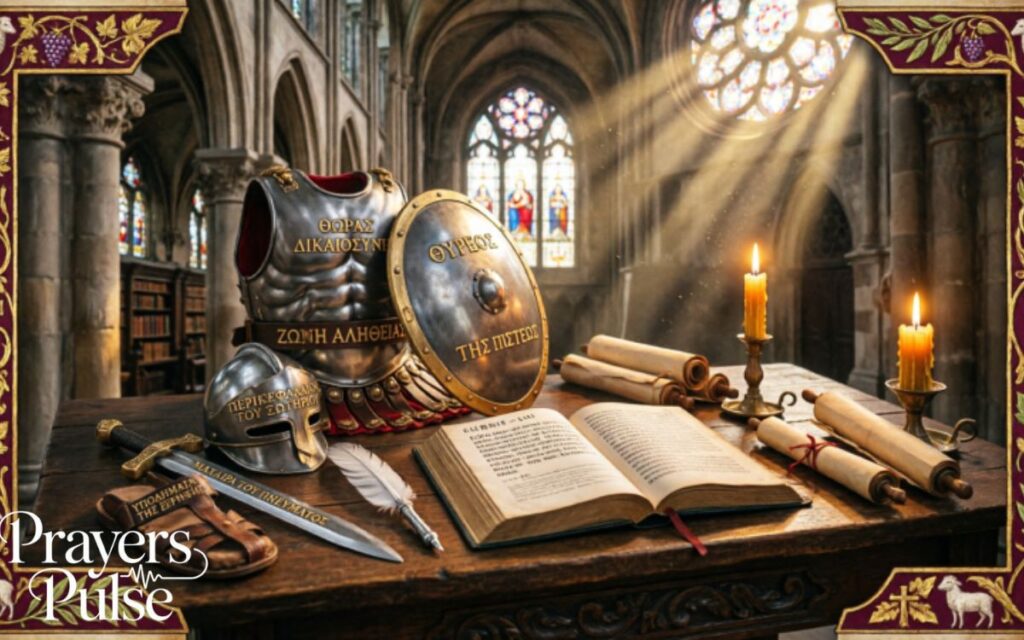
Components of spiritual armor:
Belt of Truth (v. 14)
- Personal integrity and honesty
- Knowing and believing biblical truth
- Truth holds everything else together
Breastplate of Righteousness (v. 14)
- Christ’s imputed righteousness, not self-righteousness
- Protects the heart from accusation and condemnation
- Guards motives and moral integrity
Shoes of the Gospel of Peace (v. 15)
- Readiness and stability in proclaiming good news
- Peace as a foundation for standing firm
- Preparedness for spiritual confrontation
Shield of Faith (v. 16)
- Trust in God that extinguishes “flaming arrows”
- Active confidence, not passive belief
- Defense against doubt and temptation
Helmet of Salvation (v. 17)
- Protects the mind and thought life
- Assurance of one’s secure standing before God
- Guards against despair and identity attacks
Sword of the Spirit (v. 17)
- Identified explicitly as “the word of God”
- The only offensive weapon listed in the armor
- Used by Jesus himself against temptation (Matthew 4:1-11)
Prayer (v. 18)
- Described as praying “at all times in the Spirit”
- Connects and activates every other piece of armor
- Includes alertness and perseverance on behalf of others
Standing Firm (v. 13-14)
- The overarching posture commanded throughout the passage
- Defensive rather than aggressive positioning
- Made possible only “having done all” the preparation described
Authority Over Demons
Jesus explicitly delegated authority over demons to his disciples in Luke 10:17-20, and this authority is consistently portrayed throughout the New Testament as derivative, exercised specifically in Christ’s name rather than through personal spiritual power or special technique.
This delegated authority explains why the disciples’ failed attempt in Mark 9:14-29 required Jesus’ direct intervention, illustrating that authority over demons depends entirely on alignment with Christ’s power rather than formula, ritual, or human effort alone.
Resisting Satan’s Schemes
| Scheme/Strategy | Biblical Description | Recommended Response |
| Deception | 2 Corinthians 11:14, disguised as “angel of light” | Discernment through scripture (1 John 4:1) |
| Accusation | Revelation 12:10, “accuser of the brethren” | Confidence in Christ’s righteousness |
| Temptation | Matthew 4:1-11, direct testing of Jesus | Scripture as response, following Christ’s example |
| Sowing doubt | Genesis 3:1, “Did God really say…?” | Anchoring identity and belief in God’s Word |
| Division | Patterns of conflict within relationships/community | Pursuing unity and reconciliation actively |
| Discouragement | Oppressive, persistent condemning thoughts | Renewing the mind through truth (Romans 12:2) |
Closing Open Doors
Pastoral teaching often describes “open doors” as patterns of sin, unresolved trauma, occult involvement, or unforgiveness that may create vulnerability to oppression, though scripture addresses this concept more through general calls to holiness than through a systematic “open door” doctrine.
Addressing these areas through confession, repentance, forgiveness, and renouncing past involvement in harmful spiritual practices reflects sound, broadly biblical wisdom even where scripture does not use this specific modern terminology.
Understanding Biblically Accurate Demons: A Summary
This study has traced demons from their varied Hebrew and Greek terminology through their possible origins, limited physical descriptions, and the substantial influence of non-biblical tradition on popular imagery. Scripture’s own statements prove far more restrained and theologically focused than centuries of accumulated folklore, art, and literature.
Returning consistently to the biblical text itself, rather than inherited cultural assumptions, produces a clearer and more confident framework for understanding both the reality and the limitations of demonic activity within God’s sovereign authority.
How Should Christians Respond to Demons? A Biblical Approach
Scripture’s consistent counsel toward demonic reality favors confident, prayerful resistance grounded in Christ’s authority rather than either fearful avoidance or unhealthy fascination with the subject.
- Submit to God first, then resist the devil, following James 4:7’s clear pattern.
- Rely on Christ’s name and authority rather than personal spiritual power (Luke 10:17).
- Use scripture actively as both defense and offense, following Jesus’ own example (Matthew 4).
- Maintain sober vigilance without excessive fear, per 1 Peter 5:8’s balanced instruction.
- Pursue community and accountability rather than facing spiritual struggle in isolation.
- Address areas of vulnerability through confession, repentance, and ongoing discipleship.
- Trust confidently in believers’ secure position, since “greater is He who is in you” (1 John 4:4).
- Anchor every response in Christ’s finished victory rather than uncertain spiritual battle.
Frequently Asked Questions
What are biblically accurate demons?
Biblically accurate demons are evil spiritual beings that oppose God and seek to deceive, tempt, and harm people.
Where do demons come from in the Bible?
The Bible associates demons with fallen angels who rebelled against God under the leadership of Satan.
What do demons look like according to the Bible?
The Bible rarely gives detailed physical descriptions of demons, focusing instead on their actions and spiritual influence.
Are demons fallen angels?
Many Christian traditions teach that demons are fallen angels who joined Satan’s rebellion against God.
What is the difference between demons and fallen angels?
In many interpretations, demons and fallen angels are closely related, though some theological views distinguish between them.
What powers do demons have in the Bible?
Demons are described as having the ability to deceive, tempt, oppress, and influence people, but their power is limited by God.
What are some demons mentioned in the Bible?
The Bible mentions demons generally and names figures such as Satan, while other evil spirits are described without specific names.
Can demons possess people according to the Bible?
The New Testament contains accounts of demon possession and Jesus casting out demons from afflicted individuals.
How does the Bible say to resist demons?
The Bible teaches believers to resist evil through faith, prayer, obedience to God, and spiritual vigilance.
What does Jesus say about demons?
Jesus demonstrated authority over demons by casting them out and teaching that God’s power is greater than all evil spirits.
Conclusion
The concept of biblically accurate demons is rooted in Scripture’s portrayal of spiritual evil as a real and serious force that opposes God’s will. Rather than focusing on popular culture’s depictions, a biblical perspective emphasizes the influence of deception, temptation, and spiritual opposition. Understanding these teachings helps believers recognize the importance of faith, discernment, and reliance on God’s power.
In the end, studying biblically accurate demons is less about fear and more about gaining a deeper understanding of spiritual realities. The Bible consistently points to God’s sovereignty, protection, and ultimate victory over evil. By remaining grounded in Scripture and faith, believers can face spiritual challenges with confidence, knowing that God’s strength is greater than any force that stands against Hi

Denzel is a passionate faith writer with four years of experience in prayer and Bible blogging. He now contributes has expertise to PrayersPulse.com, creating inspiring content that strengthens prayer life and deepens understanding of Scripture.