

What Is the Biblically Accurate Satan? Exploring His True Role and Appearance in Scripture examines what the Bible actually teaches about Satan rather than relying on popular artwork, folklore, or modern depictions. In Scripture, Satan is primarily portrayed as a spiritual adversary whose purpose is to deceive, accuse, tempt, and oppose God’s plans.
When reflecting on What Is the Biblically Accurate Satan? Exploring His True Role and Appearance in Scripture, the Bible describes him as a fallen being who seeks to lead people away from truth and obedience to God. While many imagine Satan with horns, a tail, and red skin, these images are not found in the biblical text.
Who Is Satan in the Bible?
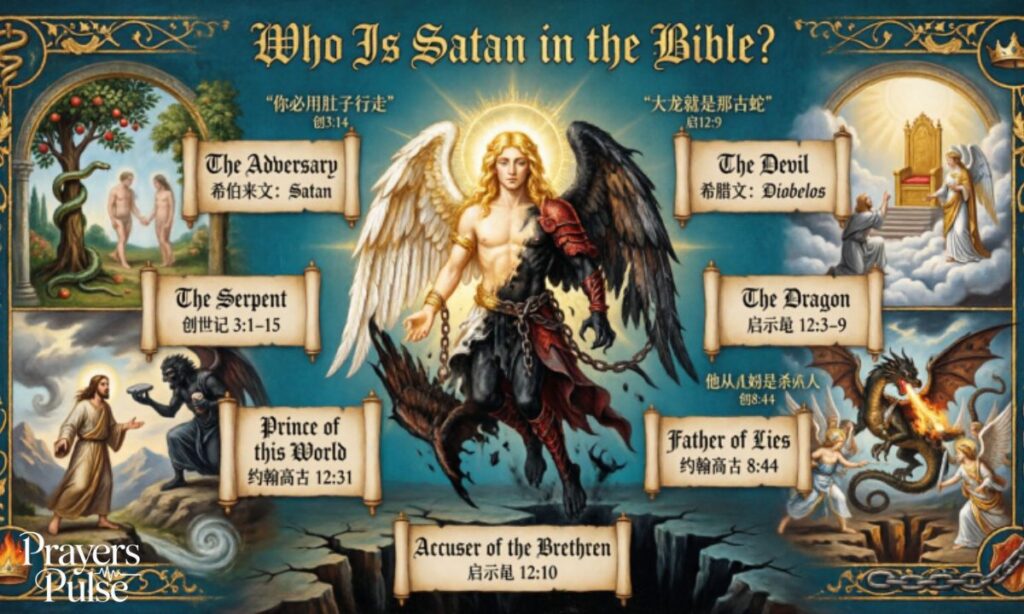
The name Satan comes from the Hebrew word ha-satan, which simply means “the adversary” or “the accuser.” It is not always used as a personal name in the Old Testament. Sometimes it refers to a role or function — an opposing force or a legal accuser.
In the New Testament, Satan becomes much more clearly defined as a specific personal being — a powerful spiritual enemy opposed to God and humanity.
He is also called by several other names throughout the Bible:
- The Devil — from the Greek diabolos, meaning slanderer
- Lucifer — a Latin translation meaning “morning star” or “light-bearer,” appearing in Isaiah 14
- Beelzebul — meaning “lord of the flies” or “lord of the house”
- The Dragon — used symbolically in Revelation
- The Serpent — connected to the Garden of Eden
- The Prince of this World — used by Jesus in John 12:31
- The God of this Age — used by Paul in 2 Corinthians 4:4
None of these names describe a red cartoon villain. They describe a being of significant power, cunning intelligence, and spiritual authority.
Satan’s Original Nature — Was He an Angel?
The Bible does not give a long and detailed biography of Satan’s origin, but there are a few key passages that scholars have long connected to his fall.
Isaiah 14:12–15 says:
“How you have fallen from heaven, morning star, son of the dawn! You have been cast down to the earth.”
This passage is written about the King of Babylon, but many theologians believe it also describes the fall of Satan — a being of great glory and brightness who fell because of pride and the desire to be like God.
Ezekiel 28:12–17 speaks to the King of Tyre but again contains language that seems to go far beyond a human ruler:
“You were the seal of perfection, full of wisdom and perfect in beauty. You were in Eden, the garden of God… You were blameless in your ways from the day you were created till wickedness was found in you… Your heart became proud on account of your beauty.”
Based on these passages, the traditional biblical understanding is that Satan was originally a high-ranking, glorious angelic being — possibly the most magnificent of all created beings — who fell because of pride and rebellion against God.
He was not created evil. He became evil by choice.
Satan in the Old Testament
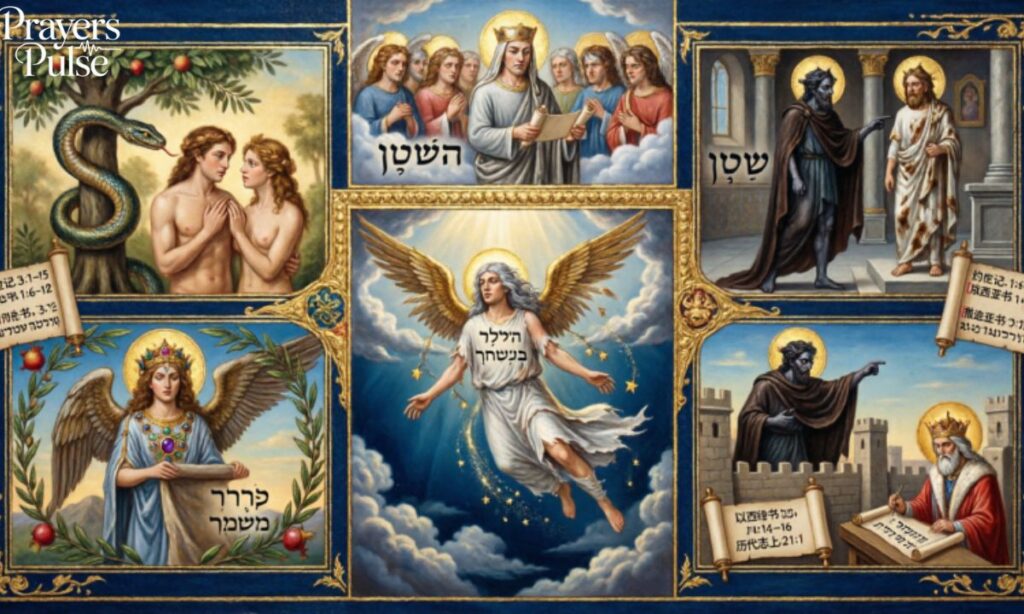
Satan appears surprisingly rarely in the Old Testament as a named figure. He shows up in only a few key places.
The Garden of Eden (Genesis 3)
The serpent who tempts Eve is never directly called Satan in Genesis itself, but the New Testament makes the connection clearly. Revelation 12:9 identifies “that ancient serpent” as the Devil and Satan.
The serpent in Genesis is described as more crafty than any other creature. He does not appear with fire or wings. He is subtle, persuasive, and deceptive — which is far more terrifying than horns and a pitchfork.
The Book of Job
This is one of the most striking portraits of Satan in the entire Old Testament. In Job 1 and 2, Satan appears in a heavenly court, among “the sons of God” who come to present themselves before the Lord.
Satan here is functioning as a legal accuser. He challenges Job’s faithfulness and actually receives permission from God to test Job. He cannot act freely — he operates within limits set by God.
This is a critically important detail. The biblically accurate Satan is not God’s equal. He is a created being with real but limited power, always subject to God’s ultimate authority.
Zechariah 3:1–2
Satan appears again as an accuser, standing at the right hand of the high priest Joshua to accuse him. The angel of the Lord rebukes Satan, again showing his role as an adversary and legal opponent.
Satan in the New Testament
The New Testament gives us a much fuller picture of Satan and his activities.
The Temptation of Jesus (Matthew 4, Luke 4)
This is one of the most detailed interactions with Satan in the entire Bible. He appears to Jesus in the wilderness and tempts him three times. A few things stand out here:
- Satan quotes Scripture — he knows the Bible and twists it cleverly
- He offers Jesus “all the kingdoms of the world” — suggesting he genuinely controls significant worldly power
- Jesus does not deny this offer or call it fake — he simply refuses it
- Satan is not described physically at all in this passage
His Character and Methods
Throughout the New Testament, Satan’s personality and tactics are described in very specific ways:
- John 8:44 — Jesus calls him “a murderer from the beginning” and “the father of lies.” Deception is his primary weapon.
- 1 Peter 5:8 — “Your enemy the devil prowls around like a roaring lion looking for someone to devour.” He is aggressive and predatory.
- 2 Corinthians 11:14 — “Satan himself masquerades as an angel of light.” He does not always appear dark and threatening. He can appear beautiful, reasonable, and even holy.
- Ephesians 6:11 — Paul warns about “the schemes of the devil,” suggesting intelligence and strategic planning.
The biblically accurate Satan is not a bumbling villain or a clumsy monster. He is highly intelligent, patient, deceptive, and strategic.
What Does Satan Actually Look Like?
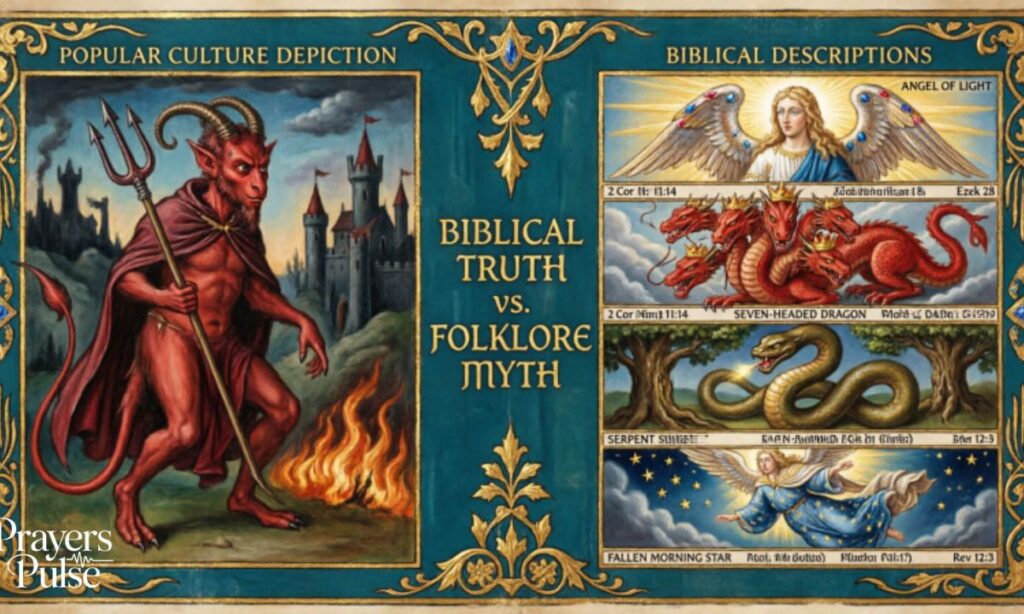
Here is the surprising truth — the Bible almost never describes Satan’s physical appearance.
He is not described with red skin, horns, a tail, or a pitchfork anywhere in Scripture. Those images came from:
- Medieval European art which blended pagan imagery with Christian themes
- Dante’s Inferno, a literary work, not Scripture
- Greek and Roman depictions of gods like Pan and Hades
- Cultural folklore that built up over centuries
The only physical descriptions the Bible gives are symbolic and metaphorical:
- In Revelation, he is described as a great red dragon with seven heads and ten horns — but Revelation is a book of symbols and visions, not a literal physical description
- He appears as a serpent in Genesis
- He can appear as an angel of light according to Paul
If anything, the Bible suggests Satan is more likely to appear attractive and trustworthy than monstrous and terrifying. That is precisely what makes him dangerous.
Satan’s Power and Limitations
The Bible is very clear that Satan has real power — but it is also very clear that his power has real limits.
What power does he have?
- He is called the “ruler of the kingdom of the air” in Ephesians 2:2
- He blinds the minds of unbelievers according to 2 Corinthians 4:4
- He can cause physical illness — as seen in Job and in Luke 13 where Jesus heals a woman “whom Satan has kept bound for eighteen years”
- He can influence human hearts — John 13:2 says he “prompted” Judas to betray Jesus
- He has authority over demonic forces
What are his limits?
- He could not touch Job without God’s explicit permission
- He could not tempt Jesus beyond what was allowed
- He is a created being, not eternal or omnipotent
- He is not omniscient — he does not know everything
- He is not omnipresent — he cannot be everywhere at once like God
- James 4:7 says simply: “Resist the devil, and he will flee from you.”
This is not a being of infinite power. He is powerful but bounded. Dangerous but defeatable.
Is Satan in Charge of Hell?
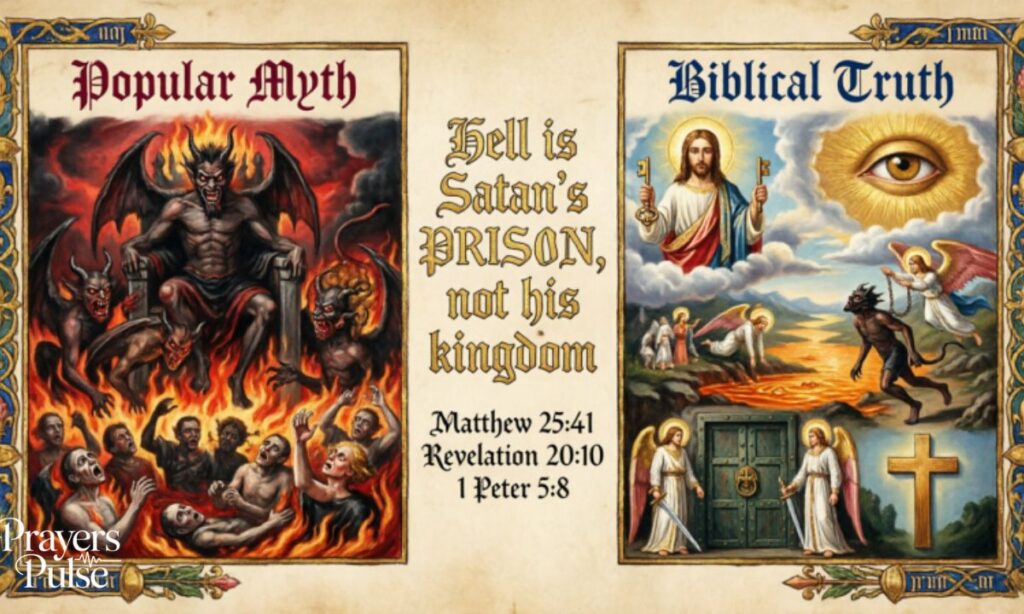
This is one of the biggest misconceptions that comes entirely from popular culture and not from the Bible.
Satan is not the ruler of hell. He is not sitting on a dark throne down below running the place. Hell in the Bible is not his kingdom — it is his punishment.
Revelation 20:10 says:
“And the devil, who deceived them, was thrown into the lake of fire and sulfur, where the beast and the false prophet had been thrown. They will be tormented day and night for ever and ever.”
Satan is thrown into hell. He does not rule it. He suffers in it alongside the wicked. He is a prisoner, not a warden.
Satan’s Fall — Why Did He Rebel?
The Bible points to pride as the root of Satan’s rebellion. Isaiah 14 describes a being who said in his heart:
“I will ascend to the heavens. I will raise my throne above the stars of God… I will make myself the most High.”
Five times the phrase “I will” appears. Satan’s sin was the sin of self-exaltation — the desire to replace God rather than serve Him.
1 Timothy 3:6 warns against appointing new believers to church leadership too quickly, lest they “become conceited and fall under the same judgment as the devil.” Pride is clearly identified as the core of his downfall.
He was given glory, beauty, wisdom, and position — and he wanted more. He wanted to be God himself.
Satan and Demons
The Bible suggests that when Satan fell, he did not fall alone. Revelation 12:4 uses symbolic language to suggest that a third of the angels fell with him. These fallen angels are what the Bible refers to as demons.
Satan appears to be the head of this demonic hierarchy. Ephesians 6:12 describes a structured spiritual opposition:
“For our struggle is not against flesh and blood, but against the rulers, against the authorities, against the powers of this dark world and against the spiritual forces of evil in the heavenly realms.”
This paints a picture of an organized spiritual kingdom — not chaos, but a structured rebellion led by Satan against God and humanity.
Satan’s Ultimate Fate
The Bible is absolutely clear on how Satan’s story ends. There is no suspense, no cliffhanger.
- Revelation 12:9 — He is hurled to the earth, knowing his time is short
- Romans 16:20 — “The God of peace will soon crush Satan under your feet”
- Revelation 20:2–3 — He is bound for a thousand years and thrown into the Abyss
- Revelation 20:10 — He is thrown into the lake of fire forever
Satan is not a being with an uncertain future. He is a defeated enemy operating on borrowed time. The Bible presents him as already condemned, already defeated at the cross, and already sentenced — just awaiting final execution of that sentence.
Colossians 2:15 says Jesus, through the cross, “disarmed the powers and authorities” and “triumphed over them.”
How Should We Think About Satan Biblically?
The Bible strikes a careful balance that we should maintain:
Do not underestimate him. He is real, powerful, intelligent, and actively working. Dismissing him as a myth is exactly what he would want.
Do not overestimate him. He is not God’s equal. He is not all-powerful. He is not in charge of hell. He is a created, limited, already-defeated being.
Do not be obsessed with him. The Bible calls us to fix our eyes on Jesus, not to constantly study and focus on the enemy. Awareness is healthy. Obsession is dangerous.
Do resist him. James 4:7 and 1 Peter 5:8–9 both call believers to active, firm resistance grounded in faith.
Frequently asked questions
What Does “Biblically Accurate Satan” Mean?
It refers to the description and role of Satan found in the Bible rather than popular culture.
Is Satan Described as a Red Horned Devil in the Bible?
No, the Bible does not describe Satan as a red-skinned figure with horns and a pitchfork.
What Does the Bible Say About Satan’s Appearance?
The Bible focuses more on Satan’s actions and character than on his physical appearance.
Is Satan Considered a Fallen Angel?
Many Christian interpretations view Satan as a fallen angel who rebelled against God.
What Is Satan’s Main Role in the Bible?
He is portrayed as a deceiver, tempter, and adversary who opposes God’s purposes.
Does Satan Appear as a Serpent in Scripture?
Yes, the serpent in the Garden of Eden is commonly associated with Satan in Christian theology.
Can Satan Disguise Himself According to the Bible?
Yes, Scripture suggests that Satan can appear deceptively to mislead people.
Why Does Modern Art Portray Satan Differently?
Many common images of Satan come from folklore, literature, and artistic traditions rather than the Bible.
Is Satan Equal in Power to God?
No, Christian belief teaches that God is sovereign and Satan is a created being with limited power.
Why Is the Idea of a Biblically Accurate Satan Important?
It helps people understand Satan based on Scripture rather than cultural myths and misconceptions.
Conclusion
What Is the Biblically Accurate Satan? Exploring His True Role and Appearance in Scripture reveals that Satan is portrayed in the Bible primarily as an adversary, accuser, and deceiver rather than the horned figure often depicted in popular culture. Scripture focuses more on his influence, actions, and opposition to God’s purposes than on a detailed physical description. Understanding his biblical role provides a clearer and more accurate perspective.
Ultimately, What Is the Biblically Accurate Satan? Exploring His True Role and Appearance in Scripture highlights the importance of relying on Scripture rather than tradition or artistic interpretations. His true significance lies in his spiritual role and the challenges he presents to faith and obedience. This understanding encourages believers to pursue wisdom, discernment, and a deeper knowledge of God’s Word.

Denzel is a passionate faith writer with four years of experience in prayer and Bible blogging. He now contributes has expertise to PrayersPulse.com, creating inspiring content that strengthens prayer life and deepens understanding of Scripture.